
What is Sangfor aSAN
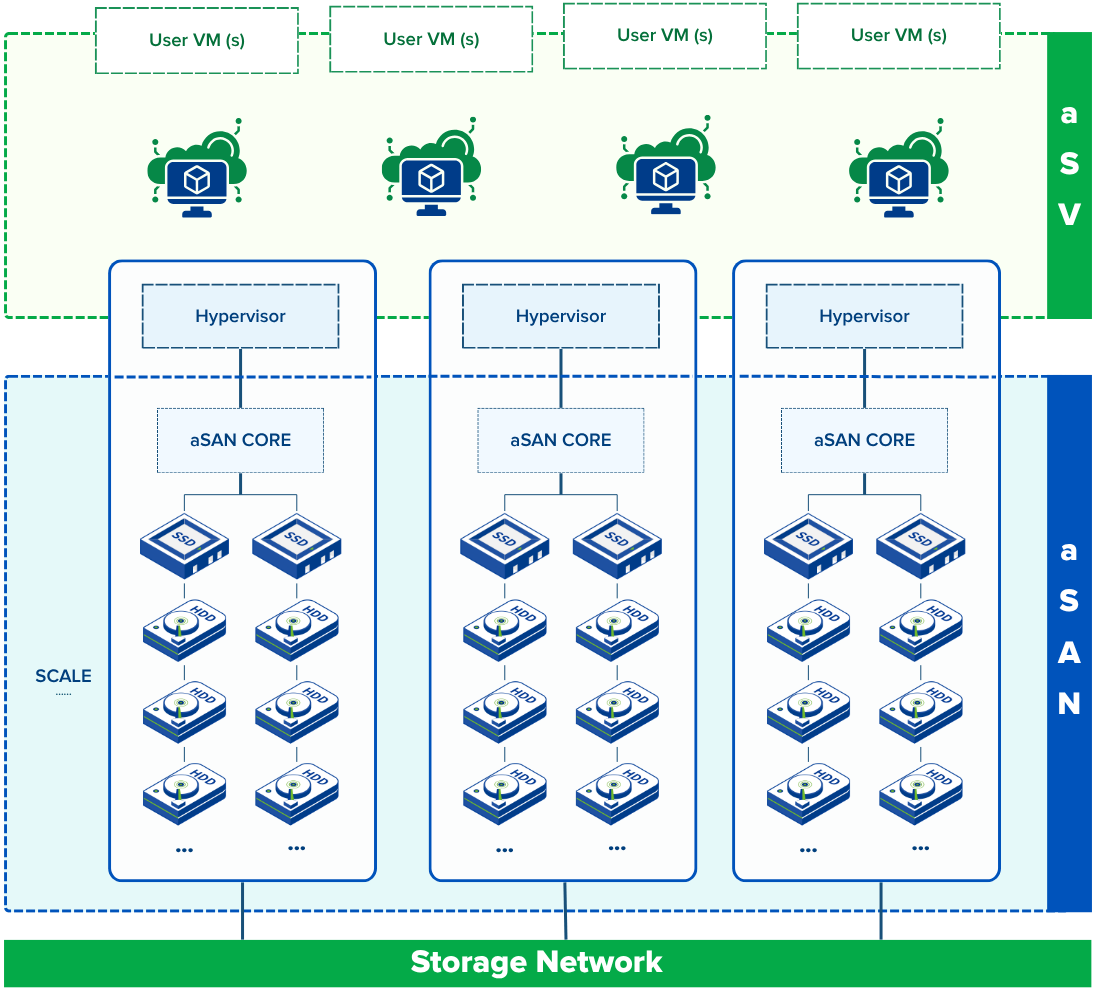
Sangfor aSAN, also known as Sangfor Distributed Storage Fabric, or Sangfor Server SAN, is a software-defined distributed storage solution independently developed by Sangfor. It aggregates the local disks of standard x86 servers into a unified storage resource pool, enabling centralized storage management, intelligent resource allocation, and efficient data services. Through industry-standard block storage and iSCSI services, aSAN provides non-disruptive, flexible and scalable storage to virtualized environments, allowing virtual machines (VMs) to dynamically consume storage resources based on business needs.
*aSAN is currently designed to work as an integral part of the Sangfor hypervisor, aSV, rather than as a standalone storage module*
Sangfor aSAN: Core Features & Benefits
High Performance Distributed Storage
Sangfor aSAN leverages intelligent data placement, SSD acceleration, and distributed storage technologies to deliver consistently high performance for mission-critical workloads.
SSD Tiering and Intelligent Caching
• Combines SSD and HDD storage tiers to balance performance and capacity.
• SSDs serve as both write cache and read cache, while HDDs provide cost-effective bulk storage.
• Automatically moves hot and cold data between storage tiers based on workload activity.
Distributed Data Striping
• Data is divided into multiple blocks and distributed across disks and nodes simultaneously.
• Enables parallel I/O processing and delivers up to 3x higher write performance compared to traditional non-striped storage architectures.
• Eliminates storage controller bottlenecks common in legacy SAN environments.
I/O Localization
• Keeps virtual machine data as close as possible to the node where the VM is running.
• Reduces storage network traffic and latency.
• Improves application responsiveness and user experience.
Intelligent Read-Ahead Acceleration
• Predictively loads related data into SSD cache when uncached data is requested.
• Accelerates sequential workloads and improves read performance for frequently accessed applications.
Key Benefits
High IOPS and low latency
Optimized performance for virtualization and enterprise applications
Eliminates single-controller performance bottlenecks
Predictable performance under heavy workloads
Enterprise Data Protection & Reliability
Sangfor aSAN protects critical business data through built-in redundancy, automated recovery, and proactive storage health management.
Multi-Replica Data Protection
• Every data block is automatically replicated two or three times.
• Replicas are stored across separate physical nodes to ensure high availability.
• Protects against disk, server, and node failures.
Automated Self-Healing Recovery
• Automatically rebuilds lost data using healthy replicas when hardware failures occur.
• Rebuild speeds of up to 1 TB every 30 minutes help minimize recovery times.
• Supports interrupted rebuild resumption and intelligent load control to protect production workloads.
Split-Brain Prevention
• Uses a witness-based arbitration mechanism to prevent split-brain scenarios during network interruptions.
• Maintains data consistency and cluster stability.
Active Disk Health Monitoring
Continuously scans storage media for latent bad sectors and potential hardware issues. Adaptive flow-control mechanisms keep performance impact below 5% during scheduled maintenance windows.
Key Benefits
Enterprise-grade availability and fault tolerance
Faster recovery from hardware failures
Improved data integrity and consistency
Reduced operational risk and downtime
Linear Scalability & Deployment Flexibility
Unlike traditional storage systems that require disruptive forklift upgrades, Sangfor aSAN scales seamlessly as business needs evolve.
Scale-Out Architecture
• Capacity and performance grow simultaneously by simply adding disks or cluster nodes.
• Supports non-disruptive expansion with no application downtime.
• Enables flexible, pay-as-you-grow infrastructure investment.
Multi-Volume Storage Pools
• A single cluster can host multiple independent storage volumes.
• Each volume can be configured with customized: Replica policies; Stripe widths; Performance and QoS settings
Stretched Cluster Support
• Supports active-active storage deployments across two physical sites.
• Uses an additional witness node to maintain consistency and availability.
• Provides enhanced business continuity and disaster resilience.
Key Benefits
Seamless storage expansion
No disruptive upgrades
Flexible deployment options
Improved disaster recovery readiness
Simplified Storage Management
Sangfor aSAN eliminates the complexity traditionally associated with enterprise storage management.
Unified HCI Management Platform
• Fully integrated into the Sangfor HCI ecosystem.
• Manage compute, storage, networking, and virtualization from a single web-based console.
• Eliminates the need for multiple management tools and dedicated storage administration.
Centralized Resource Management
• Provides a unified view of storage capacity, performance, and health.
• Simplifies monitoring, troubleshooting, and resource allocation.
• Reduces operational complexity and management overhead.
Key Benefits
Faster deployment and provisioning
Reduced administrative workload
Lower operational costs
Improved IT efficiency
Cost-Efficient Software-Defined Storage
Sangfor aSAN helps organizations modernize storage infrastructure while significantly reducing capital and operational expenses.
Hardware Independence
• Runs on industry-standard x86 servers.
• Eliminates reliance on expensive proprietary SAN hardware.
• Avoids vendor lock-in and costly storage controller upgrades.
Optimized Resource Utilization
• Pools local SSD and HDD resources across the entire cluster.
• Maximizes infrastructure efficiency and storage utilization.
Built-In Data Reduction
Reduces storage consumption and improves capacity efficiency.
Lower Total Cost of Ownership (TCO)
• Consolidates compute and storage infrastructure into a unified platform.
• Reduces hardware, licensing, maintenance, and operational expenses.
Key Benefits
Lower infrastructure investments
Reduced licensing costs
Better storage utilization
Faster return on investment










Overcoming Traditional Storage Challenges with Distributed Storage
Why Choose Sangfor aSAN?
Sangfor aSAN combines software-defined storage (SDS), distributed storage architecture, and hyperconverged infrastructure (HCI) capabilities into a single platform. By delivering high performance, enterprise-grade data protection, seamless scalability, simplified management, and lower total cost of ownership, aSAN provides a modern alternative to traditional SAN storage solutions for virtualized data centers and cloud-ready environments.
| Customer Challenge |  How Sangfor aSAN Solves It |
|---|---|
| High Storage Costs Traditional SAN storage relies on expensive proprietary hardware and often leads to vendor lock-in. |  Lower Total Cost of Ownership (TCO) Sangfor aSAN runs on standard x86 servers, eliminating the need for dedicated storage appliances while maximizing the value of existing infrastructure investments. |
| Storage Controller Bottlenecks Performance is limited by a single storage controller, creating I/O bottlenecks as workloads grow. | Distributed Storage Architecture aSAN distributes data across all disks and nodes in the cluster, enabling parallel processing and high I/O performance without single-controller limitations. |
| Complex Storage Management Separate management tools and dedicated storage teams increase operational complexity. | Unified HCI Management aSAN is fully integrated into Sangfor HCI, providing centralized, web-based management for compute, storage, and virtualization through a single console. |
| Limited Scalability Traditional storage often requires disruptive forklift upgrades and long-term capacity planning. | Seamless Scale-Out Expansion Allows linear expansion of both capacity and performance on demand by simply adding nodes, avoiding downtime and costly hardware replacements. |
| Data Loss and Availability Risks Single points of failure and lengthy recovery times can put critical business data at risk. | Built-in Data Protection Multi-replica data protection (2-way or 3-way replication) ensures high availability, while automated self-healing accelerates data rebuilds at speeds of up to 1 TB every 30 minutes. |
| Inconsistent Storage Performance Cache pollution and large scan-read operations can impact application responsiveness. | Intelligent Data Tiering Advanced hot and cold data management optimizes storage performance and minimizes the impact of scan-read interference, ensuring predictable application performance. |


VMware Migration Success Story

SAMA S.p.A.
SAMA S.p.A. migrated from VMware to Sangfor HCI, simplifying infrastructure management and improving reliability with high availability, built-in backup, and enhanced business continuity.

SCTV
PT Surya Citra Televisi (SCTV) migrated critical workloads from VMware to Sangfor Cloud Platform, reducing complexity and optimizing operations with a simplified, future-ready virtualization environment.

Nishat Emporium Mall
Nishat Emporium Mall migrated from VMware vSphere Standard to Sangfor HCI, achieving improved availability, centralized management, automated operations, and reduced downtime.

Kementerian Komunikasi
The Ministry of Communications Malaysia replaced VMware infrastructure with Sangfor HCI, achieving up to 40% TCO savings, seamless migration, and simplified infrastructure management.
Frequently Asked Questions on Sangfor aSAN
Sangfor aSAN combines software-defined storage (SDS), distributed storage architecture, and hyperconverged infrastructure (HCI) capabilities into a single platform. By delivering high performance, enterprise-grade data protection, seamless scalability, simplified management, and lower total cost of ownership, aSAN provides a modern alternative to traditional SAN storage solutions for virtualized data centers and cloud-ready environments.
Sangfor aSAN is a software-defined distributed storage solution that aggregates the local disks of standard x86 servers into a unified storage pool. It provides block storage services and iSCSI services for virtual machines (VMs) and applications without requiring dedicated SAN hardware.
Sangfor aSAN serves as the distributed storage foundation of Sangfor HCI. While aSAN delivers enterprise storage services, Sangfor HCI integrates compute, storage, networking, and virtualization into a single hyperconverged infrastructure platform.
aSAN: The built-in virtual storage of Sangfor HCI. It is designed to provide reliable, high-performance storage for virtual machines within the HCI cluster, using local disks from the HCI nodes. It is not a standalone product.
aStor: A full-featured, standalone distributed storage platform. It is designed for enterprise workloads that require unified block, file, and object storage at scale, such as AI training, medical PACS, media production, backup repositories, and file sharing. It can complement HCI by providing secondary or high-performance NAS storage.
aSAN enhances storage performance through SSD tiering, intelligent caching, distributed data striping, and I/O localization. By distributing data across multiple disks and keeping VM data close to the hosting node, aSAN reduces latency and can deliver up to three times higher write performance than traditional non-striped storage.
aSAN safeguards data with two-way or three-way replication, storing multiple copies across separate physical nodes. In the event of a disk or node failure, lost data is automatically rebuilt from healthy replicas at speeds of up to 1 TB every 30 minutes.
aSAN uses a witness-based arbitration mechanism to maintain cluster consistency and prevent split-brain conditions during network interruptions or node communication failures.
Yes. aSAN supports non-disruptive scale-out expansion, allowing organizations to add disks or nodes to increase storage capacity and performance without interrupting running workloads.
aSAN supports deployments starting from two nodes. However, a minimum of three nodes is recommended for production environments to ensure optimal availability, performance, and fault tolerance.
Yes. aSAN supports stretched cluster deployments, enabling a single storage cluster to span two sites with a witness node. This architecture provides active-active availability and enhanced business continuity across locations.
aSAN eliminates the need for proprietary SAN hardware and associated licensing costs. By leveraging standard x86 servers with commodity SSDs and HDDs, organizations can significantly lower storage infrastructure costs while maintaining enterprise-grade performance and reliability.
Sangfor aSAN delivers high-performance distributed storage, enterprise-grade data protection, linear scalability, simplified management, and lower total cost of ownership, making it an ideal storage platform for virtualization, private cloud, and HCI environments.