AI-Native Unified Storage Solution
As business needs evolve, enterprise data centers are overwhelmed by fragmented storage systems and mismatched hardware, forcing organizations into costly, redundant investments. Sangfor aStor All-Flash Unified Storage (EDS) is designed to eliminate these data silos, delivering a truly unified storage architecture that supports diverse workloads — from mission-critical databases to AI training — on a single platform.
aStor All-Flash evolves from unified enterprise storage into AI-native unified storage. With a unified data view, AI-ready data services, and native vector storage capabilities, organizations can accelerate AI training, analytics, RAG applications, and intelligent agents using existing data assets, without the complexity of large-scale migration projects.

01
Rebuilt for high-performance AI access, with capabilities available on-premises that were previously cloud-only.
02
Access and utilize data across NAS, object storage, cloud, and aStor environments through a single unified view, eliminating the need for large-scale migration projects.
03
Vector embeddings live alongside source data on the same unified storage foundation, reducing the need to stand up and operate a separate vector database for common RAG and agent-memory use cases.
04
Asynchronous replication for both file and object, data versioning, and block-level FC/SCSI support extend the platform’s reliability story into the AI era.
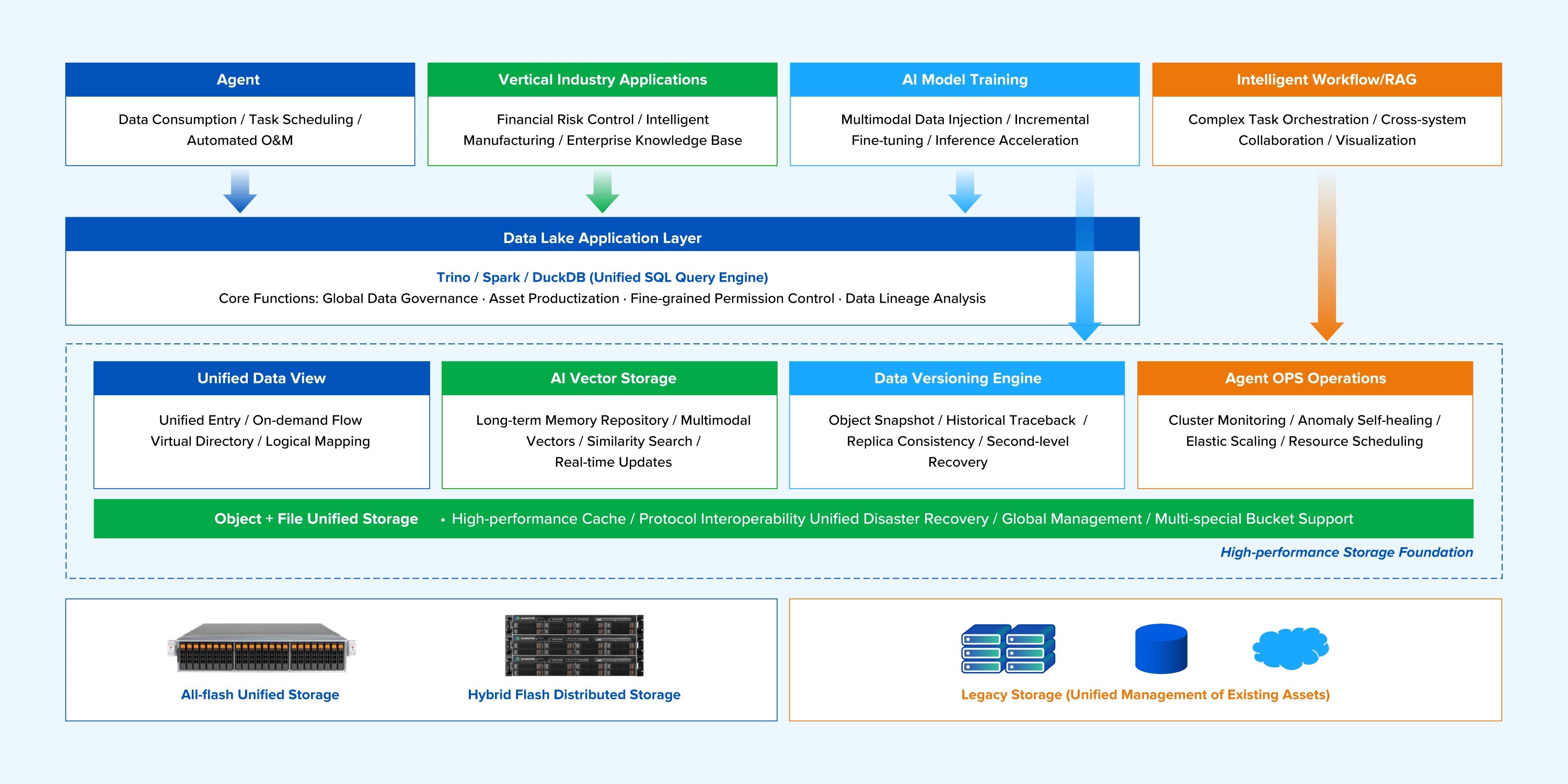
Sangfor aStor All-Flash is built on a fully symmetrical, software-defined distributed architecture that separates the control plane from the data plane, ensuring linear scalability of both capacity and performance. New layers purpose-built for AI data workflows extend this foundation, so the platform grows from a high-performance storage foundation into a complete AI data infrastructure.

All-flash and hybrid flash distributed storage unifying object and file access on advanced general-purpose hardware (Intel Xeon 5th Gen CPUs, DDR5 memory, end-to-end PCIe 5.0/NVMe), plus continued management of existing legacy storage assets.
A logical namespace across all-flash, hybrid flash, and third-party storage (NAS, object, cloud), giving applications and AI agents a single entry point without physically moving data.
Git-style branching, committing, merging and rollback for enterprise datasets — object snapshot, historical traceback, and second-level recovery.
Long-term memory repository, multimodal vector hosting, similarity search, and real-time index updates, co-located with source data.
Supports unified SQL query engines (Trino / Spark / DuckDB) with global data governance, asset productization, fine-grained permission control, and data lineage analysis.
Model training and fine-tuning, RAG and intelligent agent workflows, and vertical industry applications (financial risk control, intelligent manufacturing, enterprise knowledge bases) all consume data from the same unified foundation.
Ultimate High Performance
Ease of Use & Intelligence
Enhanced Security & Reliability
AI-Native Data Services
Enterprise data rarely lives in one place. Most organizations run NAS systems, object storage, cloud storage, and years of accumulated legacy platforms side by side. Building an AI platform has traditionally meant collecting and migrating all of this data into a centralized data lake first — an expensive, slow project that is often never fully completed.
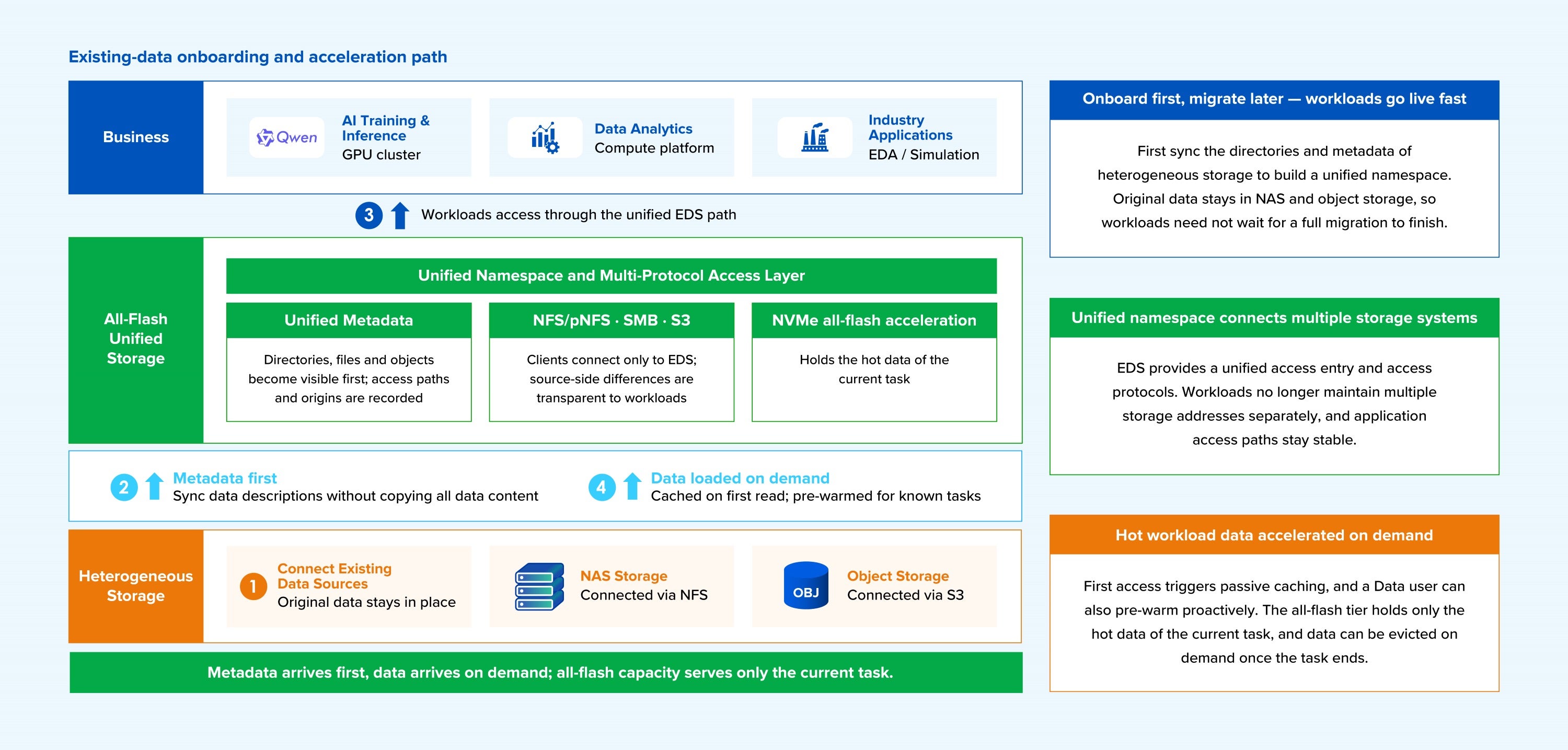
Data Flow 2.0 removes that requirement. Instead of physically moving data, aStor All-Flash builds a logical Unified Data View: a metadata-first abstraction layer that presents all enterprise data through a single namespace. Applications and AI agents no longer need to know where data physically resides — they query the unified metadata layer, and data is loaded on demand.

Onboard first, migrate later - AI workloads go live on existing data without waiting for a full migration
01
Directories, files and objects from heterogeneous storage become visible in the unified namespace as soon as their metadata is synchronized — without waiting for the underlying data to move.
02
The first read triggers passive caching into the all-flash tier; known workloads can also be pre-warmed proactively. The all-flash tier holds only the hot data the current task actually needs.
03
When source data changes, a Notify mechanism updates the unified metadata and query views incrementally, so AI workloads always see current data — shrinking the knowledge-refresh lag from days to seconds.
04
Once a task completes, hot data can be evicted back to lower-cost tiers automatically, avoiding permanent duplication of data that was only needed temporarily.
1. Extreme Performance Series (TLC NVMe)
Designed for mission-critical databases and high-intensity I/O.
· aStor-EDS-F6000T: High-performance all-flash node (Intel Xeon Gold CPU, 24 NVMe SSDs).
· aStor-EDS-F3000T: Compact high-performance all-flash entry point (Intel Xeon Silver CPU, 24 NVMe SSDs).

2. Balanced Performance Series (QLC NVMe)
Optimized for massive data capacity and read-intensive workloads.
· aStor-EDS-F6000Q: High-density all-flash node balancing performance with capacity cost-efficiency (QLC Media).
· aStor-EDS-F3000Q: Efficient all-flash option for read-intensive workloads and massive data consolidation (QLC Media).