
Summarize this blog article with AI:
 Ask ChatGPT
 Ask Grok
 Ask Perplexity
 Ask Claude
 Ask Google AI
External storage remains an important part of many hyperconverged environments. It can improve data access, support flexible capacity expansion, and accommodate growing business demand. Its health, however, is directly tied to application stability.
A delay of more than ten seconds in transferring medical images can slow a critical diagnosis. Repeated stalls in bank transaction-log synchronization can disrupt data processing. Design files that keep loading can hold back engineering work. These symptoms may appear intermittent, but the underlying cause is often a degraded external storage path.
PART 1. Degraded External Storage Paths: A Hidden Barrier to Performance and Efficiency
Maintaining path health is essential to reliable data flow and efficient business operations. Multipath I/O is widely used to improve storage-access redundancy and availability through load balancing and failover.
In production, however, a single degraded path can reduce access performance for the entire storage LUN:
- In load-balancing mode, a high-latency path can pull down the IOPS efficiency of healthy paths and create uneven performance.
- In active/standby mode, hidden latency on the active path can directly cause application stalls. If standby-path detection reacts too slowly, failover may not occur in time to protect service continuity.
To address these risks, Sangfor HCI introduces external storage path degradation detection and isolation, designed to identify performance hazards in multipath I/O environments.
PART 2. Core Technology: A Closed Loop of Monitoring, Isolation, and Recovery
Sangfor HCI manages external storage paths through three coordinated modules: precise anomaly monitoring, intelligent risk isolation, and dynamic path recovery. When the system detects storage stalls or performance degradation, it raises an alert and can isolate the affected path before it impacts business workloads.
Compared with conventional approaches such as eBPF kprobes or kernel diskstats, Sangfor implements the required logic directly in the system kernel. This design minimizes resource overhead, increases detection precision, and has negligible impact on system performance.
1. Precise Anomaly Monitoring
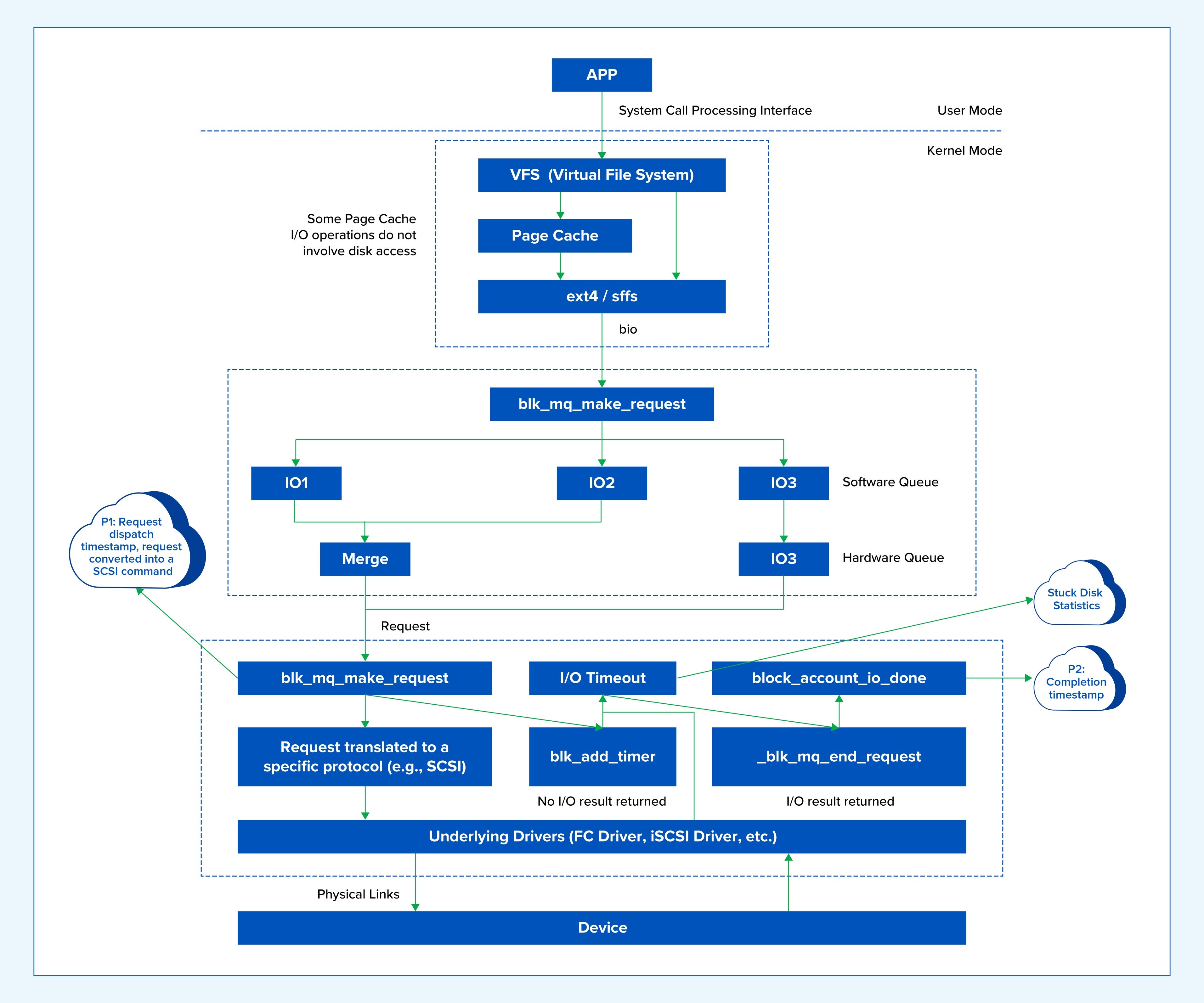
During data reads and writes, the system combines slow-I/O monitoring with I/O-stall monitoring to create a multi-layer anomaly-detection approach.
Slow-I/O monitoring: millisecond-level latency tracking
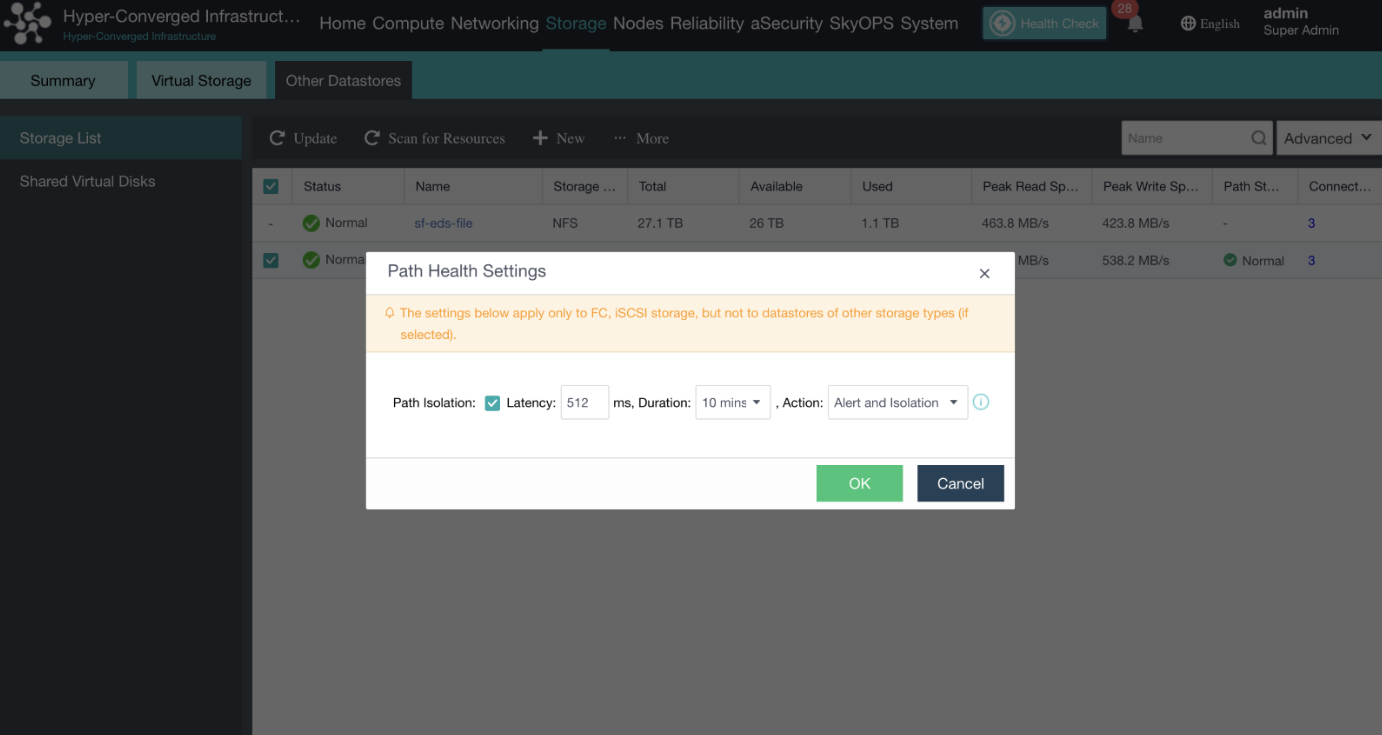
Principle: The system records the start time (P1) and completion time (P2) of each I/O operation. It calculates the read/write duration and compares it with a configurable threshold. The default is 512 ms. If latency exceeds the limit, the platform records the time, disk, data region, and related information. By default, no more than one log entry is recorded every five seconds, and this limit can be temporarily disabled.
Decision mechanism: The distribution of I/O time buckets for each disk partition can be viewed through the /proc/ioslow_stats interface. Administrators can configure an analysis window from 30 seconds to 30 minutes. If at least 50% of operations on an external storage disk exceed the threshold, the system automatically triggers an alert or isolation action.
I/O-stall monitoring: kernel-level timeout capture
Principle: Sangfor adds logic to the kernel function that handles data I/O timeouts. Requests that do not return on time are counted as stalled I/O events. Administrators can view the real-time status of affected partitions through /proc/iostuck_stats.
Alerting: The alert service scans changes in the stalled-I/O count every ten minutes and notifies administrators of anomalies.
2. Intelligent Isolation That Balances Reliability and Availability
- Latency-based isolation: For load-balancing or multi-active/multi-standby multipath modes, the system compares the average latency of all available paths. If the difference between high-latency and low-latency paths exceeds the configured threshold (such as 50% of the default value), the abnormal path is isolated. For an active/standby configuration, the system directly isolates the path as soon as an individual latency anomaly is detected on that path.
- Isolation guardrail: The platform retains at least 50% of available paths and never fewer than one path, preventing excessive isolation from eliminating redundancy.
- Closed-loop operation: During isolation, the path is marked unavailable and the device is taken offline. During recovery, the disabled state is cleared automatically and the device is rescanned without manual intervention.
3. Deep-Scan Recovery for Dynamic Path Updates
When an I/O path is isolated because of a fault or excessive latency, deep-scan recovery starts immediately:
- Remove invalid paths: Delete unavailable links marked by the multipath service.
- Reconnect and verify devices: Scan storage devices against the LUN ID list and recreate missing path devices in the kernel.
- Restore healthy resources: Clean up invalid paths left by storage-mapping changes and re-enable recovered high-latency paths that were previously disabled.
PART 3. Broader Functional Coverage and Flexible Deployment
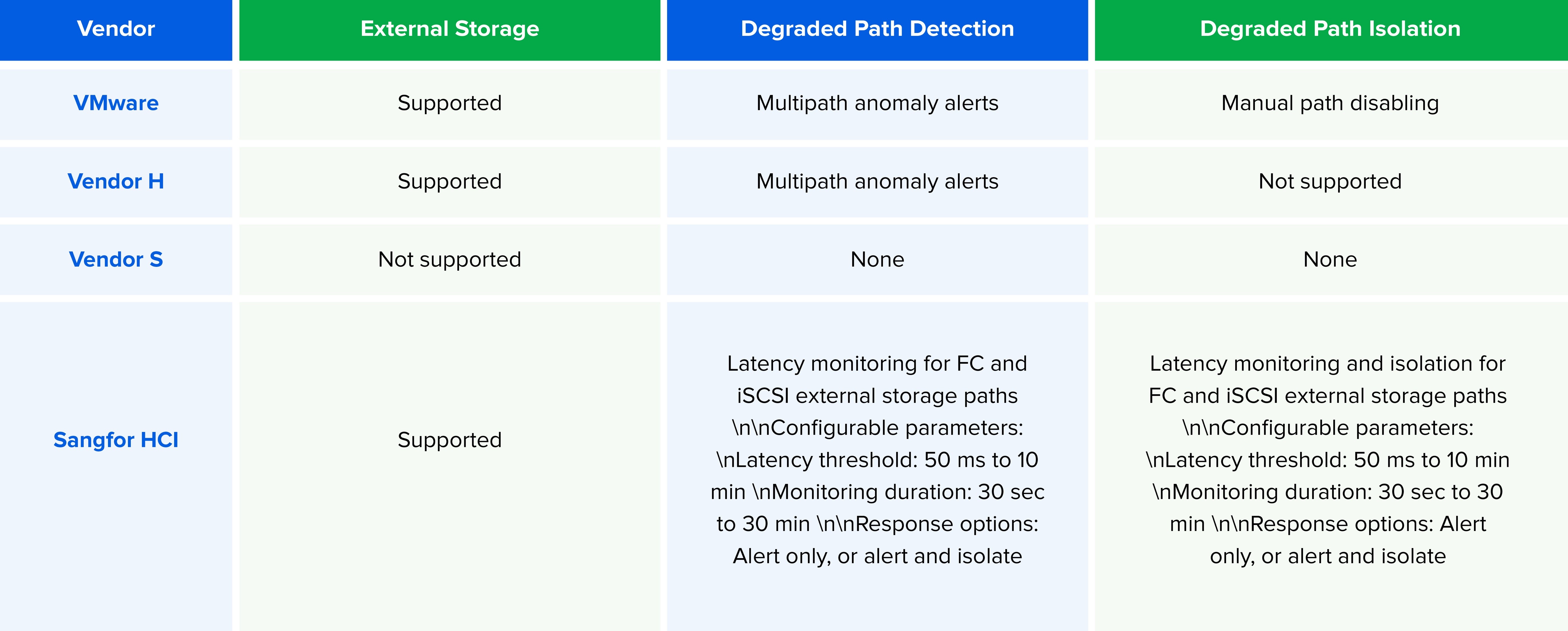
Sangfor HCI is designed to provide broader path-health management than solutions that offer limited protocol coverage, fixed monitoring parameters, or only one response method.
1. Path-monitoring coverage
Sangfor HCI supports latency monitoring for common external storage connectivity, including Fibre Channel and iSCSI. This helps accommodate a wider range of storage architectures than platforms with incomplete protocol coverage.
2. Configuration flexibility
Administrators can tune latency thresholds and monitoring periods to reflect the characteristics and service-level requirements of their workloads. This provides more precise control than fixed or limited configuration models.
3. Flexible anomaly response
Sangfor supports multiple response methods, including automatic and manual isolation. This flexibility helps organizations apply different operational policies across different business scenarios, rather than relying on a single treatment method or operating without degraded-path isolation.
Conclusion: Detect Storage Risks Before They Disrupt the Business
Storage degradation rarely begins as a complete failure. More often, it appears as intermittent latency, stalled I/O, or uneven path performance that is difficult to identify before applications are affected. By continuously monitoring path latency, isolating degraded connections, and dynamically restoring recovered paths, Sangfor HCI helps IT teams address storage risks earlier and maintain service continuity.
For organizations evaluating a VMware replacement, external storage compatibility alone is not enough. The ability to detect and manage degraded paths before they disrupt critical workloads is equally important for building a resilient HCI environment.
Feature behavior depends on product version, storage architecture, multipath configuration, and workload conditions. Customers should validate representative scenarios in their own environment.
Evaluating VMware Alternatives?
As organizations reassess their virtualization strategy, understanding the broader server virtualization landscape is equally important. Sangfor was recently recognized as a Visionary in the 2026 Gartner® Magic Quadrant™ for Server Virtualization Platforms. Download the Gartner® Magic Quadrant™ Report to explore market trends, vendor evaluations, and key considerations when selecting your next virtualization platform.

