
Summarize this Threat Intelligence article with AI:
 Ask ChatGPT
 Ask Grok
 Ask Perplexity
 Ask Claude
 Ask Google AI
The Story: The Flawless Defense




Incident Overview
On October 15, 2026, Citizen Lab exposed AdFection, a technique for delivering zero-click spyware through targeted online advertisements. Its investigation identified Discover-Tech, an advertising technology company, as a facilitator of attacks involving surveillance software developed by Candiru, a commercial spyware vendor. [S1]
At least 45 Al Jazeera devices were targeted during 2024–2025, with investigators confirming successful infections through network evidence and a recovered Windows spyware sample. Discover-Tech's advertising footprint was far broader: Citizen Lab analyzed 3.77 billion advertising bids from March–June 2026 and identified ads containing suspicious scripts across 75,373 mobile apps and 120,768 websites. [S1]
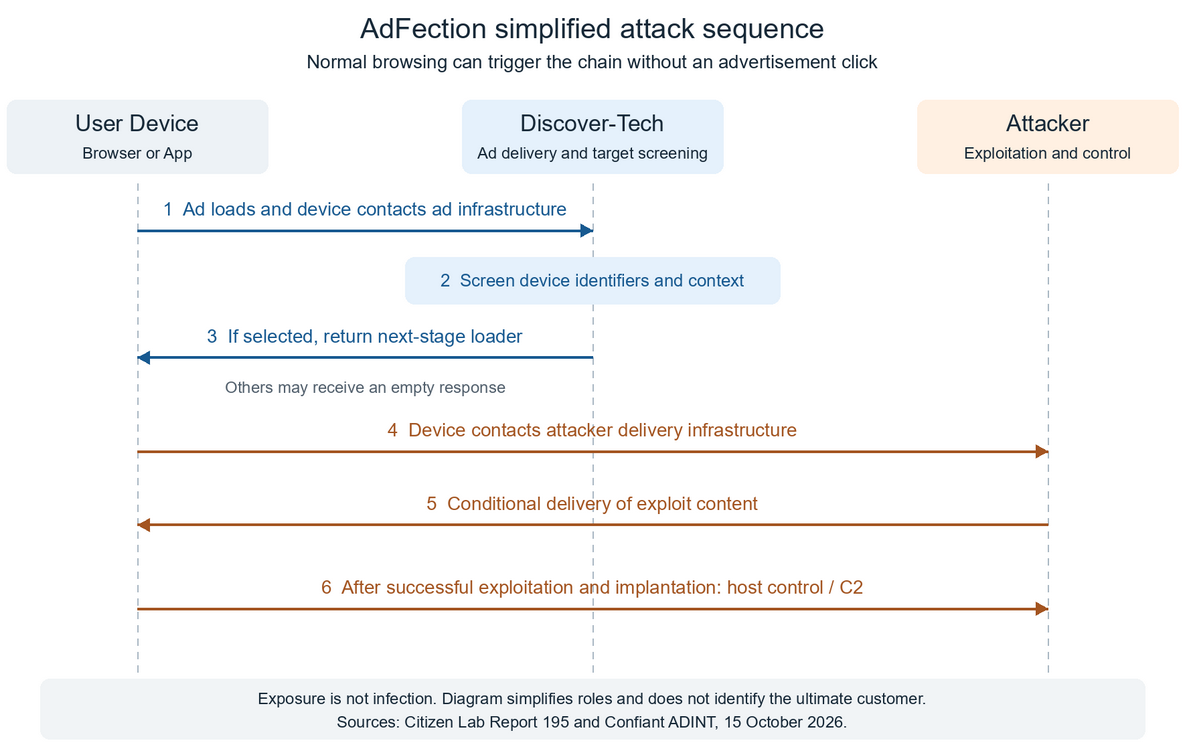
The diagram below illustrates how advertisement delivery, target screening and downstream exploit activity connect within this operation.
Sangfor FarSight Labs Threat Analysis
- Targeted Delivery & Screening: Citizen Lab identified Discover-Tech ads contacting a NOAS/getAd server that selectively returned JavaScript to chosen devices. Confiant analyzed related device-fingerprinting and remote-instruction functionality, but did not recover the full in-the-wild exploit chain. [S1, S2]
- Limitations of Clean Scans: The response depends on device identifiers and request context. A scanner that is not the intended target can receive an empty response and miss the malicious next stage. [S1, S2]
- Separate Exposure from Infection: Advertising requests indicate exposure or profiling; validator connections, implant artifacts and implant-linked C2 traffic provide stronger evidence of attack progression. [S1]
Investigation Guidance
Investigation Evidence Matrix
| Observation | Supported assessment | Next step |
| Discover-Tech advertising / NOAS request | Evidence of an ad impression, identification or conditional delivery | Capture app/site, endpoint, request time and response context |
| Candiru validator connection after an ad event | Potential next-stage validation; stronger when linked in a device timeline | Check follow-on connections, endpoint behavior and logs |
| Recovered Windows DLL / COM hijack artifact | Implant evidence if it matches verified malware characteristics | Preserve sample, compute hash, examine persistence |
| Candiru C2 traffic linked to implant | Supports spyware activity on the affected host | Scope device activity, related hosts and potential exfiltration |
Selected Historical Indicators
These examples come from the October 2026 Citizen Lab and Confiant reports and are investigative pivots, not a current campaign blocklist. [S1, S2]
| Role | Published example | Investigation use |
| Ad delivery / profiling | mtrtb[.]com subdomains; NOAS/getAd requests | Review advertising-response and identifier context. [S1, S2] |
| Candiru validator | keyadapter[.]com; sharethere[.]net | Check whether it follows a suspect ad event. [S1] |
| Candiru C2 in recovered DLL | fearevolve[.]com; jobmarcher[.]com | Correlate with implant and endpoint activity. [S1] |
Recovered Windows DLL SHA-256 (Citizen Lab): 255869de85e2a171993fc5eb8a556d873a1b8966e040f6f55926f2fa2d595cc8 [S1]
MITRE ATT&CK Mapping
| Behavior | Mapping | Evidence boundary |
| Encountering exploit content while browsing and becoming compromised | T1189 Drive-by Compromise | Mechanism mapping does not establish exploitation from one impression |
| COM hijacking persistence in the Windows sample | T1546.015 Component Object Model Hijacking | Applies to the analyzed sample not every platform |
Enterprise Security Checklist
• Policy Coverage: Verify ad-blocking and anti-tracking controls apply to managed devices both on-premise and remotely, including in-app browsing.
• Telemetry & Correlation: Ensure network requests correlate to specific devices and processes rather than shared exit IP addresses.
• Sequence Reconstruction: Correlate ad/NOAS contact with validator traffic, possible C2 connections and endpoint artifacts on a single device timeline. [S1]
• Playbook Refinement: Classify findings as ad exposure, suspected exploit delivery or confirmed compromise; avoid treating ad-domain hits as infections or blocking shared public CDNs wholesale.
How Sangfor Helps
| Pain Point | Sangfor Solution |
| Ads from multiple sources can appear as web pop-ups, embedded content or endpoint pop-ups, increasing user exposure to unwanted and potentially malicious advertising. | Athena SWG intelligently monitors and classifies advertising sources across the web, combining cloud-based threat intelligence to filter unwanted and risky ads. Coverage includes ads from sources such as Google, Tanx, MediaV, News, etc.. helping reduce ad-related exposure. |
| Unpatched operating systems, browsers and applications leave endpoints vulnerable to exploitation, while compromised or poorly protected devices can increase the impact of malicious advertising. | Athena EPP strengthens endpoint protection against exploitation and malicious activity. Combined with timely patching, exploit mitigation and stricter device policies for high-risk users, it helps reduce endpoint compromise risk and limit potential impact. |
| Web activity, endpoint anomalies and network connections are scattered across security tools, making it difficult to identify a coordinated attack. | Athena XDR correlates telemetry across security layers, with AI and Security GPT assisting investigation. Analysts can connect suspicious web activity, endpoint behavior and network communications to identify potential attack chains. |
| Rotating infrastructure and legitimate advertising traffic create noisy alerts, making it difficult to distinguish malicious activity from benign exposure. | Sangfor threat intelligence and FarSight Labs research enrich investigations with threat context. Athena XDR supports IOC and IOA matching, helping analysts prioritize suspicious activity based on indicator relevance, freshness, confidence and local evidence. |
References
[S1] Citizen Lab. “Exposing AdFection: How Discover-Tech Turned Targeted Ads Into a Pipeline for Zero-Click Mercenary Spyware.” 15 October 2026.
[S2] Confiant. “ADINT: Weaponized Ad Tech for Zero-Click Spyware and Mass Identity Vacuuming.” 15 October 2026.