
Summarize this Threat Intelligence article with AI:
 Ask ChatGPT
 Ask Grok
 Ask Perplexity
 Ask Claude
 Ask Google AI
The Story: The Lost Toolkit



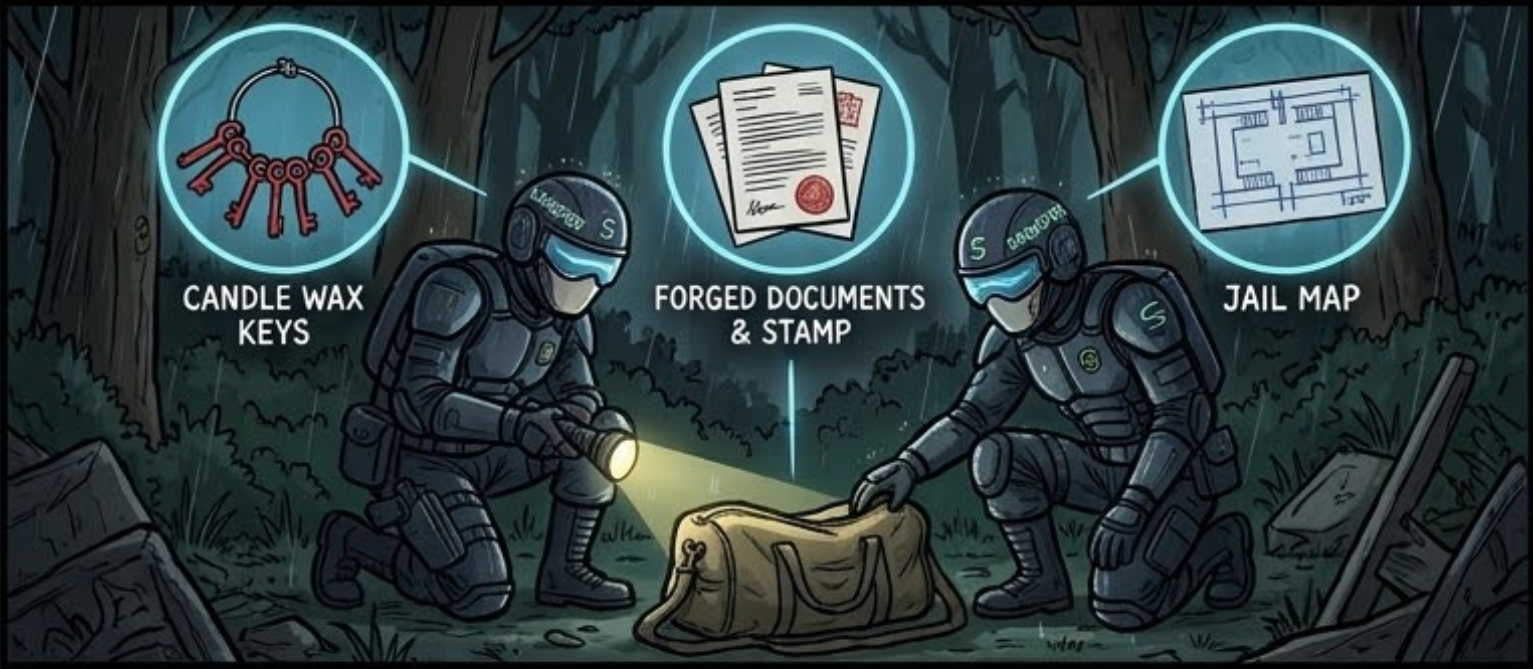
The Story Behind the Comic: The Careless Mastermind
Sangfor FarSight Labs researchers recently stumbled upon an open digital toolbox left behind by hackers on the web.
The tools were crafted to steal credit card data from a real payment service. The attacker had done months of homework—mapping out every lock, hallway, and guard shift inside the target's system.
Yet, for all their technical precision, they made a hilarious blunder: they left the entire toolbox unlocked on the sidewalk, complete with their own front-door key inside.
Sangfor Investigation
Confirmed Facts & Key Findings
The exposed directory was not a random dump but a fully functional attack toolkit organized into seven distinct modules—ranging from memory-resident components and tunnels to remote access and data-theft scripts.
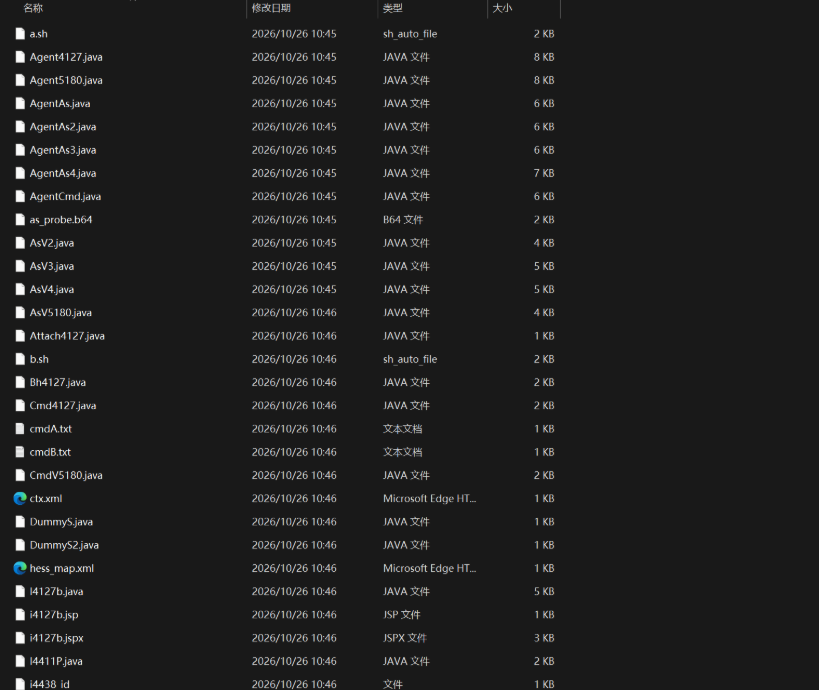
Activity Timeline: While all file timestamps matched the packaging date, embedded archive timestamps and script logs confirmed the actual operation took place on September 27–28, 2026.
Three Rarely Exposed Core Assets:
- OpenSSH Private Key (ed25519): Configured to create a root-level reverse tunnel back to the command-and-control server.
- Remote Session Identifier: An embedded session token used for persistent control.
- Unstripped Linux Payload: Retained full debugging symbols, directly revealing the attacker's build environment and development trails.
Investigation: How the Toolkit Was Constructed
1. Dual Memory Shells: Built for Redundancy
The toolkit included two independent, in-memory webshell families to ensure continuous access even if one failed:
- AES-Encrypted Shell: Decrypted and executed commands in-memory, returning outputs through the same channel. Deployed as JSP, JSPX, and custom pipeline variants for multiple entry points.
- Base64 Dynamic Class-Loader: Evolved across four iterations, adding access logging, isolated classloaders, and decoy page contexts for stealth.

2. Fileless Runtime Injection
To bypass disk-based file integrity checks, the attackers switched to memory-only execution:
- Utilized the Java Attach API to inject malicious agents directly into active application processes.
- Handled requests entirely in memory, leaving application directories untouched.
- Accepted that memory components would vanish upon restart, relying on a dedicated background payload for persistence instead.

3. Bulletproof Persistence: Dual Payloads & Watchdog
Persistence was maintained through an aggressive multi-layered recovery mechanism:
- Dual Backdoors: Dropped both an ELF Linux binary and a Java archive into hidden paths (or shared memory if unwritable).
- Failover Watchdogs: Enforced survival via a per-minute cron job plus a 25-second active polling loop to restart killed processes.
- Container Awareness: The crontab paths followed Alpine/BusyBox formats, proving the malware was tailored specifically for containerized targets.
Key Takeaways
Targeted, Field-Level Data Harvesting
The scripts exploited an unauthenticated administrative query endpoint to systematically extract orders dating from 2019 to 2026. Rather than dumping raw database outputs, they selectively grabbed only high-value cardholder fields (PAN, CVV, bank accounts), confirming the attacker had already mapped the application’s underlying data model.
Ongoing Surveillance Rather Than a One-Time Pull
A secondary query routine monitored the most recent seven days and newly onboarded merchant dates, proving the attacker was actively tracking incoming transactions rather than executing a quick smash-and-grab.
The Shift from Data Theft to Transaction Fraud (The Private Key)
The attacker verified and exfiltrated the merchant’s RSA private signing key. This elevates the incident from a data breach into a catastrophic transaction-integrity issue: with this key, the attacker can forge legally valid, mathematically legitimate payment confirmations and settlements that downstream banks must accept without cracking any encryption.
Human-Led, AI-Assisted Tooling
Structural evidence across 42 scripts—repetitive scaffolding, constraint-style prompting rules ("do not touch this file"), mixed Chinese circled numbering in English comments, and rapid iterative rollbacks—indicates an experienced operator was directing an LLM to generate and adapt custom payloads at machine speed.
The Blind Spot in Modern Payment Security:
Cryptographic signature validation only answers "Was this signed with the right key?", not "Should this payment exist?" Defenses must move away from static key protections and signature-based detection toward contextual transaction binding and behavioral anomalies (e.g., broad historical queries, mass paging, unauthorized key copies).
Behavior and MITRE ATT&CK Mapping
| Attack stage | Attacker objective and risk | Recommended ATT&CK mapping | Signals and defensive response |
| 1. Access is converted into a trusted foothold | Register a handler inside a legitimate application, reached through a URL path that already belongs to a business service. | T1078 Valid Accounts where credentials are reused; T1505.003 Web Shell where a server-side component is registered; T1190 only where an application vulnerability is confirmed. | Unexpected entries in application configuration; new URL mappings under existing business paths; handler classes appearing in application directories; descriptor changes outside deployment windows. |
| 2. Persistence moves into memory | Avoid file-based detection by loading components into the running application process. | T1055 Process Injection; T1620 Reflective Code Loading; T1543 only where an OS-level service is actually created. | JVM attach activity without a deployment; newly loaded classes in a running process; tooling libraries accessed at runtime; application restarts that clear implants while remote access persists. |
| 3. Internal services are queried for sensitive context | Use trusted internal interfaces to enumerate and extract order, merchant, and card data. | T1213 Data from Information Repositories; T1005 Data from Local System for staging; T1552.004 Private Keys where signing material is copied. | Wide time-window queries; sequential paging; unusual field selection; access to key directories; staging files in temporary paths. |
| 4. Access is monetized | Reuse signing material or order context to produce credible payment messages, or resell validated data. | Fraud outcomes should be described as fraud rather than force-mapped to ATT&CK; T1041 or T1567 only where exfiltration is confirmed. | Signature validation anomalies; merchant complaints about unexpected confirmations; reconciliation mismatches; outbound transfers from application servers. |
Actionable Checklist for Enterprise Security
Immediate Exposure Check
If you run Java payment servers, perform these eight checks immediately:
- Deployment Drift: Compare current deployment descriptors against baseline artifacts for unauthorized servlets or hidden handler paths.
- Exposed Admin APIs: Verify web-tier internal services; flag any unauthenticated management interface as a security incident.
- Unapproved Binaries: Scan application libraries (lib/, classes/) for unexpected classes or JAR files missing from the build manifest.
- JVM Injections: Audit JVM Attach API operations, dynamic agent loading, and tools running from /tmp.
- Persistence Artifacts: Inspect /tmp and /dev/shm for binaries or watchdog scripts, and review cron jobs running on 1-minute intervals.
- Key Material Integrity: Audit access logs to payment signing keys and check for unapproved copies outside secure keystores.
- Abnormal Data Queries: Monitor database logs for broad-window queries, bulk card paging, or queries targeting only sensitive payment fields.
- Forensic Evidence Preservation: Snapshot process trees, system/access logs, DNS records, and key usage history before revoking attacker access.
Indicators
| Type | Value |
| Command-and-control host | 91.224.92[.]16 |
| C2 ports | 18128 (payload delivery), 18129 (SSH reverse tunnel), 18130/18132 (custom tunnel), 18140/18141 (remote-access handlers), 18142 (minimal reverse shell) |
| Handler URI patterns | /i4127b, /i4127b.jsp, /i4127b.jspx, /i5180ms, /i4127bh, /hessian/i4127.jsp, /hessian/cmd |
| Staging paths | /tmp/.i5180/, /dev/shm/.i5180/, /tmp/Tun.class |
| Configuration backup pattern | web.xml.bak.i4* |
| Remote-access payload (MD5) | 652fca1b1dc6f1fdcfaf5c0fd2a67977 (ELF); 9893b75467166ac962c12b26e5e96a4f (Java) |
| Minimal reverse shell (MD5) | d549956808eaa8c3d6c30e9417eff8d9 |
How Sangfor Helps
| Pain Point | Sangfor Solution |
| Lack of Threat Intelligence | We combine external threat intelligence, infrastructure expansion, malware relationship analysis, and customer telemetry into an actionable investigation: confirming which indicators actually appear in an environment, identifying affected people, endpoints, and identities, and connecting network intrusion signals to gateway access, signing calls, and transaction anomalies. Beyond detection engineering, we can assess internal administrative exposure, application configuration controls, key-management practices, and payment response workflows, and run tabletop exercises to test whether security, payment operations, fraud, legal, and management can reach a shared judgment before funds settle. |
References
1. MITRE ATT&CK — T1505.003 Web Shell. Supports server-side component registration mapping.
2. MITRE ATT&CK — T1620 Reflective Code Loading. Supports in-memory component loading mapping.
3. MITRE ATT&CK — T1552.004 Private Keys. Supports signing-material access mapping.
4. MITRE ATT&CK — T1213 Data from Information Repositories. Supports business-system query mapping.
5. Apache Software Foundation, Tomcat 7 Security Overview. Supports deployment descriptor and container hardening guidance.
6. Rapid7, Metasploit Framework (mettle). Supports remote-access payload identification.