Sangfor aSAN Resource Management Configuration Guide
Read the full document on Sangfor Cloud Platform (SCP)
1 Introduction
In a standard scenario, the virtual storage recommends that the disks be as homogeneous as possible so that the virtual storage performance will be better and more balanced. In special circumstances where the virtual storage disk is unable to fulfill the homogeneous requirement, heterogeneous scenarios can be supported. Still, there is a minimum requirement that needs to be fulfilled.
Since HCI version 5.8.6 and above, the restrictions for the heterogeneous situation have been lowered. However, the following conditions must be met at the same time for the disk to be heterogeneous to ensure the virtual storage performance and volume usage.
1.1 Hybrid Volume (SSD+HDD)
The number of hosts ≥ 3 in the same storage volume:
Condition 1: The sum of the data disk capacity between hosts, the highest capacity, cannot exceed 80% of the sum of all the remaining hosts. Example: host A 5TB, host B 5TB, host C 5TB, host D is not allowed to exceed 12TB.
Condition 2: The ratio of the cache disk capacity to the data disk capacity of each host should not be less than 5%. For example, host A configuration with two 480GB SSDs and ten 4TB HDDs is not allowed.
Condition 3: The ratio of each host’s cache disks and data disks should be within 1:6. For example, host A has two cache disks and fifteen data disks, which is not allowed.
Condition 4: It is allowed to have a data disk with different capacities in a single host, but the capacity gap of the largest data disk should not exceed two times of the smallest data disk. For example, a 1TB disk and a 4TB disk can form virtual storage but do not form a 1TB disk and a 4TB disk in the same disk group. The capacity of a 4TB disk is four times larger than a 1TB disk, but the performance is the same as a 1TB disk, so a 4TB disk can easily become a performance bottleneck. The bigger the gap, the bigger the bottleneck.
Notice: The HDD in the host allows SAS disks and SATA disks to be mixed, but it will cause the performance of SAS disks to be equal to SATA disks (barrel effect). The host is allowed to have a varying number of disks between disk groups. The main impact is that the write performance will drop slightly when the storage pool is almost full.
1.2 Full Flash Volume (All SSD)
The number of hosts ≥ 3 in the same storage volume:
Condition 1: The sum of the data disk capacity between each host, the highest capacity cannot exceed 80% of the sum of all the remaining hosts. Example: host A 5T, host B 5T, host C 5T, host D is not allowed to exceed 12T.
Notice:For all-flash datastores, configuring cache disks is not required. However, it is recommended to configure all SSDs as data disks. It is allowed to have a data disk with different capacities in a single host, which will not affect the performance.
1.3 Hybrid Volume
The number of hosts = 2 in the same storage volume:
Condition 1: The total capacity of the two hosts must be equal.
Condition 2: The ratio of the cache disk capacity to the data disk capacity of each host should not be less than 5%. For example, host A configuration with two 480GB SSDs and ten 4TB HDDs is not allowed.
Condition 3: The ratio of the number of cache disks to data disks of each host should exceed or equal to 1:6. For example, host A has two cache disks, and fifteen data disks are not allowed.
Condition 4: It is allowed to have a data disk with different capacities in a single host, but the largest data disk capacity is not allowed to exceed 50% of the capacity of the smallest data disk. For example, a 1TB disk and a 4TB disk can form a virtual storage datastore but do not form a 1TB disk and a 4TB disk in the same disk group. The capacity of a 4TB disk is four times larger than a 1TB disk, but the performance is the same as a 1TB disk, so a 4TB disk can easily become a performance bottleneck. The bigger the gap, the bigger the bottleneck.
Notice: When expanding the capacity of two hosts in a datastore by add host, all needs to be shutdown, while expanding by disks not need to shutdown.
1.4 Multi-Datastore Expansion
Condition 1: A single cluster allows a maximum of 6 storage volumes, among which only 1 can be an stretch volume.
Condition 2: Each volume must consist of disks from at least 3 hosts.
Condition 3: Each host can participate in up to 2 volumes.
Condition 4: If a volume is configured in an all-SSD mode, no cache disk is required. Each host must have at least 2 SSDs.
Condition 5: The stretched cluster does not support creating a second stretch storage. A node also cannot have both stretched and ordinary datastore.
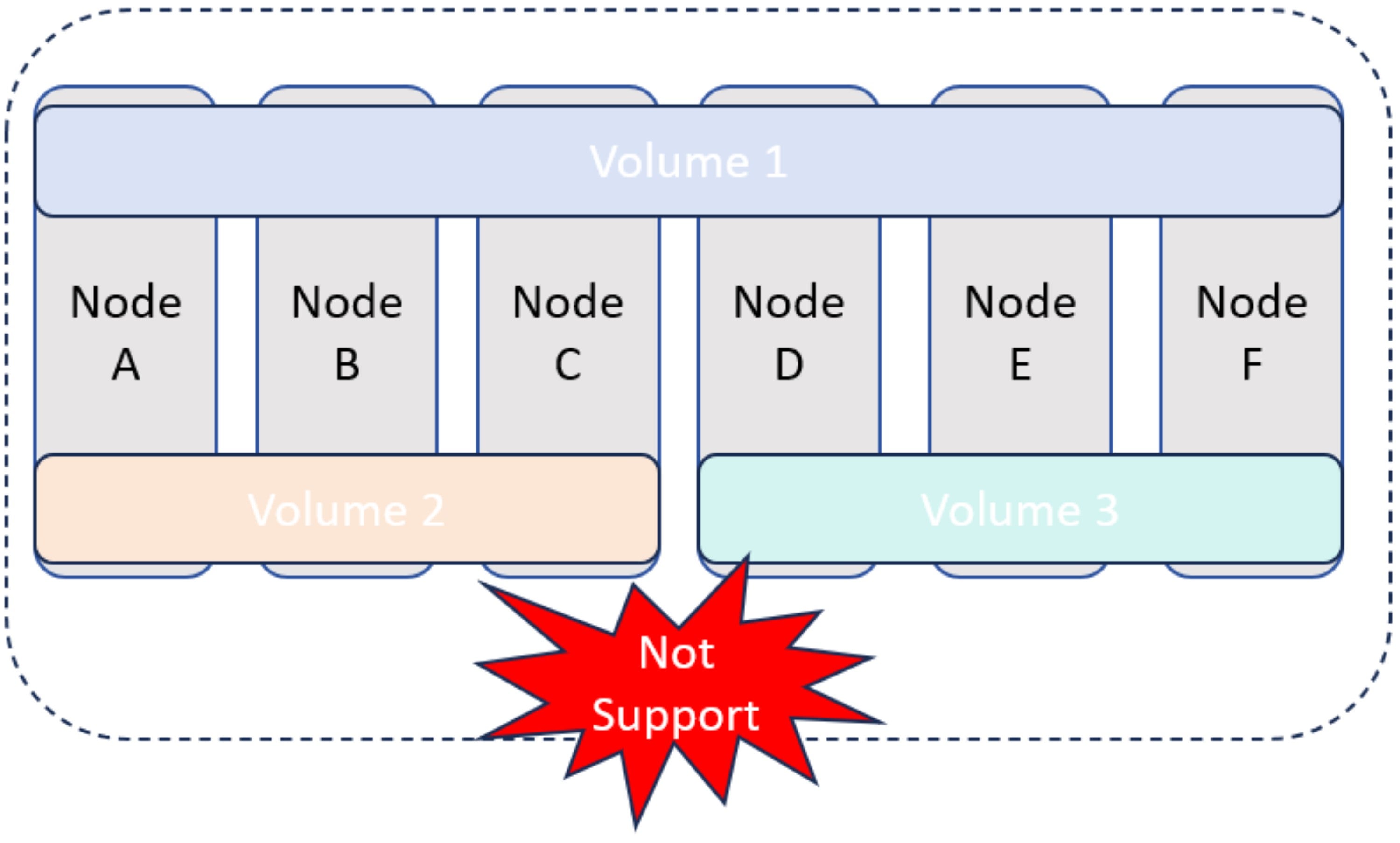
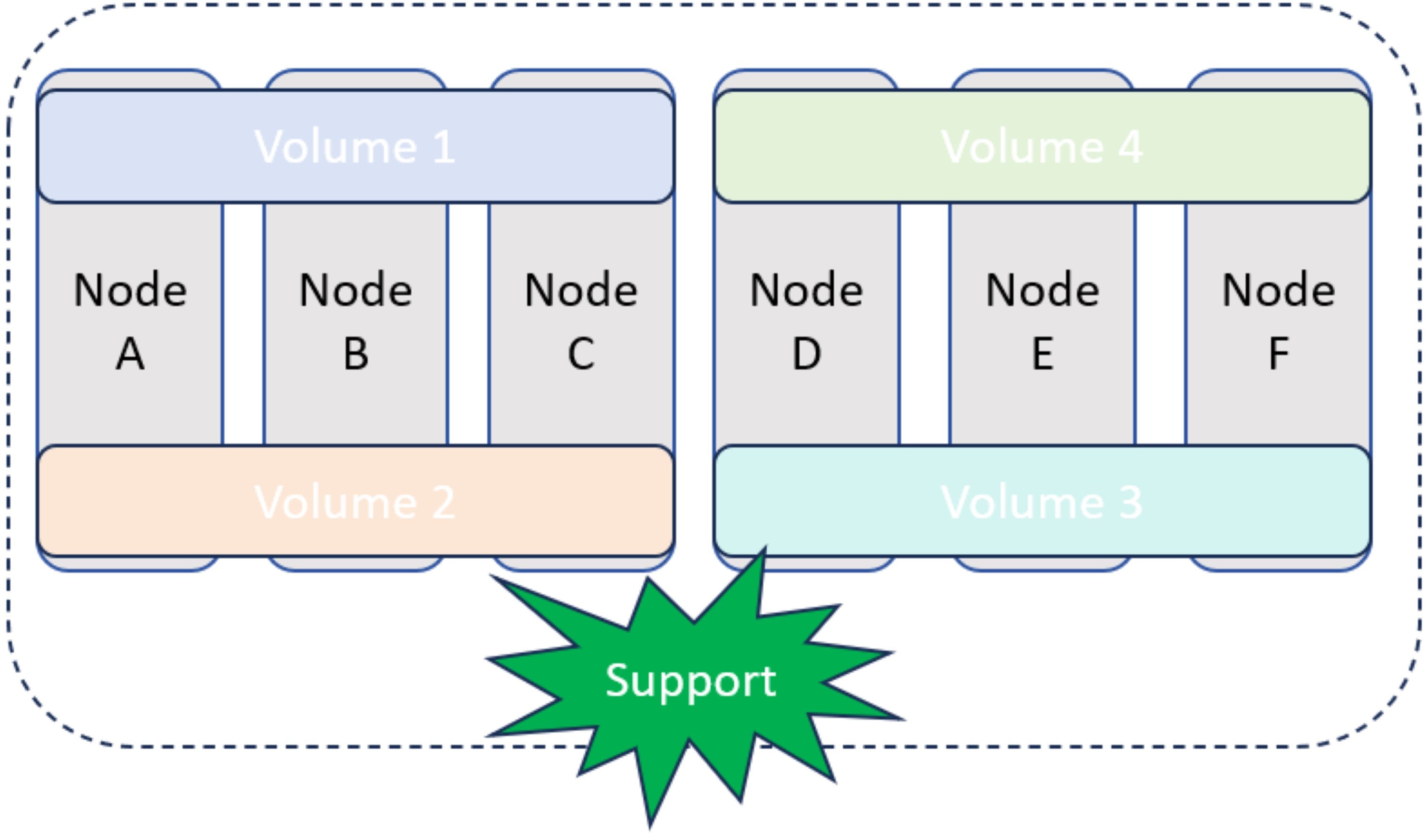
Condition 6: Hosts that make up one volume cannot simultaneously belong to two other volumes. For example, if hosts A, B, and C form Volume 1, and hosts D, E, and F form Volume 2, then hosts A, B, C, D, and E cannot create Volume 3. However, you can create Volume 3 with hosts A, B, and C, and Volume 4 with hosts D, E, and F, like the following image shows: