
Summarize this blog article with AI:
 Ask ChatGPT
  Ask Grok
  Ask Perplexity
  Ask Claude
  Ask Google AI
 In the evolving landscape of digital transformation, data sovereignty has emerged as a critical imperative for organizations navigating geopolitical risks, regulatory compliance, and cyber threats. As outlined in the IDC whitepaper published by Veeam, "Navigating Data Sovereignty in the Cloud Era with a Resilience-Centric Approach," sovereignty is no longer just about compliance—it's the foundation of digital trust and risk management in a brittle, anxious, nonlinear, and incomprehensible (BANI) world. Veeam's approach emphasizes a layered strategy focusing on data residency, encryption, access controls, legal jurisdictions, operational autonomy, and technical resilience through mechanisms like immutable backups and air-gapped environments. This resilience-centric lens shifts the focus from absolute isolation to pragmatic autonomy, enabling organizations to mitigate risks while leveraging cloud innovations.
Drawing from this framework, Sangfor Technologies offers robust solutions with its Hyper-Converged Infrastructure (HCI) and EDS, Enterprise Data Storage (aStor) that are particularly well-suited for sovereign cloud designs. These tools provide private and sovereign cloud infrastructure, ensuring data control, compliance with regulations like GDPR, and advanced protection against threats. In this technical blog, we'll explore how Sangfor HCI and aStor align with Veeam's resilience pillars, highlighting features like WORM storage, anti-ransomware capabilities, and integrated security products powered by Sangfor's cloud ecosystem. We'll also delve into the strategic partnership between Sangfor and Veeam, which amplifies these capabilities through deep integrations and shared commitments to data resilience.
Strategic Partnership with Veeam: Amplifying Resilience Through Integration
Sangfor's alignment with Veeam's resilience-centric vision is further strengthened by the strategic partnership since 2024, which positions Sangfor as a key Veeam Cloud & Service Provider (VCSP) partner—the first HCI vendor to achieve this status. This collaboration integrates Veeam's advanced backup and data management technologies directly into Sangfor's ecosystem, enabling seamless, unified data resilience solutions.
Looking ahead, Veeam Backup & Replication v13, set for release in 2026 soon, will natively support Sangfor HCI as a hypervisor through Veeam's Universal Hypervisor Integration API. This framework allows any hypervisor vendor to integrate with Veeam's backup and recovery capabilities, future-proofing environments against evolving threats and virtualization shifts. This integration provides access to Veeam's tools for users migrating from legacy systems or facing hyperscaler disruptions.
The partnership has been showcased at events like VeeamON Tour 2025 in Hong Kong, highlighting seamless VMware migrations and unified data management—directly supporting Veeam's emphasis on operational autonomy and risk mitigation in sovereign designs. By combining forces, Sangfor and Veeam empower organizations to build trusted, resilient digital foundations that prioritize sovereignty without compromising innovation.
Sovereign Cloud Design with Sangfor HCI: Building Private and Hybrid Autonomy
Sangfor HCI delivers a third-generation cloud architecture that converges compute, storage, networking, and security into a single software stack, reducing total cost of ownership (TCO) by up to 70% while simplifying operations. This design is ideal for sovereign clouds, where organizations prioritize data residency and control to comply with local laws and avoid foreign access risks, such as those posed by the CLOUD Act.
Key features for sovereign cloud include:
- Private Cloud Infrastructure: HCI allows deployment on commodity hardware, enabling fully on-premises setups that keep data within national borders. This ensures legal jurisdiction remains local, aligning with Veeam's legal lens by providing clarity on governing laws and encryption of key management.
- Hybrid Cloud Extension: Organizations can extend to local Sovereign Cloud while maintaining a unified architecture. Local CSP operates from in-country data centers, supporting data sovereignty by avoiding internationally distributed hyperscalers. This hybrid model balances innovation with resilience, allowing sensitive data to stay on premises while leveraging local/public cloud scalability.
- Built-in Resilience: HCI includes disaster recovery options like snapshots, Continuous Data Protection (CDP), and stretched clusters, ensuring business continuity amid geopolitical uncertainties. CDP records VM I/O logs every five seconds, enabling near-zero Recovery Point Objective (RPO) for critical applications.

The architecture supports ESG goals by optimizing resource use and providing guided migration from legacy systems like Physical Servers, KVM, Hyper-V, VMware or Public Clouds, with integrated security for zero-trust environments. For sovereign designs, this means organizations can achieve operational autonomy without mass repatriation from public clouds, as Veeam advocates.
Data Protection Excellence with Sangfor aStor (EDS): Immutability and Anti-Ransomware Fortification
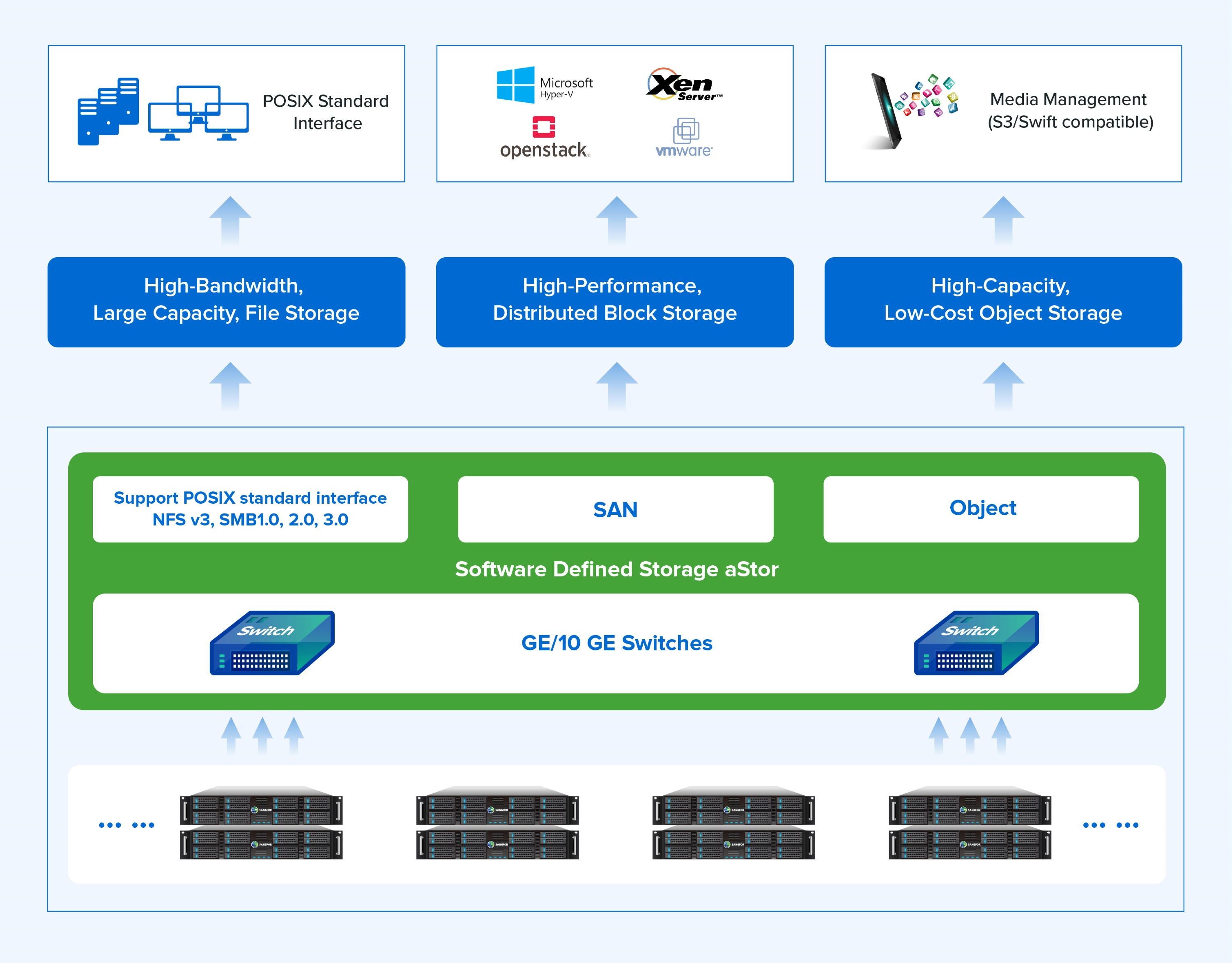
Complementing HCI, Sangfor aStor is a software-defined storage (SDS) solution that unifies enterprise data storage, offering high availability, scalability, and advanced protection features. aStor addresses Veeam's data and technical lenses by ensuring residency, encryption, and air-gapped isolation, while its WORM and anti-ransomware capabilities provide immutable backups critical for cyber-resilience.
Here's a breakdown of aStor's key features in a table for clarity:
| Feature | Description | Alignment with Veeam's Resilience Pillars |
| WORM Storage | Write Once, Read Many (WORM) ensures data cannot be modified or deleted once written, with configurable retention periods. This creates immutable snapshots resistant to ransomware encryption or insider threats. | Operational and Technical: Supports immutability for compliance and recovery, logically separating backups from production environments via HCI integration. |
| Anti-Ransomware Engine | AI-driven behavioral analysis detects and blocks ransomware in as little as 3 seconds. Includes honeypots to lure attacks, dynamic backups, and one-click file recovery. | Data and Operational: Mitigates risks like data loss from cyberattacks, exceeding native SaaS protections by enabling granular, fast Recovery Time Objective (RTO). |
| Distributed Architecture | Pools storage resources across nodes with automated management, data migration, and redundancy. Supports CDP for continuous protection. | Legal and Technical: Ensures data portability and control, allowing audits and movement within sovereign boundaries without vendor lock-in. |
| Integration with HCI | aStor runs natively with HCI, providing air-gapped environments through logical isolation from production networks. | All Pillars: Enhances overall resilience by combining storage with HCI's networking and security for end-to-end autonomy. |
aStor's anti-ransomware features, powered by AI, include post-attack recovery via Volume Shadow Copy Service (VSS) snapshots, ensuring organizations can restore files or folders without downtime. This directly tackles Veeam's concerns about limited native retention policies and granular recovery, offering flexibility for secondary uses like analytics or testing while maintaining sovereignty.
Integrated Sangfor Security Products: Powering Built-in Cloud Security
Sangfor's ecosystem extends beyond infrastructure, integrating security products and services that back built-in cloud security, all powered by the Sangfor Cloud Platform (SCP). This unified approach aligns with Veeam's operational lens, embedding cyber-resilience into the core of sovereign cloud designs.
- Athena Next-Generation Firewall (NGFW): Provides full-stack protection with AI threat detection, intrusion prevention, and secure web gateways. Integrated into HCI, it secures cloud workloads and enforces zero-trust access.
- Athena Endpoint Protection Platform (EPP): Formerly Endpoint Secure, this includes ransomware honeypots, behavioral engines, and rapid recovery. It detects process injections in 3 seconds and supports VSS backups for comprehensive endpoint defense.
- Managed Security Services: Through MSS, Sangfor offers proactive monitoring, threat analysis, and 1-on-1 expert support, ensuring compliance and data security in distributed cloud data centers.
These are managed by SCP, which also manages Kubernetes (via SKE), databases, and hybrid environments, making security seamless and scalable. For sovereign clouds, this integration means built-in defenses against ransomware, malware, and unauthorized access, reducing reliance on third-party tools and enhancing overall resilience.
Conclusion: A Proactive Path to Sovereign Resilience
Inspired by Veeam's resilience-centric framework and bolstered by the strategic Sangfor-Veeam partnership, Sangfor HCI and aStor provide a layered, pragmatic solution for data sovereignty. By enabling private and hybrid cloud infrastructures with local control, immutable WORM storage, advanced anti-ransomware features, integrated security, and upcoming Veeam v13 integrations, organizations can mitigate geopolitical and cyber risks while driving innovation. This approach transforms sovereignty from a challenge into a mandate for trusted digital foundations—start with a data classification audit and HCI deployment to build your resilient sovereign cloud today.