
Summarize this blog article with AI:
 Ask ChatGPT
 Ask Grok
 Ask Perplexity
 Ask Claude
 Ask Google AI
The Execution Gap Behind Efficiency, Effectiveness, and Trust
In Part 1 of the Advancing SecOps Maturity series, we explored how security operations mature from tool-based security to siloed SecOps, SIEM-centric SecOps, and AI-assisted SecOps.
That maturity journey matters because each stage solves real problems. Organizations move from owning security tools to operating them more consistently. They centralize security signals, context, and workflows. They adopt AI to improve detection, triage, investigation, and response support.
But Part 1 ended with an unresolved question: if mature teams have already invested in centralized visibility and AI-assisted SecOps, why do they still struggle to move faster, detect more accurately, and act with confidence?
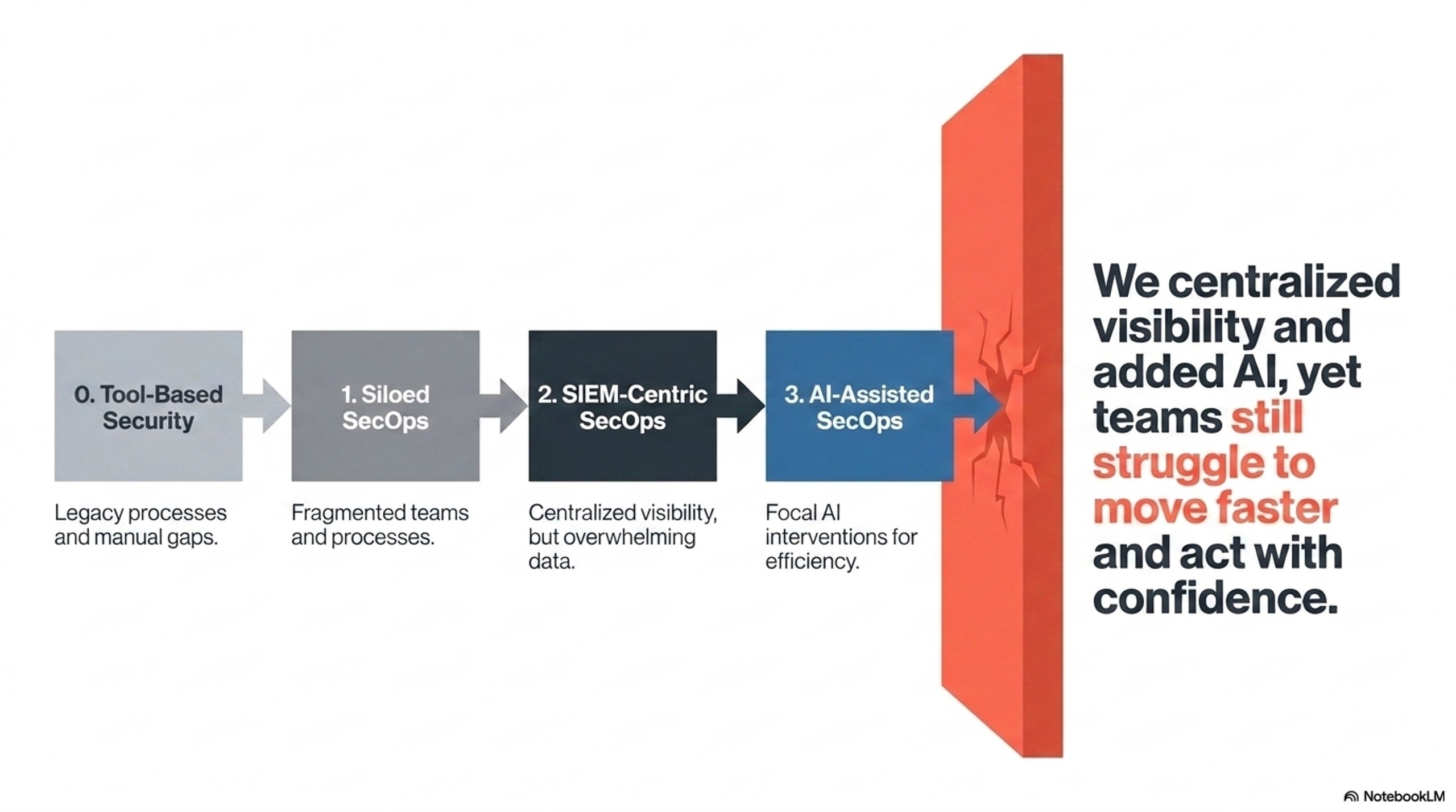
This article answers that question by examining the execution gap behind AI-assisted SecOps: why task-level AI improvements do not automatically translate into better efficiency, effectiveness, and trust across the full security workflow.
Why AI-Assisted SecOps Still Struggles
AI-assisted SecOps already improves important parts of security operations. In many platforms, that assistance is embedded into specific capabilities such as anomaly detection, risk scoring, alert prioritization, and enrichment. It can also include summarization, copilot-style explanation, response recommendation, or documentation support.
These capabilities are useful, but they also point to the first gap: much of today’s AI assistance remains task-level rather than workflow-level. Security operations, however, is not just a collection of isolated tasks. It is a workflow.
Real SecOps work requires continuity across the workflow: preserving context, connecting related signals, assessing risk and business impact, and carrying the case toward a safe decision or action.
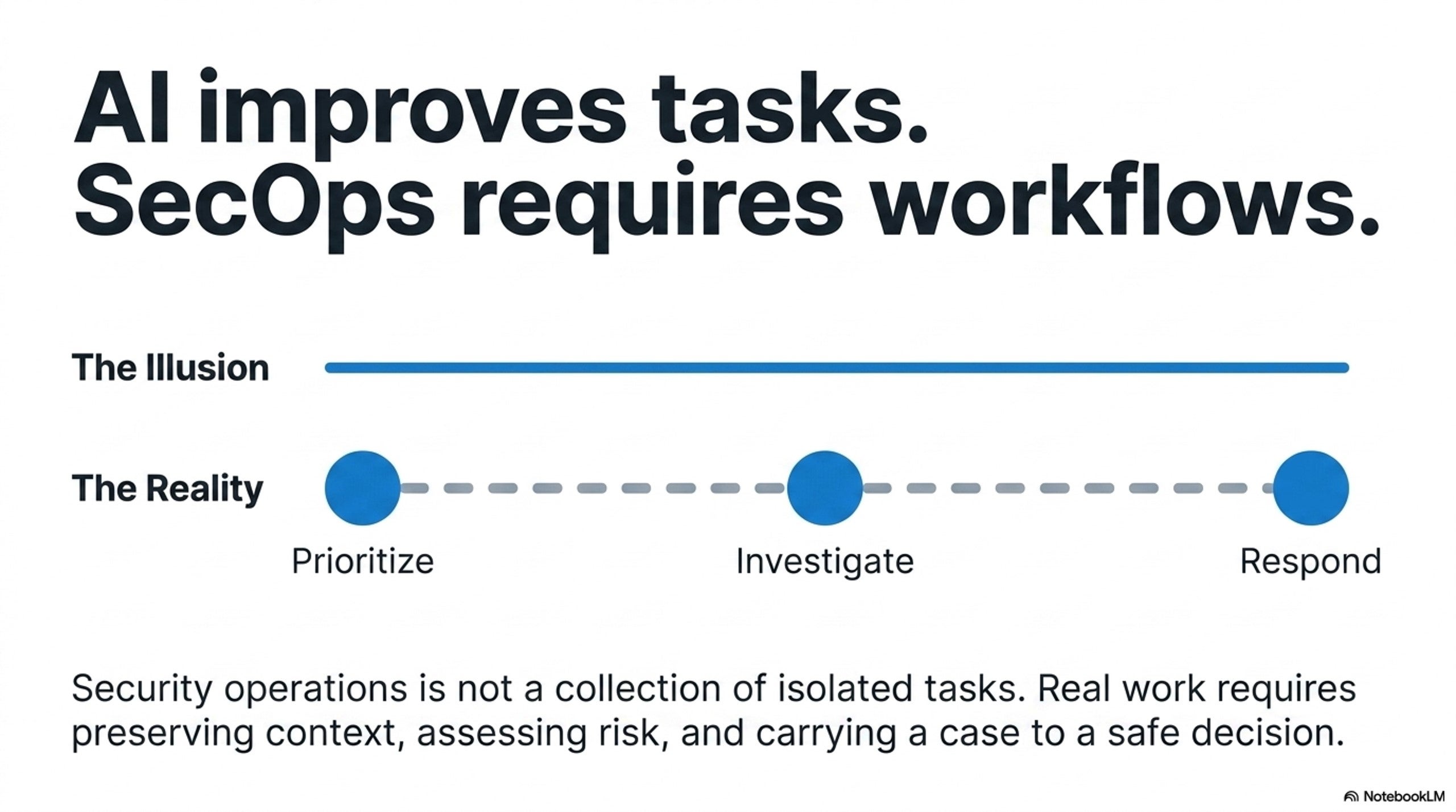
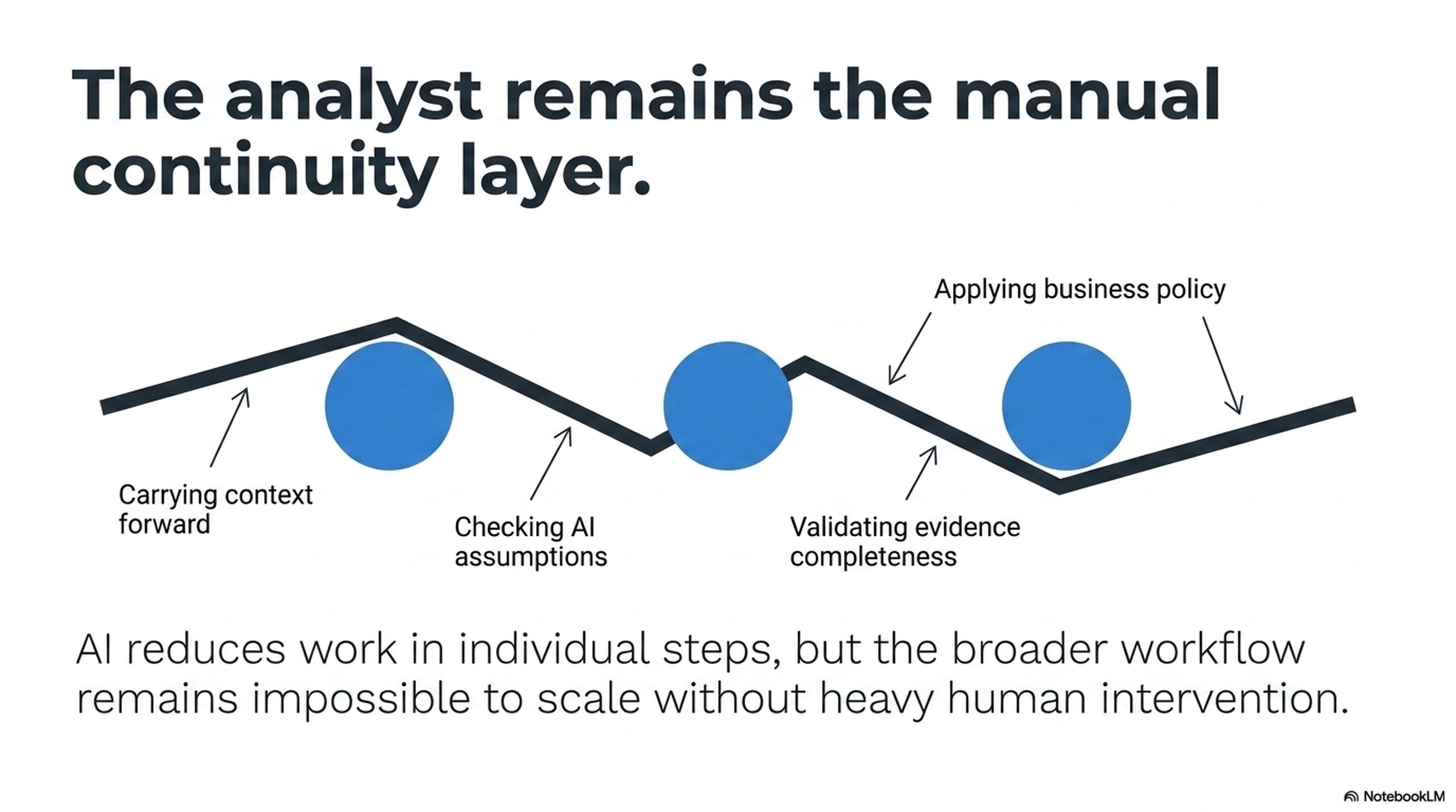
Most AI-assisted tools are not designed to carry that workflow continuously. They may not retain investigation state across steps, orchestrate actions across multiple tools, validate whether the evidence is complete, or apply business and response policies before recommending action. As a result, the analyst remains the continuity layer: carrying context forward, checking assumptions, and deciding whether the workflow is ready to move to the next step. That is why AI can reduce work in individual steps while the broader workflow remains difficult to scale.
The second gap follows from the first: trustworthiness.
Analysts may not always describe it this way, but they know the limitation in practice: AI is not yet operating like a senior analyst who can carry an investigation end to end. It may produce useful outputs, but analysts cannot assume those outputs are complete, contextual, or safe to act on. This is why AI-supported decisions are often treated cautiously. A recommendation can be useful without being ready for action. An AI-generated summary can save time without proving that the evidence is complete. A suggested response can appear reasonable, but still require validation against response policy, asset criticality, and business impact.
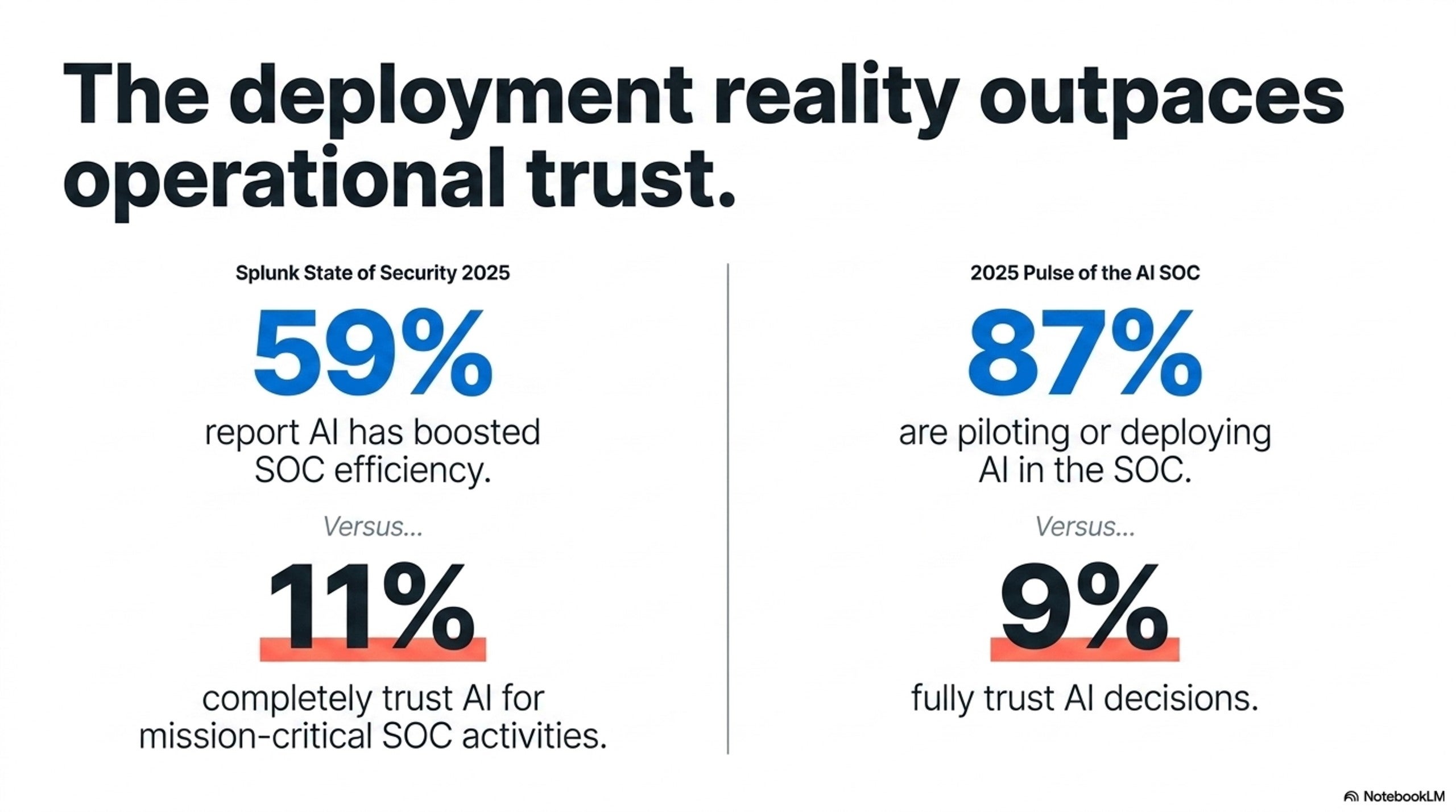
Industry data highlights this gap. Splunk’s State of Security 2025 found that 59% of respondents say AI has moderately or significantly boosted SOC efficiency, while 61% trust AI “somewhat” and only 11% trust it completely for mission-critical SOC activities. The 2025 Pulse of the AI SOC Report shows a similar pattern: 87% of organizations are adopting, piloting, or evaluating AI in the SOC, while only 9% are very confident in AI-generated alerts and recommendations, compared with 74% who are mostly or moderately confident. Together, the data suggests SOC teams see real value in AI, but still prefer human oversight for high-stakes decisions.
Explainability adds another layer to the trust problem. A 2025 systematic review published in ACM Computing Surveys analyzed 189 AI-for-SOC papers and found that 88% relied on non-explainable approaches. In a SOC environment, that matters because analysts need to understand not only the conclusion, but the reasoning behind it.
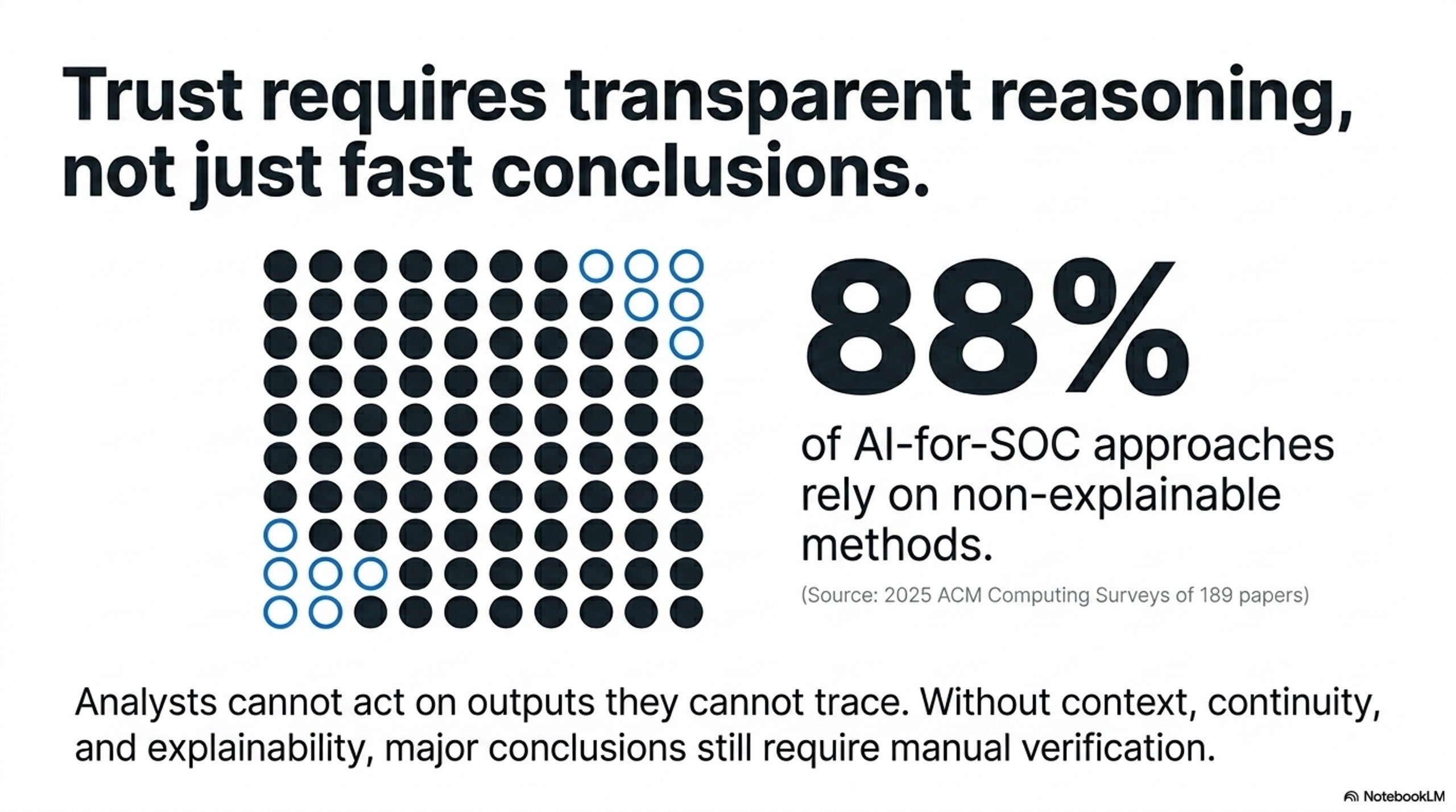
Trust, therefore, depends on context, continuity, verification, explainability, and governance. If those conditions are not met, analysts will continue to validate major conclusions manually, and teams will hesitate to automate actions that affect users, systems, or business operations.
What This Creates: The SecOps Trilemma
Security teams need to execute faster, detect and respond more effectively, and trust AI-assisted or automated decisions enough to act. But when AI assistance remains task-based and trust still depends heavily on human validation, improving one objective can create pressure on the others.
This is what we call the SecOps Trilemma: the difficulty of improving efficiency, effectiveness, and trust at the same time.
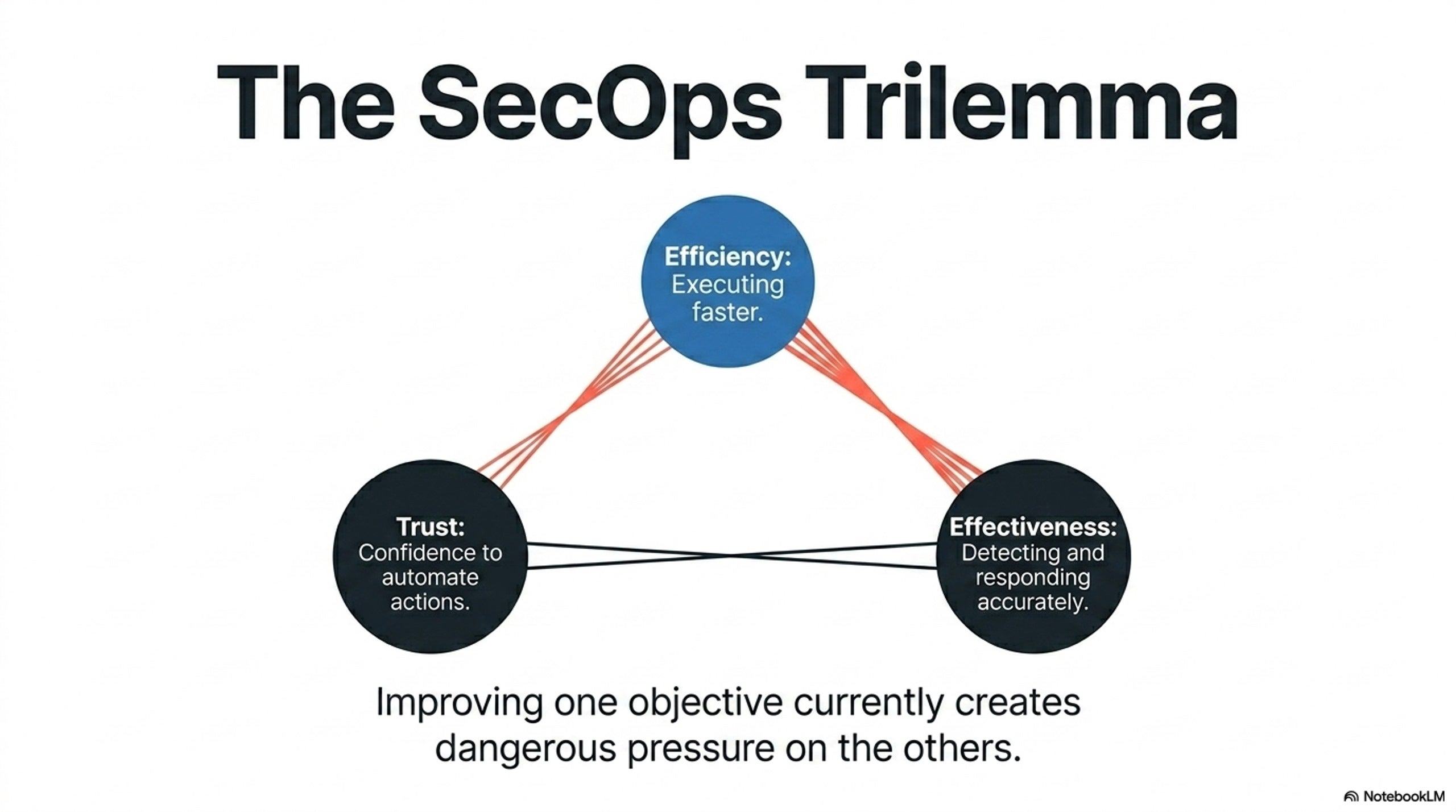
In AI-assisted SecOps, pushing for efficiency often means relying more heavily on automated prioritization, alert suppression, summarization, or response recommendations. That can reduce manual workload, but if the AI lacks full workflow context or the output is not validated, the team may overlook weak signals, fail to notice gaps in the evidence, or act too early.
Pushing for effectiveness often means adding more context, deeper correlation, stronger validation, and more complete investigation. That improves detection and response quality, but if analysts still have to gather context and connect evidence manually, the workflow becomes slower and harder to scale.
Pushing for trust means adding explainability, policy controls, approval steps, audit trails, and human review before AI-assisted or automated actions affect the business. That improves confidence and accountability, but it can also delay containment and reduce the value of automation.
All three objectives are necessary for modern security operations. The problem is that the current AI-assisted operating model still makes it difficult to improve all three together.
Why This Matters Now
The SecOps Trilemma matters because attackers are moving faster, while many security operations workflows still depend on human-led validation and coordination.
Generative AI and automation are helping attackers accelerate more stages of the attack lifecycle. Verizon’s 2026 Data Breach Investigations Report highlights that different attack techniques are being bolstered by generative AI, helping threat actors work faster across activities such as identifying security gaps and writing malware.
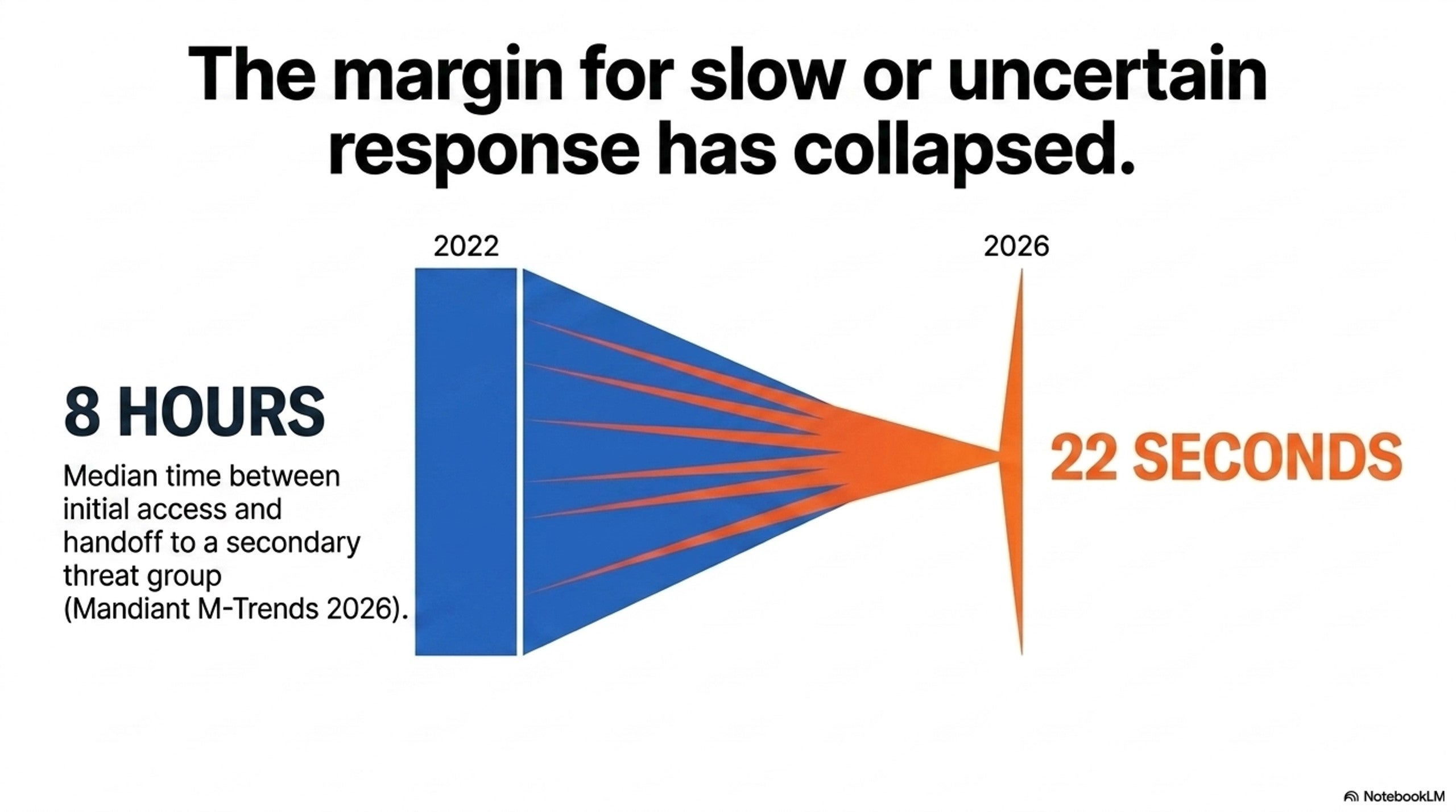
Mandiant’s M-Trends 2026 shows how compressed response windows have become. In 2022, the median time between initial access and handoff to a secondary threat group was more than eight hours. In 2025, that window collapsed to a median of just 22 seconds.
CrowdStrike’s 2026 Global Threat Report reinforces the speed challenge, reporting that average eCrime breakout time fell to 29 minutes, with the fastest observed breakout taking just 27 seconds. CrowdStrike also reported an 89% year-over-year increase in AI-enabled adversary operations.
In this environment, the implication is clear: the margin for slow or uncertain response is shrinking.
The Real Gap is the Execution Model
The SecOps Trilemma persists because AI-assisted SecOps makes parts of the workflow faster without fully changing how security work is carried forward. As long as analysts remain the continuity layer, teams can still struggle to improve efficiency, effectiveness, and trust together.
Solving this requires more than adding another AI feature, automation rule, or integration. It requires a different way of executing security work: one that can preserve context, coordinate steps, validate progress, and support trusted action under human supervision.
This is why the industry conversation is beginning to move toward Agentic SecOps: an advanced stage of SecOps maturity focused on changing how security work is executed.
In Part 3 of the Advancing SecOps Maturity series, we will explore how Agentic SecOps moves security operations from isolated AI-supported tasks toward more continuous, context-aware, and trusted workflow execution.