
Summarize this blog article with AI:
 Ask ChatGPT
  Ask Grok
  Ask Perplexity
  Ask Claude
  Ask Google AI
 Why Better SecOps Starts with Knowing Where You Are Today
As organizations grow, adopt new digital technologies, and face more complex threats, security operations has to evolve. But the right next step is not the same for everyone.
Some organizations have security tools, but no consistent operating model around them. Others have started actively reviewing alerts and responding to incidents but still rely on fragmented tools and manual handoffs. Some have centralized logs and alerts in a SIEM but now face the alert volume and noise that come with greater visibility. More mature teams may already use AI to support detection, triage, and investigation, but still depend on analysts to carry the workflow from signal to decision.
That is why the security operations maturity model matters.
It helps organizations understand where they are today, what they have already solved, what is holding them back now, and what may become the next constraint as they mature. Without that context, it is easy to plan and invest in the wrong improvement: more tools when the real issue is operating them more effectively; more analysts when the real issue is fragmented visibility that needs consolidation; or more AI when the foundations for trusted execution are not yet in place.
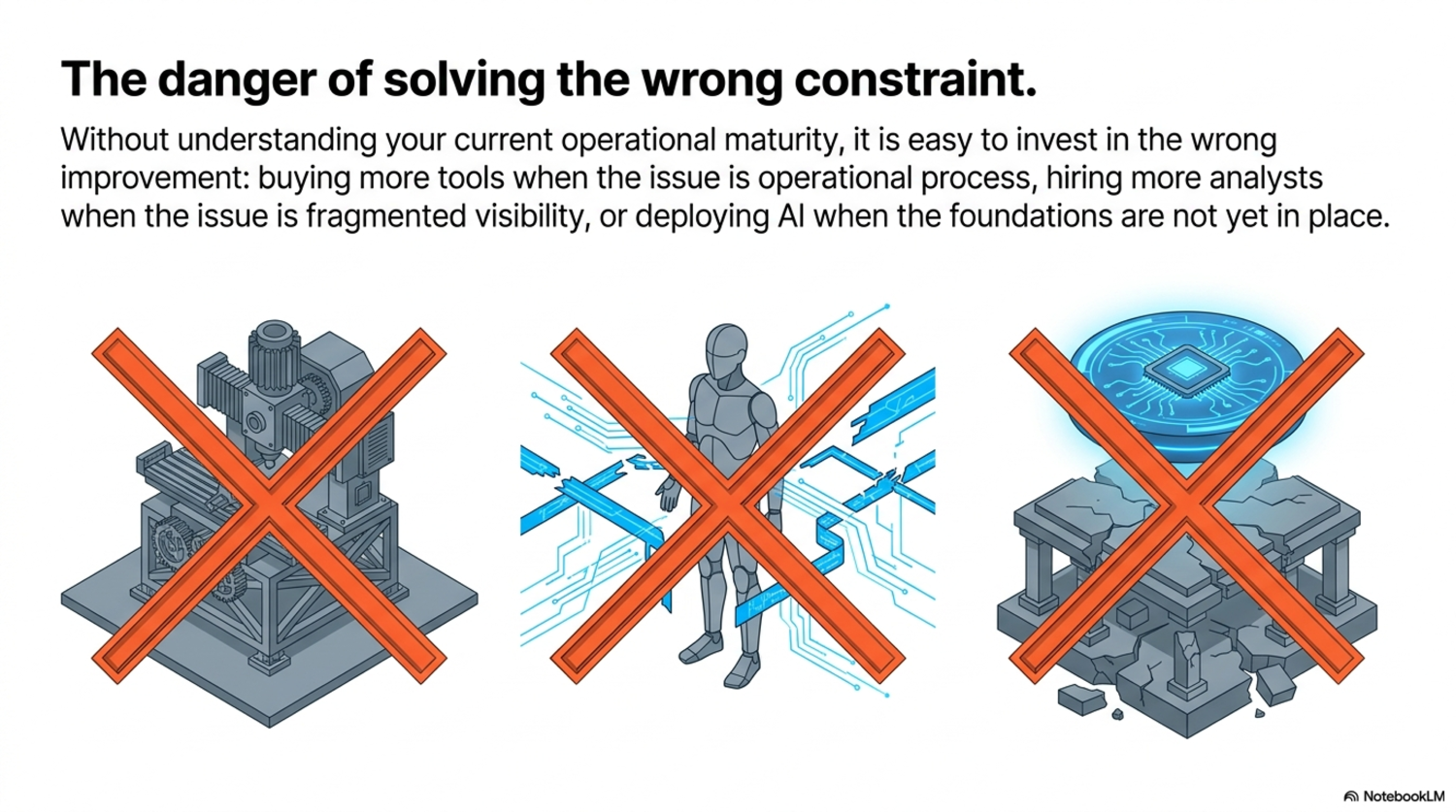
The stages below show how security operations tends to mature: what each stage improves, where it starts to break, and why the next stage becomes necessary.
In practice, organizations do not always move to the next stage as soon as these limitations appear. Many continue operating with known gaps until a business trigger makes change unavoidable: a serious incident, an audit or compliance requirement, customer pressure, cloud or business expansion, or a workload that the current team can no longer sustain. The maturity model is therefore not a fixed sequence every organization follows on schedule. It is a way to understand which pressures are building, what may trigger the next investment, and what kind of improvement is likely to matter most.
Stage 0: Tool-Based Security
Many small or early-maturity organizations begin with a basic set of security controls, such as endpoint protection, firewalls, email security, basic logging, and backups. This stage is common in small businesses, branch offices, or early-stage organizations where security is typically handled by IT generalists rather than dedicated security staff. As a result, security is not yet operated as a continuous function and is usually managed alongside other IT responsibilities.
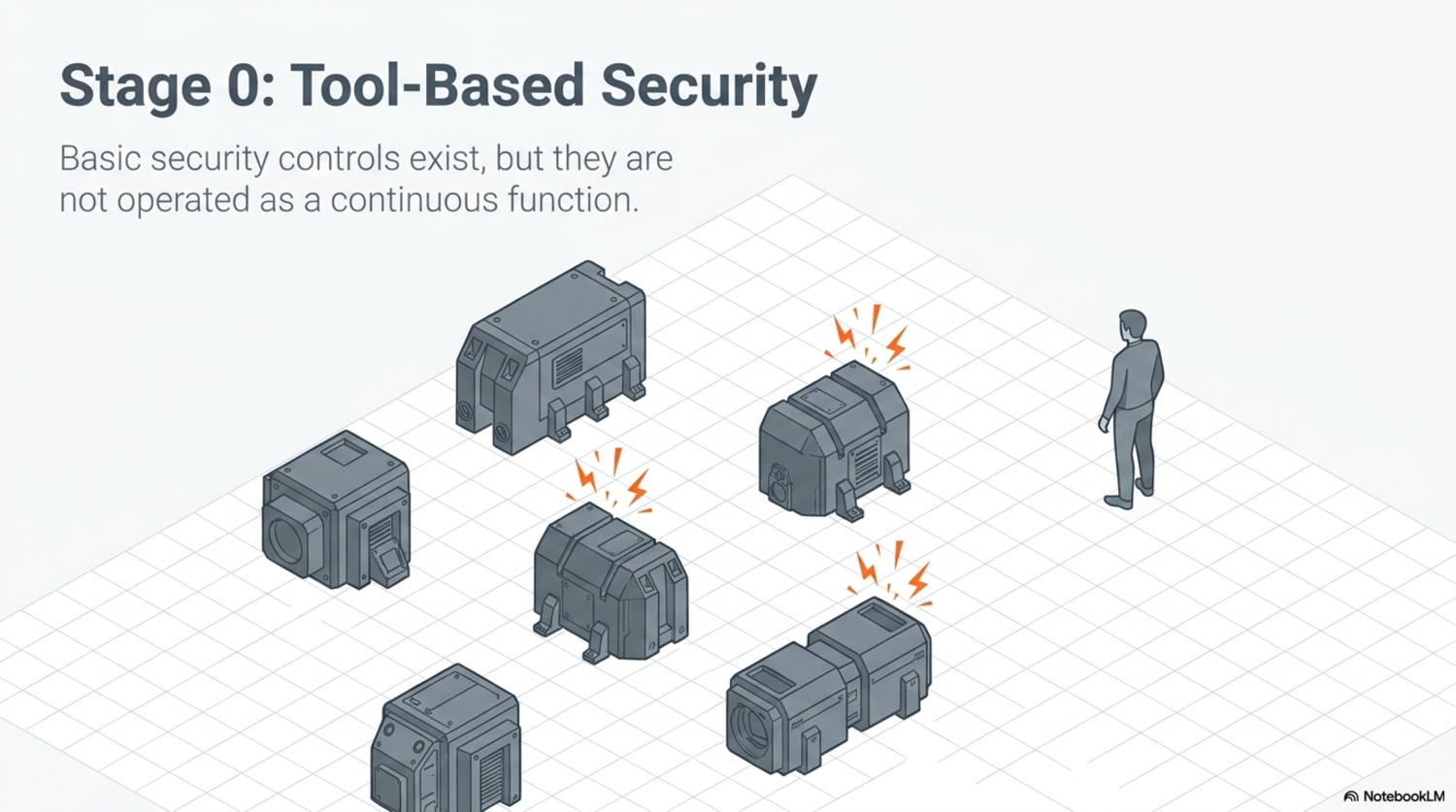
Alerts may be reviewed only when someone has time. Suspicious activity may be blocked but not investigated further. Tools may stay close to their default configuration, with little tuning or follow-up after alerts.
This is what separates having security tools from running security operations (SecOps), which requires people and processes to manage detection, investigation, response, and improvement continuously.
For smaller organizations with limited assets, simple environments, and low alert volume, this model may be enough for a time. But that changes as the organization grows. More users, data, applications, cloud services, and connected systems create more exposure. The business may also become a more attractive target for attackers and face greater accountability from customers, partners, and regulators. At that point, reactive security becomes harder to sustain: alerts can go unreviewed, threats can slip past controls, and the same issues can recur because no one is consistently investigating root causes or improving the process.
When this reactive model starts creating unacceptable risk, the next improvement is usually to move beyond tool ownership and build a security operations practice around those controls.
Stage 1: Siloed SecOps
The first step beyond tool-based security is usually not a fully designed SecOps model. This stage often appears in growing mid-sized organizations, regional enterprises, or distributed environments where different teams, sites, or business units have adopted their own security tools, but the SecOps function is still small.
More often, organizations begin operating around the tools they already have. But those tools were often deployed around different security domains, and early SecOps inherits that fragmentation. Each tool may have its own console, alert logic, evidence, and owner.
It is still a meaningful step forward. Compared with tool-based security, security work is now more proactive and intentional. Alerts are reviewed more consistently, suspicious activity is investigated more often, and response is less ad hoc.
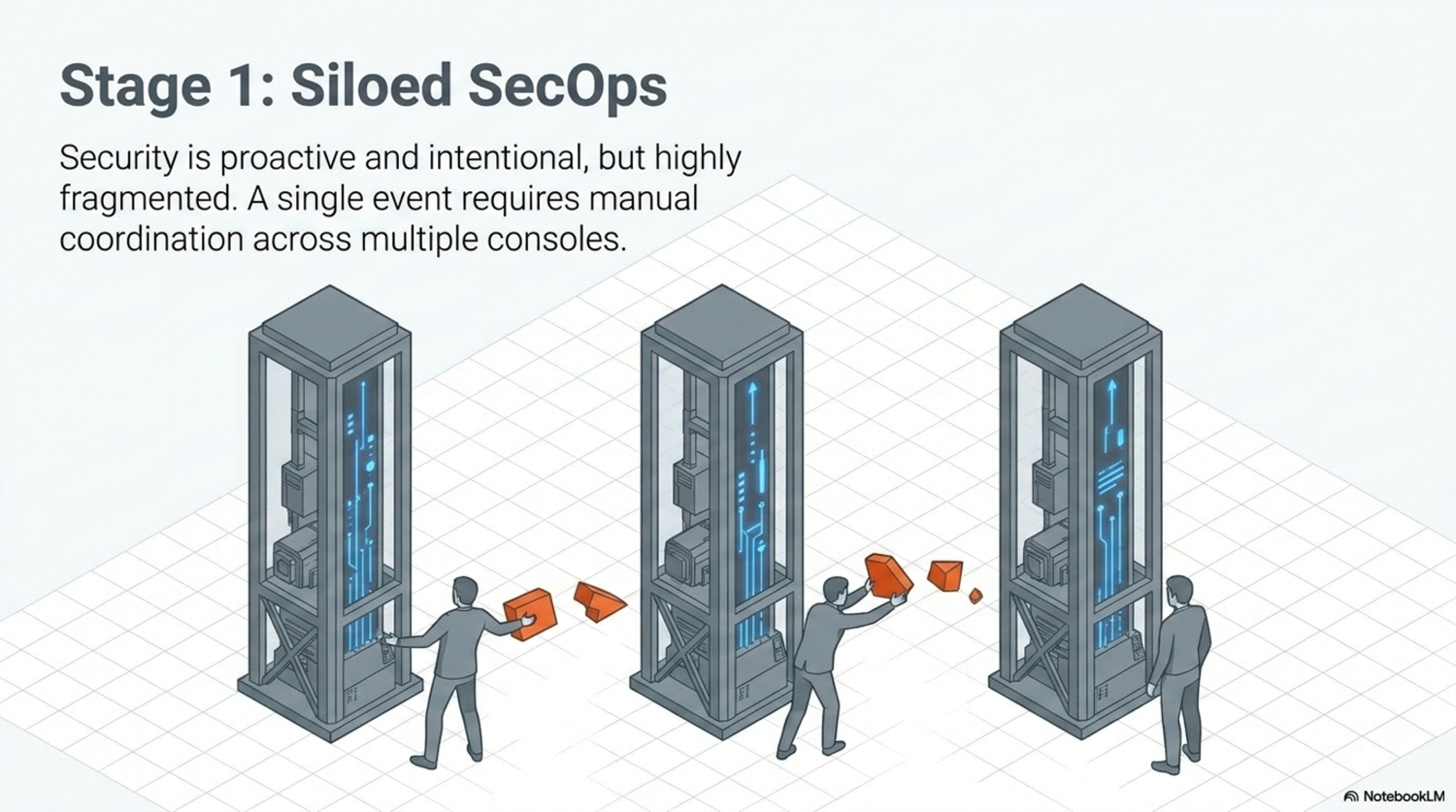
However, this fragmentation becomes harder to manage as the organization expands. A single event may require context from several places before the team can understand whether it matters. A suspicious login, for example, may need identity context, endpoint activity, email history, network traffic, and business impact. In a siloed model, people have to gather and connect that context manually.
This is where the people and process limits of siloed SecOps become clear. The organization may have started assigning dedicated security responsibility, but the function is still small and depends heavily on a few people. Experienced analysts may know where to look and which signals matter, but that knowledge is hard to scale and expensive to hire for. Less experienced team members may struggle to know what context is missing, how to interpret weak signals, or when to escalate. Investigations are slow and outcomes depend too heavily on individual experience.
For some organizations, this is also where security operations starts to feel hard to sustain. The team has moved beyond simply owning tools, but the work still depends too much on manual coordination and scarce expertise.
When fragmentation begins to slow response, increase dependence on a few people, or create visibility gaps the business can no longer accept, organizations often look for a more centralized way to bring security signals, context, and workflows together.
Stage 2: Centralized, SIEM-Centric SecOps
To scale beyond siloed SecOps, organizations move toward a centralized platform, typically a SIEM (Security Information and Event Management), that brings logs, alerts, and events from multiple tools into a shared environment. This stage is common in larger organizations, regulated industries, or multi-site environments that need centralized visibility, compliance reporting, and more consistent incident handling across many systems, users, and locations.
This centralization addresses the key limitations of Stage 1. Visibility becomes less fragmented. Analysts spend less time moving between consoles and manually connecting evidence across separate tools. Workflows such as alert triage, escalation, reporting, and compliance documentation become more consistent because cases and processes can be managed through a shared operating layer. Detection accuracy also improves: correlated signals that might be weak on their own become meaningful when evaluated together.
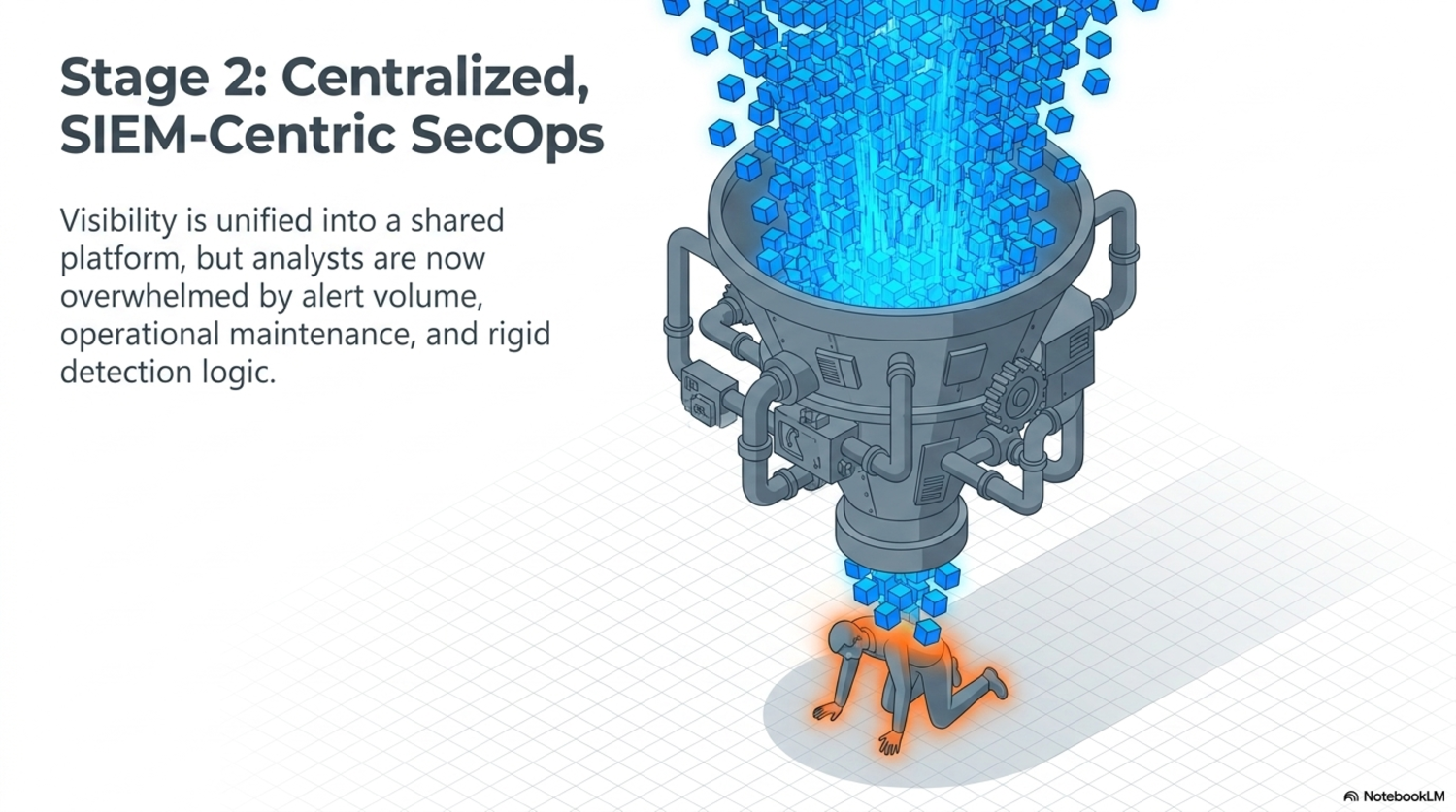
However, centralization introduces operational overhead. As tools, systems, and business environments change, the SIEM must be continuously updated to stay effective. Data sources need to be onboarded or adjusted, integrations maintained, parsers and normalization updated, and storage or retention requirements managed.
Beyond platform maintenance, the deeper challenge is detection logic. SIEM rules, signatures, and correlation logic work well for known threats, well-defined attack patterns, and previously observed behaviors. But emerging threats, subtle anomalies, and behavioral changes that fall outside predefined rules can still go undetected.
These operational and detection limitations directly affect event and incident handling. When SIEM data is incomplete, inconsistent, or poorly normalized, analysts spend more time validating what they are seeing and filling in missing context. When detection logic depends too heavily on predefined rules, unusual or weak signals can be harder to prioritize or interpret. While analysts no longer spend as much time jumping between tools, they still have to decide what is meaningful, what is missing, and what should happen next.
Taken together, these limits do not make SIEM irrelevant. They clarify what SIEM-centric SecOps is best suited for. It remains valuable for log management, event correlation, compliance reporting, and investigation support. But when the priority is faster threat detection and response against unknown, adaptive, or behaviorally subtle threats, organizations need capabilities that can help prioritize alerts, identify abnormal behavior, connect related signals, and reduce the manual burden of triage and investigation.
When alert volume, rule maintenance, and detection-quality challenges start to outpace the team’s capacity, many organizations begin looking toward AI-assisted SecOps.
Stage 3: AI-Assisted SecOps
At this stage, AI is introduced to help teams make better use of the visibility and data they have already centralized. This stage is common in larger organizations and enterprises that have already established centralized visibility and repeatable security workflows, but need help reducing alert noise, accelerating triage, improving investigation consistency, and scaling security operations more effectively.
These capabilities may be delivered through XDR, next-generation SIEM, or AI SOC tools. They can also be accessed via AI-powered MDR services, which provide managed detection and response.
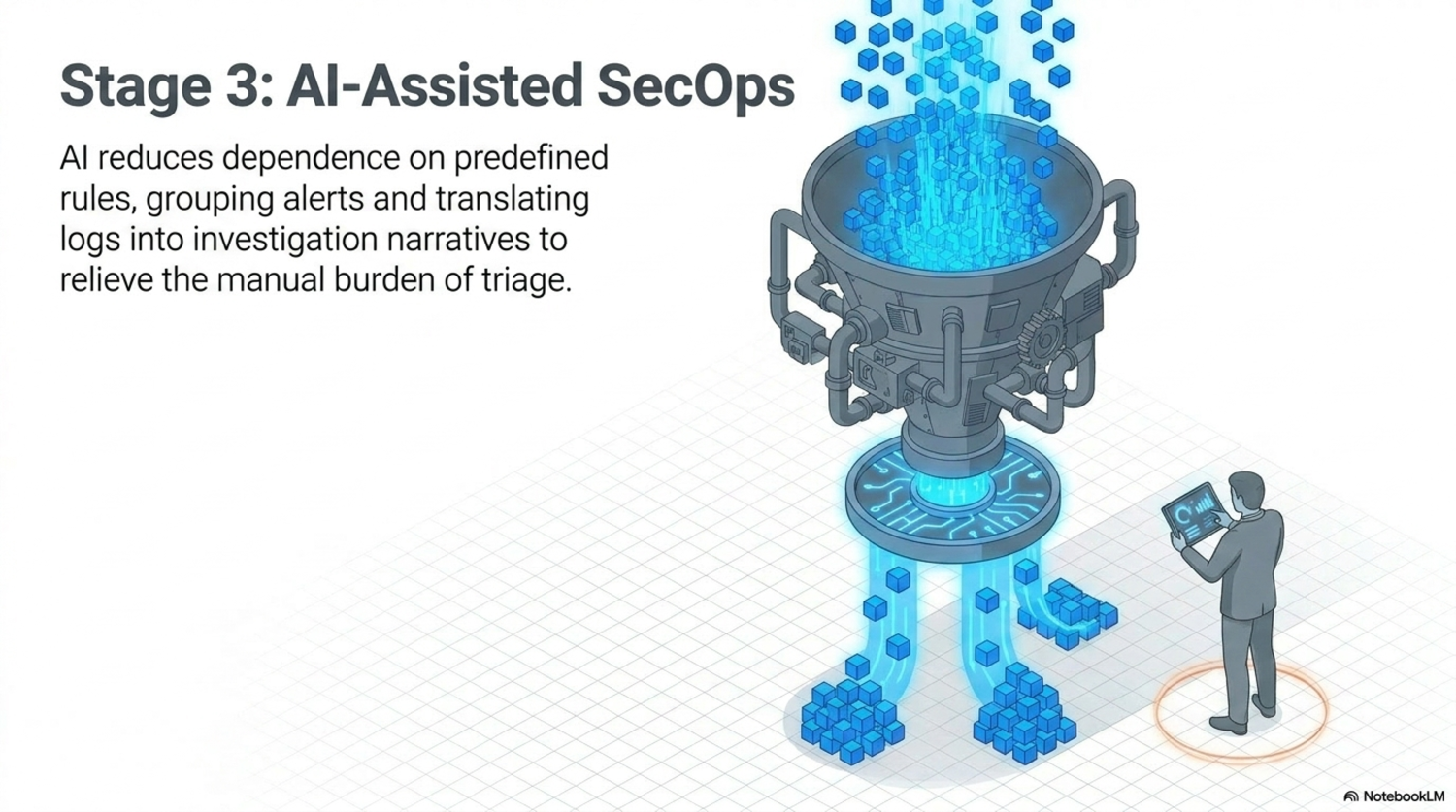
For threat detection, AI reduces dependence on detection logic that has to be fully defined in advance. It can learn normal patterns of behavior across users, assets, applications, and networks, then identify activity that looks unusual for that environment. It can also use context such as asset criticality, user behavior, time, frequency, and related activity to evaluate weak signals more accurately. This helps detect threats that traditional rules may miss, reduce false positives from benign anomalies, and lower the effort required to create and maintain detection rules for every possible scenario.
AI also improves alert triage before an analyst begins the investigation. In SIEM-centric SecOps, suspicious activity may already be surfaced as an alert, and analysts have to decide whether it is meaningful, isolated, or part of a broader incident. AI-assisted triage reduces that burden by enriching the alert with relevant context, assessing likely risk, and grouping it with related activity before it reaches the analyst. This helps reduce noise by lowering the priority of benign or low-value alerts, while escalating alerts that are more likely to require investigation.
During investigation, generative AI (GenAI) adds another layer of support. Instead of forcing the analyst to translate logs, alerts, and tool outputs into an investigation narrative from scratch, GenAI can explain the sequence of events, summarize the available evidence, and provide response recommendations. This is especially useful when the investigation involves multiple systems, ambiguous signals, or a large amount of supporting evidence.
These improvements can deliver measurable operational benefits. IBM’s Cost of a Data Breach Report 2025 found that organizations using AI and automation extensively in security operations saved an average USD 1.9 million in breach costs and reduced the breach lifecycle by an average of 80 days.
For many organizations, AI-assisted SecOps represents the most advanced practical stage of security operations for threat detection and response today. It improves effectiveness by helping detect suspicious activity more accurately and improves efficiency by reducing the manual work required to review alerts, gather context, connect evidence, and execute responses.
Why Teams Still Struggle with AI-Assisted SecOps
But even for organizations at this level of maturity, security operations can still feel incomplete.
Teams may have centralized security data, improved detection coverage, adopted AI-assisted triage, and added GenAI support for investigation and reporting. Yet analysts remain overloaded, alert fatigue persists, coverage gaps remain, and investigations can still move too slowly. Most importantly, despite major investments in security platforms, AI, and skilled teams, large organizations continue to suffer successful breaches.
That leaves an important question: if mature teams have already invested in centralized visibility and AI-assisted SecOps, why do they still struggle to move faster, detect more accurately, and act with confidence?
Part 2 of the Advancing SecOps Maturity series examines that question directly: why AI-assisted SecOps still struggles to balance efficiency, effectiveness, and trust, and why the real gap is not visibility or AI adoption alone, but how security work is executed.