
Summarize this blog article with AI:
 Ask ChatGPT
 Ask Grok
 Ask Perplexity
 Ask Claude
 Ask Google AI;
You’re looking for an app before a customer meeting. The search result has the right name and a familiar logo. The download page looks professional. Would you know whether it was the official site?
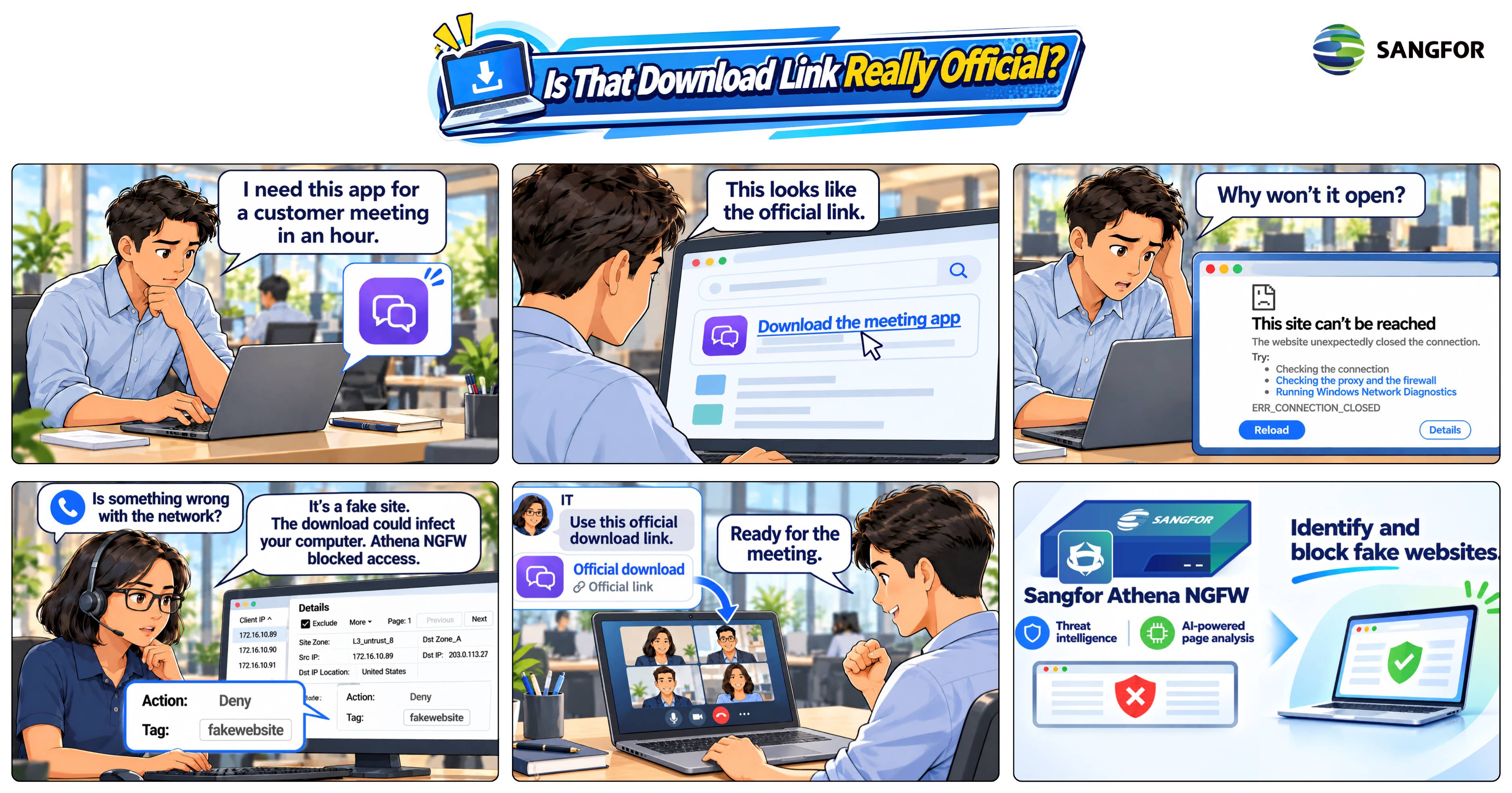
Phishing can take many forms, including fake websites designed to trick someone into sharing sensitive information or taking an action that helps an attacker. These sites may imitate a work sign-in page, a software download page, or a payment portal, and people can reach them through search results, ads, emails, or chat messages
Why a Convincing Fake Website Can Become a Business Incident
A fake login page can give an attacker access to a work account. Depending on the account’s permissions, an attacker may be able to read emails, open shared files, or use the employee’s mailbox to send convincing requests to colleagues and customers. A stolen password can be the first step in a much larger incident because a single work account may provide access to multiple services.
A fake download page can turn a routine task into a security incident. Someone who runs a malicious installer may give an attacker access to the device or expose business information stored on it, potentially compromising data or other resources accessible from that device.
What AI Changes
Generative AI reduces the work needed to build and revise a convincing lookalike page. In 2025, Okta observed attackers using an AI website builder to create replicas of legitimate sign-in pages for multiple brands.
For businesses, the practical concern is that convincing copies can appear quickly and at new web addresses. For employees, the familiar layouts, logos, and other visual cues they rely on can increasingly be reproduced, making appearance alone a weaker signal of whether a site can be trusted.
Why Reputation-Based Web Protection Can Leave a Detection Gap
Many web protection controls use threat intelligence, blocklists, and reputation data to block known malicious domains, URLs, and IP addresses. CISA recommends these mechanisms, including website reputation scoring for new, potentially malicious sites.
The limitation is timing. A newly created or newly activated fake site may have little history when it is first encountered. Unit 42 notes that traditional URL filtering may initially label newly registered domains as benign or unknown before malicious content appears, while reactive blocklisting can identify some malicious domains too late to stop attacks.
As generative AI makes convincing fake pages faster to create and revise, relying only on historical reputation or previously observed indicators becomes less sufficient. This creates a need for controls that can look beyond whether a domain or URL has already been classified and assess what the page itself is presenting and asking the user to do.
Where Sangfor Athena NGFW Improves Protection
Sangfor Athena NGFW combines its Threat Intelligence Gateway with AI-powered page analysis to strengthen protection against fake websites and phishing.
The Threat Intelligence Gateway uses a dedicated AI agent for website risk assessment. It examines HTML structure, page content, and the actions users are asked to take, looking for signs of impersonation or phishing. This extends detection beyond URL and IP reputation, helping identify threats on newly encountered websites.
By identifying and blocking risky access at the network level, Athena NGFW helps reduce exposure to password theft and malware infection. IT teams gain a centrally enforced layer of protection that can intervene even when a convincing page earns an employee’s trust.
Ask yourself: If an employee clicks a link to a newly created fake website today, what protection can intervene before they enter their password or download a file?
If the answer depends mainly on the employee realizing something is wrong, there may be an opportunity to strengthen that layer of defense.
Explore how Sangfor Athena NGFW helps identify and block fake websites before they become security incidents.