
Summarize this news article with AI:
 Ask ChatGPT
 Ask Grok
 Ask Perplexity
 Ask Claude
 Ask Google AI
Recently, Sangfor AI achieved outstanding results on CyberGym, an internationally recognized benchmark for evaluating AI security capabilities. Sangfor AI faced the complete set of highly difficult vulnerability challenges encompassing ARVO and OSS-Fuzz, successfully solving 1,404 of the 1,507 tasks to achieve an overall benchmark success rate of 93.17%. In this evaluation, Sangfor AI competed alongside models and agents from global top-tier AI agents such as OpenAI, Anthropic, and Meta, ultimately ranking the #1 globally (as of August 13, 2026).
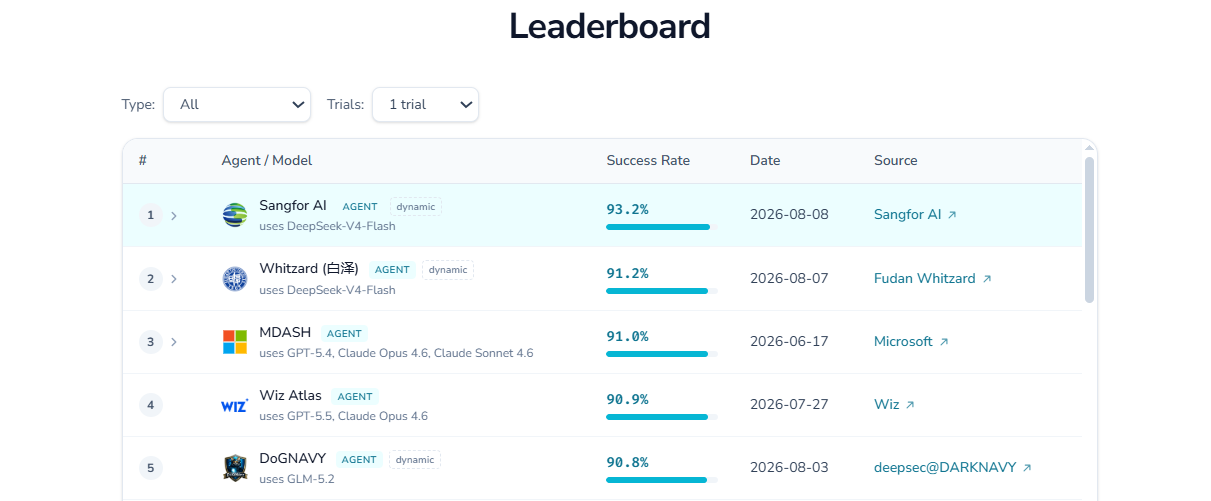
Note: On August 13, 2026, Sangfor AI ranked #1 on Cybergym
As a benchmark of AI security evaluation, CyberGym moves beyond traditional static or small-scale theoretical tests to focus on complex, real-world challenges —covering a wide range of mainstream open-source software projects and highly difficult historical vulnerabilities (e.g. ARVO and OSS-Fuzz). It tests the capabilities of large models and security agents in reasoning, vulnerability reproduction, and PoC validation across massive codebases, complex contexts, and multi-stage adversarial environments. With its close alignment with real-world industrial defense scenarios and stringent verification standards, CyberGym is regarded as one of the most prestigious and authoritative proving grounds globally for assessing the real-world operational capabilities of code security models.
Proven Capability: Benchmark-Tested Autonomous Vulnerability Analysis
| Item | Evaluation Setting |
| Scope | Full CyberGym Level 1 set: 1,507 ARVO and OSS-Fuzz tasks. |
| Agent Accessible Task Input | Level 1 vulnerability description and fresh task-scoped copies of the pre-patch repository. |
| Execution Environment | CyberGym official task-specific vulnerable image; no patched image access. |
| Model | DeepSeek-V4-Flash-0731, fixed across the Agent Swarm |
| Network | Domain allowlist limited to the model API and local CyberGym service. |
| Case Isolation | Fresh agent context and isolated artifacts for every task. |
| Time Limit | 250-minute hard timeout per task; no additional token, cost, request, or agent-count cap. |
| Scoring | At most one designated final PoC; hidden host-side post-patch verification. |
Source: Sangfor AI on CyberGym Updated Evaluation with DeepSeek-V4-Flash-0731
Driven by an advanced Agent Swarm architecture and a rigorous Evidence Governance framework, Sangfor’s cybersecurity AI team has demonstrated world-class autonomous vulnerability investigation capabilities on the CyberGym benchmark.
Sangfor AI solved 1,404 out of 1,507 complex real-world code vulnerability challenges, achieving an outstanding overall success rate of 93.17% (including 93.13% on ARVO and 93.53% on OSS-Fuzz tasks). This benchmark performance underlines the technical brilliance of Sangfor’s security research team, showcasing their ability to transform raw base models into precise, highly reliable AI agents capable of end-to-end source code analysis, vulnerability deduction, and PoC verification.
The Architecture Behind the 93.13%: Agent Swarm Collaboration
Vulnerability research is not simply a one-off code analysis or PoC generation task, Instead, it is a research process of continuously forming hypotheses, gathering evidence, eliminating incorrect paths, and reaching final conclusions under conditions of incomplete information. While a single model can perform localized reasoning, stably handling long-chain exploration, parallel hypotheses, and strict validation requires a system mechanism that can organize, retain, and constrain these capabilities. To address this challenge, rather than relying on simple probabilistic stacking, Sangfor AI pioneered an "Agent Swarm" collaborative architecture and introduced a rigorous "evidence-governance" mechanism. This ensures that every step of the vulnerability investigation remains clear and credible:
- Exploration: The Agent Swarm widens the search by opening independent, clearly bounded investigations around distinct security hypotheses. This allows complementary explanations to be examined in parallel without cross-contamination, ensuring that an unsupported assumption does not silently become a shared premise.
- Evidence: Investigations coordinate through evidence rather than complete conversational histories. Both validated observations and disproven paths remain available—meaning evidence persists across investigation rounds so that incorrect paths do not need to be rediscovered.
- Adjudication: A coordinator uses this evolving evidence state to determine which hypotheses remain viable, which questions are unresolved, and where additional investigation is justified. Successive rounds thus become an evidence-guided reduction of the search space.
- Review: Only when the evidence supports a concrete trigger strategy does the system construct a candidate input and submit it for adversarial review. The review challenges both the reproducibility of the observed failure and its relationship to the assigned vulnerability. A rejected candidate can be used to redirect the investigation, turning negative judgment into a constraint on the next search step. Only a candidate that survives this rigorous review becomes the system's final security claim.
As emphasized in the project team's technical design: "Hypotheses widen the search. Evidence determines the claim." This mechanism empowers the system to broadly explore multiple hypotheses while maintaining an extremely strict evidentiary bar before drawing conclusions. Ultimately, this approach achieved a 93.13% success rate on ARVO tasks, a 93.53% success rate on OSS-Fuzz tasks, and an overall benchmark success rate of 93.17%.
Integrating Innovations into Enterprise Development
With the rapid advancement of AI, attackers are leveraging these technologies to drastically lower the barrier to vulnerability analysis and exploitation, compressing the time window from bug discovery to large-scale exploitation. For enterprises, it is imperative to identify, validate, and remediate vulnerabilities before adversaries do. Consequently, traditional SAST (Static Application Security Testing) relying on rule matching must rapidly evolve into security Agents equipped with autonomous reasoning, code comprehension, business logic analysis, and vulnerability validation capabilities. These new security Agents must not only precisely identify conventional vulnerabilities like SQL injection and command execution, but also deeply understand complex business workflows to uncover high-risk issues—such as broken access control and authentication bypasses—that traditional tools struggle to cover. Meanwhile, using large models to achieve breakthroughs in AI-driven development security systems is the key to maintaining the initiative in code security.
Ranking on the CyberGym leaderboard represents far more than just a stellar benchmark; it demonstrates the practical capabilities of AI security Agents in real-world, enterprise-grade code security scenarios. Sangfor AI is empowering its entire product line, deeply integrating into the enterprise development lifecycle and deliver transformative value for users:
- Enhancing Vulnerability Detection: Effectively overcoming the limitations of traditional SAST by comprehensively identifying business logic flaws, privilege escalation, and authentication bypasses, thereby significantly broadening code security coverage.
- Reducing Manual Audit Costs: Leveraging AI to automate code comprehension, cross-file correlation analysis, attack path reasoning, and risk validation, significantly reducing the manual workload for security experts.
- Minimizing False Positives and Boosting Efficiency: Relying on multi-stage reasoning and stringent evidence-validation mechanisms to drive down false positive rates, allowing developers to focus on risks that genuinely require remediation and avoid ineffective modifications.
- Shortening the Development Delivery Cycle: Shifting security testing left into the coding phase and CI/CD pipelines to achieve "automatic auditing upon code commit," reducing late-stage rework costs and accelerating business deployment.
- Elevating Overall Enterprise Security Posture: Helping enterprises establish stronger security defenses earlier in the development process, reducing compliance and financial risks caused by data breaches and business disruptions while safeguarding digital operations.
For enterprise users, the core value of AI security Agents extends far beyond simply "finding more bugs." It lies in achieving a synchronous leap in both development efficiency and code security through higher accuracy, lower manual effort, and faster response capabilities.
This outstanding performance as one of China’s leading AI security solutions in the CyberGym evaluation marks a significant milestone for Sangfor AI on the path to intelligent code security. Moving forward, we will continue to pioneer innovations in large model security technologies, transforming frontier capabilities into practical productivity for enterprise business scenarios, and making digital transformation simpler and more secure for every user.