Summarize this news article with AI:
 Ask ChatGPT
 Ask Grok
 Ask Perplexity
 Ask Claude
 Ask Google AI
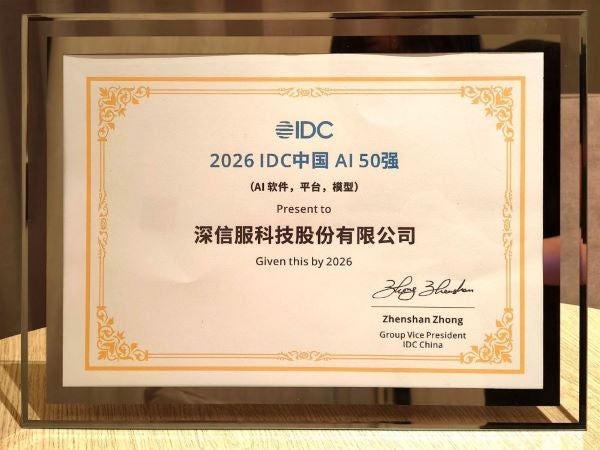
On July 30, IDC, one of the industry's most authoritative research firms, released its annual "China AI 50" list, and Sangfor made the cut. The company was recognized for sustained innovation and large-scale deployment of private AI infrastructure.
The China AI 50 is IDC's yearly benchmark for China's AI technology vendors. Vendors are evaluated on both technical depth and real-world commercial traction, including R&D investment, patent quality, revenue growth, and staying power, and the list spans both established industry leaders and emerging challengers.
Moving Enterprise AI From Pilot to Production
Over the past two years, most enterprises have completed their initial validation of large language models. But as AI moves from pilot projects to production at scale, the real bottleneck usually isn't the model itself. It's the infrastructure and security underneath it. Compute utilization stays low, multiple systems are hard to orchestrate together, AI applications are easy to launch but hard to manage, and the attack surface keeps expanding.
Sangfor's work is built solve this exact problem. Focused on private AI infrastructure, the company covers the full lifecycle of enterprise AI, from building and running AI workloads to optimizing and protecting them, and delivers what it calls a genuinely production-grade AI foundation. That foundation rests on four pillars.
#1 Faster, simpler AI application development. Whether an AI agent can run reliably at production scale usually comes down to consistency. Reliable agents typically require constant tuning by domain experts, which keeps deployment costs high. Sangfor's commercial version of FastGPT uses a low-code platform that build RAG pipelines, workflows, and other agents quickly. In complex scenarios, it pushes accuracy above 95% without requiring in-house AI expertise. For more demanding enterprise development, Sangfor CoStrict, the company's AI coding platform, focuses on code compliance, reliability, and security. It uses private deployment and full visibility into existing codebases to improve both the speed and quality of end-to-end development.
#2 High-performance AI infrastructure, without starting from scratch. Most enterprises don't want to stand up an entirely new system just to run AI. Sangfor Hyperconverged Infrastructure lets companies run both traditional and AI workloads within their existing IT architecture and business units, smoothly and without disruption, while staying open, interoperable, and production-ready out of the box. Its unified storage platform for training and inference increases throughput by two to five times, addresses idle-GPU waste, and meaningfully improves both compute efficiency and ROI.
#3 A smarter way to govern compute. Managing AI agents at scale brings a familiar set of headaches, including unclear compute usage, uncontrolled token waste, and AI spending that's hard to rein in. Sangfor's AI Compute Gateway acts as a central dispatch system for compute across multiple models and infrastructure. It cuts token consumption by 50% and improves ROI by two to five times, giving enterprises full visibility and control over how their compute is actually being used.
#4 AI-powered security, built for a new kind of threat. Cybersecurity has entered a fully AI-driven phase of attack and defense, with threats that are now automated, industrialized, and deployed at scale. Under these conditions, rule-based, manually maintained defenses no longer hold up. In 2023, Sangfor launched Security GPT, one of the first large language models purpose-built for cybersecurity in China, trained on an extensive proprietary security corpus. It has since shift enterprise security from passive defense to active, AI-driven response. The model now automatically resolves more than 99% of alert noise, with an 80% automated remediation rate. Its traffic-detection model identified more than 280 zero-day vulnerabilities in 2025 alone, and its phishing-detection rate reaches 99.72%. Security GPT is now deployed across more than 1,000 enterprises, making it one of the most widely adopted models of its kind in the industry.
Redefining "Security AI"
Sangfor argues that securing AI agents can't stop at guardrails and compliance checks. It requires a closed-loop protection system across the entire AI lifecycle. That means managing agent identity and access, monitoring agent behavior in real time, running in-depth evaluations before deployment, and continuously auditing systems while they're live. The result is asset level visibility and risk management for enterprise AI, so companies can innovate with confidence, knowing their AI systems are visible and controllable.
Sangfor sticks to AI infrastructure products and solutions, and partners with AI service providers in its ecosystem to give customers standardized application templates and the underlying technical support they need. This separates infrastructure supply from front-line business innovation.
Built on a Track Record
Sangfor has picked up a string of recognitions in AI over the past year. Its AI security agent currently ranks first globally on CyberGym, an international benchmark for AI security capability (as of August 26, 2026). In a national assessment of AI-enabled cybersecurity conducted in 2025, Sangfor's Security GPT took first place in three separate categories. Sangfor's AI Innovation Platform and Sangfor CoStrict were both named among China's flagship AI application cases for 2025, and its technology is now deployed in real-world settings across energy, transportation, power, finance, and healthcare.
Being named to the IDC China AI 50 adds to that track record. It underscores Sangfor's role in moving AI in China from proof-of-concept to production. Working alongside its ecosystem partners, the company plans to keep supporting Chinese enterprises as they innovate efficiently, securely, and at scale.