
Summarize this blog article with AI:
 Ask ChatGPT
 Ask Grok
 Ask Perplexity
 Ask Claude
 Ask Google AI
When you’re asked to think of a container, you might picture a massive, brightly colored shipping container that you’d find on a ship moving goods from one country to another. Now, in computing, the idea of a container is not so dissimilar. In a transformative way, the idea of containers revolutionized software systems, much as shipping containers revolutionized global trade.
Without standardized shipping containers, every port would need different loading equipment, cargo transfers would take days instead of hours, and international trade would be dramatically slower and more expensive. The simple invention of the shipping container transformed logistics by creating a universal way to package, move, and manage goods worldwide. A similar revolution happened with modern computing.
In the past, applications were built as large, monolithic systems tied closely to the infrastructure beneath them. This meant that deploying software was often a lengthy process filled with dependency conflicts and unpredictable behavior between different environments. Naturally, this was not an efficient solution as digital transformation began to take off.
Today, applications are increasingly broken into smaller, more independent services that can be packaged, deployed, and scaled individually. This architectural shift has fueled the rise of containers, software systems like Kubernetes or Docker, and the broader movement known as Cloud Native Computing. Today, we’ll be exploring the history of containerization, the realities behind the Kubernetes vs Docker debate, the evolution of orchestration platforms, and how organizations can choose a practical framework for long-term cloud computing success.
Understanding Containerization in the Era of Modern Cloud Computing
While virtual machines improved hardware utilization, containers offer a much more scalable, secure, and optimized environment for applications to run. This is why modern enterprises shifted to containers as the next logical step. Virtual machines were an era-defining technology, yet they came with their own set of challenges as well.
Each VM contains a complete operating system, which requires dedicated storage, memory, security updates, and maintenance. So, as organizations expanded their digital services, suddenly needing hundreds or even thousands of VMs created unavoidable operational overheads and resource inefficiencies. Now, unlike virtual machines, containers share the host operating system kernel while maintaining their isolated application environments. This dramatically reduces resource consumption and startup times.
Think of the virtual machine setup as a traditional standalone, white picket fence home. It has its own plumbing, security system, and electricity, and occasionally needs maintenance to stay running. On the other hand, we have containers, which are more like apartments in a modern high-rise complex. In these apartments, residents enjoy their private living spaces while sharing core infrastructure, like elevators, utilities, and structural support.
This means that containers are much more efficient by sharing the host operating system's kernel, or the complex building infrastructure, while still maintaining isolated user spaces, or living areas. This efficiency became especially valuable for supporting microservices architectures, where applications are divided into smaller, independent services that can evolve separately.
By sharing common resources, containers can also be created and destroyed in seconds rather than minutes, making them easier to scale for high-traffic occasions. Organizations can further deploy more applications on the same hardware while reducing operational costs. Ultimately, containers offer superior deployment speed and resource density that modern companies need to bypass older operational bottlenecks. Now, let’s try to understand how Docker vs Kubernetes fits into this conversation.
Breaking Down the Core Rivalry of Kubernetes vs Docker
First, let’s address the elephant in the room. Kubernetes is not a replacement for Docker. This is simply a misconception that people come to by not understanding the dedicated roles of each technology. Kubernetes is open-source software that DevOps uses to deploy, manage, and scale containers across a cluster. Docker is another open-source technology that creates containers. So, technically, there is no Kubernetes vs Docker, but rather two complementary layers of infrastructure that work together to a final goal.
Think of a server that uses containers to optimize performance and efficiency. To do this, you would use Docker to build, distribute, and run the containers. When an application works on one computer but cannot work on another, it’s often due to a different OS and environment. Docker essentially creates a container with all the right elements for the app to run, then sends this to the new computer, giving you all the right ingredients to run the app successfully.
However, that’s where its job ends. By itself, Docker helps you build and run containers on a single host and cannot do much for complex applications consisting of multiple instances of multiple containers. For this, you would need a master orchestrator to call the shots. Enter Kubernetes.
You can think of Kubernetes, or K8s, as the grand manager that helps you run, control, and expand container workloads across multiple servers in a cluster. After grouping containers into Pods, the software automatically handles service discovery, load balancing, autoscaling, and self-healing. If a container fails, Kubernetes provides a new one; if a computer fails, it reroutes traffic to a working one.
Using our earlier logistics analogy, you can think of Docker as the company that manufactures shipping containers, while Kubernetes acts as the global logistics network coordinator, deciding where those containers travel, when they move, and how disruptions are handled. Docker and Kubernetes are not competitors, but rather solutions to problems at different levels, with Kubernetes being a tool for managing containers like Docker. Each serves a specific purpose and can be used in specific situations.
Kubernetes performs best in complex setups that need resilience, automated scheduling, and dynamic scaling. The self-healing infrastructure is best suited for organizations managing multiple microservices with complex communication and security needs or if it needs centralized management for complex or large-scale projects. Using Kubernetes for anything less than this would be overkill.
Docker is mostly used for developing microservices or containerized apps, when you need consistency between local development and production, and to have a lightweight environment for testing and deployment. If you’re new to working with containers, it would be better to start with just Docker, then once you have multiple containers that are becoming too complex, you can introduce Kubernetes to manage them efficiently.
For most enterprises, the real conversation is not about Docker vs Kubernetes but involves understanding how both technologies contribute to a broader Cloud Native Computing strategy. Now, let’s explore the structural differences of the two platforms.
The Structural Differences of Docker vs Kubernetes
At a simplified level, Docker focuses on container creation and execution, allowing developers to build standardized container images that package applications and dependencies together. These images can then run consistently across laptops, testing environments, and production systems. Think of Docker as someone who builds the perfect gift basket to run your app properly, including all the necessary code, runtime, system tools, system libraries, and settings. It can be deployed manually, using Docker Compose, or using an orchestrator like Kubernetes or Docker Swarm.
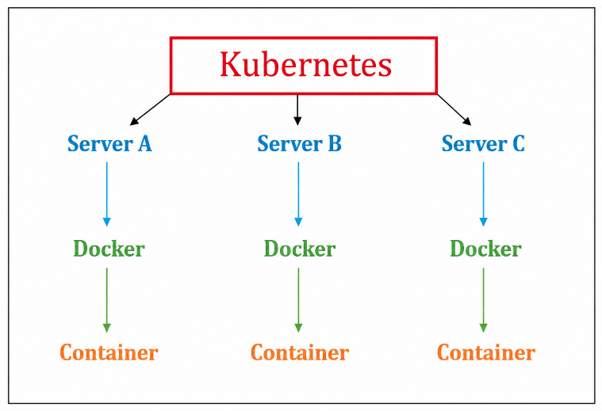
Kubernetes sits above this layer. Rather than only managing individual containers like Docker, Kubernetes coordinates clusters of machines. It manages where containers should run, monitors health, replaces failed instances, balances workloads, and scales resources automatically. To simplify it further, let’s compare the two software more directly:
| Feature | Docker | Kubernetes |
| Primary Purpose | Creates, packages, and runs containers | Orchestrates and manages containers at scale |
| Role in Infrastructure | Container runtime and development platform | Container orchestration platform |
| Target Users | Developers and DevOps teams | Platform engineers, DevOps, and operations teams |
| Deployment Scope | Single host or small environments | Multi-node clusters and enterprise environments |
| Scalability | Manual or limited native scaling | Automated horizontal and vertical scaling |
| Self-Healing | Limited | Automatically restarts and replaces failed workloads |
| Load Balancing | Basic capabilities | Advanced built-in load balancing and traffic routing |
| Learning Curve | Relatively easy | More complex and requires operational expertise |
| Best Use Cases | Development, testing, CI/CD workflows, small deployments | Large-scale production environments, microservices, cloud-native applications |
| Ecosystem Support | Extensive container tooling and image repositories | Vast ecosystem including monitoring, security, service mesh, and automation tools |
| Resource Management | Individual container management | Cluster-wide resource optimization |
The Kubernetes market share grew from US$ 2.57 billion in 2025 to an estimated US$ 3.13 billion in 2026 and is projected to reach US$ 8.41 billion by 2031. In fact, industry analysts increasingly view container runtime flexibility as a strategic advantage for all organizations. The CNCF Annual Cloud Native Survey found that, with around 82% of container users running Kubernetes in production, cloud native has gone beyond a defining threshold.
The research, which centers around the future of AI infrastructure, states that what was once experimental is now foundational, stating that today, Kubernetes serves as the common operating layer that organizations depend on to run modern, production-grade systems and bring AI into real-world environments.
To ensure flexibility, modern enterprises are increasingly prioritizing architectures that separate application development from infrastructure management. This ensures a scalable and ideal environment for future innovation and the reduction of long-term dependency risks. Now, let’s look at how standard clustered container management compares to advanced orchestration.
Container Orchestration Showdown of Docker Swarm vs Kubernetes
Standard clustered container management and advanced orchestration differ mainly by automation scope, scaling intelligence, and operational complexity. As container adoption expanded, organizations needed more ways to manage workloads across multiple servers, which led to the operational leap from single-host systems to multi-node setups and the rise of orchestration platforms. Docker Swarm was introduced as Docker's native clustering solution. It extended familiar Docker workflows while enabling containers to run across multiple hosts. Now, it has become more about Docker Swarm vs Kubernetes, rather than Docker vs Kubernetes, due to the similar functions.
However, Kubernetes has still evolved into a more comprehensive orchestration platform designed to handle much larger-scale production environments than even Docker Swarm could manage. The comparison between the two often centers on simplicity versus capability. While Docker Swarm provides quicker deployment, minimal configuration, and a familiar Docker experience, it is mostly suited to smaller environments and loads.
Kubernetes still maintains superior scheduling, self-healing capabilities, and extensive ecosystem integrations, which makes it the better-suited platform for sophisticated networking and enterprise-grade scalability. For IT leaders looking to make the right decision when choosing between the two, they should always evaluate both immediate and future requirements.
Organizations seeking rapid deployment and modest scale may appreciate Docker Swarm's simplicity; however, businesses expecting rapid growth, complex workloads, regulatory requirements, or global operations often find Kubernetes better aligned with long-term objectives.
A recent study showed that the optimal choice depends on deployment scale, team expertise, and operational requirements, with hybrid approaches emerging for specific use cases. Their recommendations include adoption of standalone Docker for development and small-scale production, while recommending orchestration platforms for enterprise deployments exceeding ten containers or requiring advanced features.
Kubernetes vs Docker Swarm for Scaling Applications
When comparing the two software, scaling behavior becomes a critical differentiator. Smaller environments often operate effectively with straightforward clustering solutions. However, as applications grow, infrastructure complexity increases dramatically. Consider a streaming platform experiencing unpredictable demand spikes during major live events, like the recent World Cup. Here, traffic can multiply within seconds, often overwhelming simpler clustered solutions.
However, Kubernetes offers sophisticated capabilities that thrive in these situations with automated horizontal scaling, fine-grained access security, policy isolation, and fault tolerance at scale, alongside extensive governance frameworks that support these requirements. Now, this does not make Docker Swarm obsolete. Rather, it illustrates how infrastructure requirements evolve as organizations expand.
Transitioning from Docker Compose vs Kubernetes for Enterprise Workloads
Many development teams encounter containers for the first time through Docker Compose. However, the Docker Compose vs Kubernetes comparison highlights a commonly seen growth journey. Docker Compose simplifies local development by allowing developers to define multiple application services within a single configuration file, an approach which is ideal for development and testing.
However, high-availability production environments have a much higher bar of demands which can often exceed the intended scope of Docker Compose. This makes the migration from Docker Compose to Kubernetes challenging along a few fault lines, including configuration consistency and automation. To combat these obstacles, organizations can adopt CI/CD pipelines to reduce deployment risks and maintain consistency across environments. This checklist can include:
✔ Standardizing container images
✔ Automating deployment processes
✔ Implementing infrastructure monitoring
✔ Defining security policies
✔ Establishing governance frameworks
At the end of the day, enterprises that approach Kubernetes adoption strategically with the correct long-term goals in mind enjoy a smoother transformative journey, while still minimizing operational disruptions.
The Rise of Cloud Native Computing and Real-World Applications
Today, modern container orchestration is used across industries for microservices management, automated scaling, and hybrid cloud deployments, helping to run most apps smoothly and securely. Cloud native computing has rapidly evolved from a niche engineering practice into a mainstream enterprise strategy. Today, organizations rely on containers and orchestration platforms to drive rapid continuous delivery, break apart massive legacy systems, and securely process elastic big data workloads.
According to the CNCF Annual Cloud Native Survey, the cloud native landscape has shifted between 2023 and 2025, with 98% of organizations now using cloud native techniques in at least some capacity, and Kubernetes cementing its position as the de facto orchestration platform, running in 82% of containerized environments.
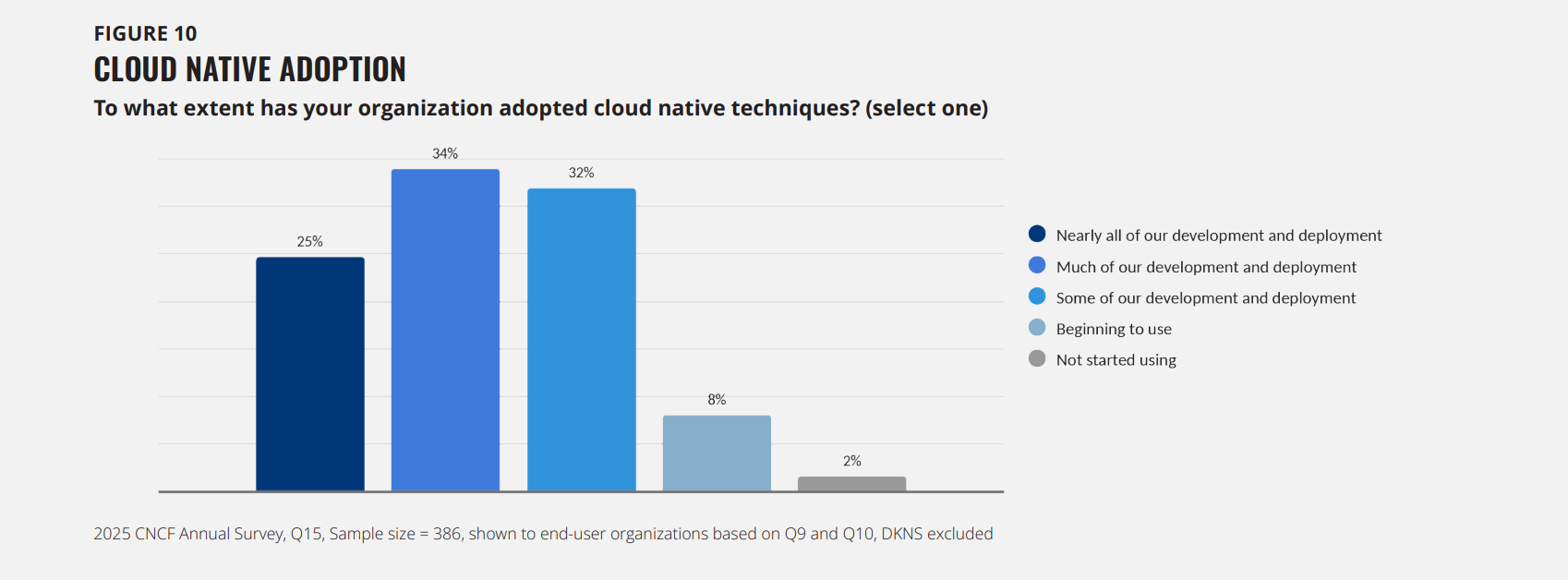
Sourced from CNCF Annual Cloud Native Survey
In this day and age, orchestration platforms and cloud native computing are used across multiple businesses and sectors. As a common example, retail stores often rely on containers to manage spikes in online traffic during sales and busy periods. By adding application instances when demand increases, orchestration platforms keep the sites from crashing and being overwhelmed. They’re then scaled down once the traffic subsides, improving both performance and cost efficiency.
Financial institutions also require uninterrupted services alongside strict security controls. Using containerized microservices, banks can release updates incrementally without taking entire systems offline. Streaming platforms like Netflix and Spotify also use containers for their microservices architectures, ensuring rapid feature releases and seamless updates. Each of these scenarios explains why Cloud native computing continues to gain momentum across virtually every industry. However, choosing the right platform is what makes the difference.
Streamlining Enterprise Operations with Sangfor Kubernetes Engine
As global companies accelerate cloud-native transformation and Private AI initiatives, managing bare-metal Kubernetes clusters alongside legacy VM infrastructure becomes complex and risky. To solve this problem, Sangfor Kubernetes Engine (SKE) natively integrates Sangfor Hyperconverged Infrastructure with Sangfor Kubernetes Engine at an architectural level. This is especially helpful for medium to large enterprises and global markets.
Rather than needing complex command-line orchestration or fragmented third-party management, IT teams can then provision production-ready, fully compliant K8s clusters through Sangfor’s Cloud Platform in under 15 minutes. By unifying compute (aSV), distributed software-defined storage (aSAN), and visualized networking (aNet), SKE allows enterprise IT to run traditional VMs and high-density container workloads on the exact same physical hardware.
SKE also uses advanced vGPU deep-slicing and dynamic scheduling to eliminate GPU contention during intensive AI inference, along with aSEC kernel-level native security that enforces built-in micro-segmentation and distributed firewall protection across all container Pods.
Structurally, Sangfor Kubernetes Engine is natively compatible with classic virtual machine layers, unified control portals, and built-in security mitigation strategies. For companies struggling to balance traditional workloads alongside modern containerized applications, this unified approach streamlines operations while minimizing risk, allowing your team to focus more on application innovation and less on infrastructure administration.
Conclusion
The journey from traditional virtualized infrastructure to containerized Cloud Native Computing represents one of the most significant shifts in modern IT history. Understanding the Kubernetes vs Docker debate begins with recognizing that these are not at all competing technologies, and they solve different problems in their own rights. While Docker excels at packaging and running containerized applications, Kubernetes provides the orchestration framework required to manage them at scale.
Similarly, comparisons such as Docker Swarm vs Kubernetes and Docker Compose vs Kubernetes reveal an important reality: infrastructure decisions should be guided by business objectives, operational maturity, and long-term growth expectations. As enterprises continue modernizing their digital ecosystems, container orchestration will remain a foundational pillar of future cloud infrastructure strategies.
Ready to bypass deployment complexity and eliminate operational risks in your cloud ecosystem? Audit your infrastructure's current scaling limits today and consult with enterprise deployment teams to discover how Sangfor Kubernetes Engine can seamlessly accelerate your application modernization strategy.
FAQ
Docker creates and runs containers, while Kubernetes manages and orchestrates large numbers of containers across multiple servers.
No. Kubernetes and Docker address different obstacles, and many organizations use container technologies like Docker alongside Kubernetes orchestration for optimal efficiency.
Docker is generally easier for beginners because it focuses on container creation and management, whereas Kubernetes introduces more complex orchestration concepts.
Docker Swarm is a container clustering solution that helps organizations manage containers across multiple hosts using Docker-native tools.
Docker Swarm offers simpler deployment and management, while Kubernetes provides more advanced scalability, automation, and resilience features.
Docker Compose is primarily used for defining and running multi-container applications locally, while Kubernetes is designed for large-scale production orchestration.
Kubernetes provides automated scaling, self-healing, security controls, and multi-cloud flexibility that support complex production workloads.
While standard Kubernetes orchestrates container scaling, enterprise production environments require underlying storage IOPS, network isolation, and GPU resource management. Enterprise HCI platforms like Sangfor HCI integrate Kubernetes capabilities natively alongside aSEC kernel-level security and vGPU deep-slicing technologies. This allows large organizations to run high-throughput Private AI workloads and containerized microservices smoothly alongside legacy VMs without risking security breaches or storage bottlenecks.