
Summarize this blog article with AI:
 Ask ChatGPT
 Ask Grok
 Ask Perplexity
 Ask Claude
 Ask Google AI
As enterprises run increasingly I/O-intensive workloads, storage performance often becomes a critical bottleneck, even in modern hyper-converged infrastructure (HCI) environments.
To resolve this challenge, Sangfor HCI has launched dual asynchronous I/O processing modes in its 3-Tier scenariofor external storage connectivity. This gives organizations the flexibility to select the optimal solution based on their business characteristics, fully leverage underlying hardware performance, and ensure stable, high-efficiency I/O output even under heavy load.
The Complete Async I/O Stack in Sangfor HCI 3-Tier Architecture
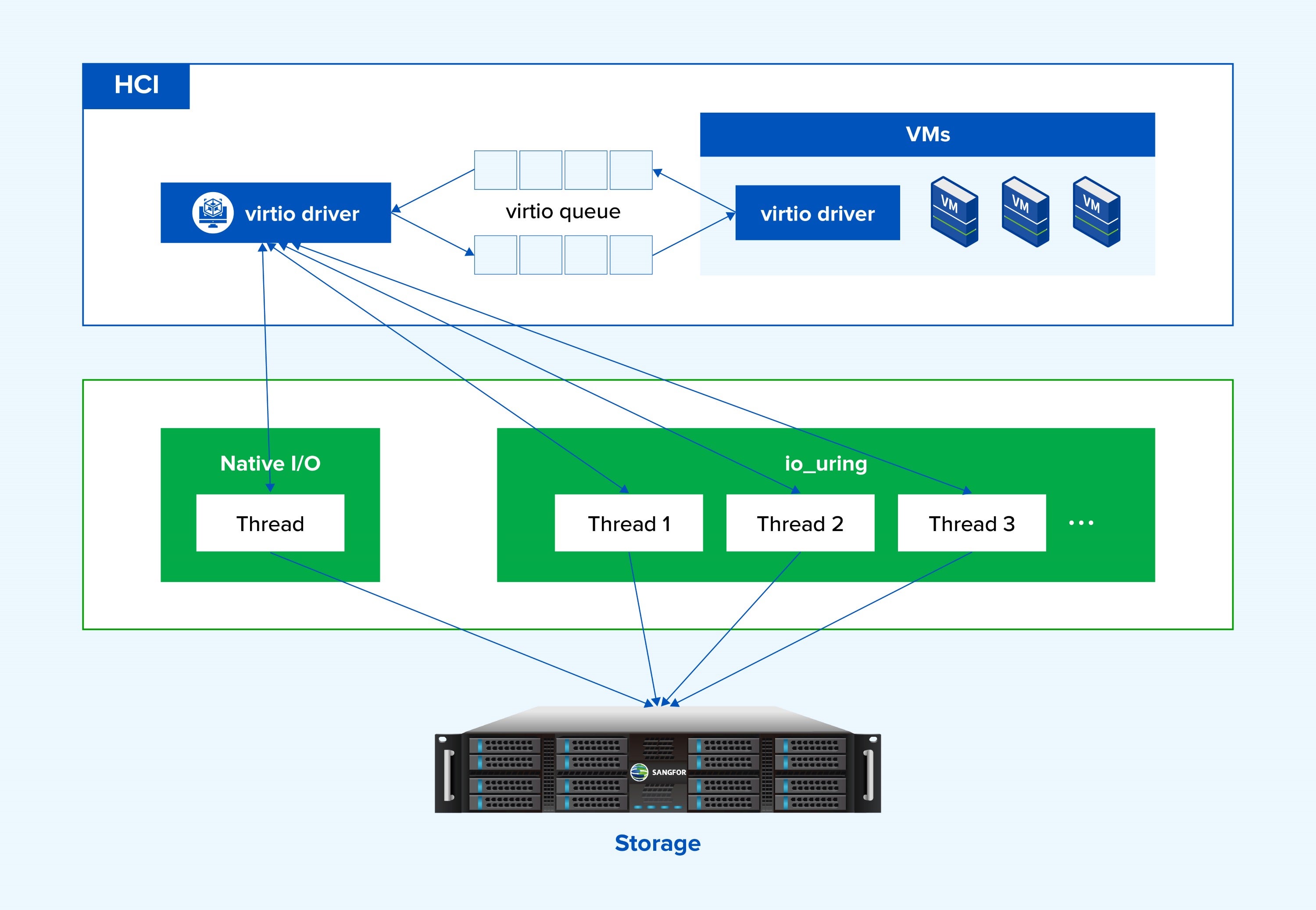
When VMs connected to external storage run I/O requests on Sangfor HCI, the full processing path follows a mature, layered architecture:
- The VM sends I/O requests through the built-in virtio driver, which forwards all I/O tasks to the unified HCI storage layer for centralized scheduling.
- The storage layer routes tasks to different asynchronous I/O processing pipelines based on the mode you enable, completing final I/O interactions with the connected external storage devices.
Mode 1: Native Async I/O – The Proven and Reliable Option for Standard Workloads
Native mode uses the traditional asynchronous I/O processing approach that has been fully validated in long-term production deployments across multiple industries.
Core Working Logic
All disk I/O requests from virtual machines are executed sequentially through a relatively fixed processing path. The system allocates a limited number of dedicated threads to process Linux AIO tasks, running each I/O step by step following the predefined processing flow.
Applicable Scenarios
This mode is simple to implement and has proven stability, making it a perfect fit for business scenarios with low I/O loads or low concurrency requirements. It requires almost no additional configuration, reduces the probability of unexpected compatibility issues, and is an ideal default choice for users running general lightweight business, small-scale test environments, or legacy workloads.
Limitations
When I/O pressure continues to rise, the processing capacity of this mode is primarily limited by single-core CPU performance. As concurrent I/O requests accumulate, it will gradually hit a noticeable throughput bottleneck, making it unable to fully utilize the multi-core performance of modern X86 servers to handle high-density I/O tasks.
Mode 2: io_uring Mode – Optimized for High-Performance and Scalable Workloads
Built on top of the latest Linux kernel high-performance I/O framework, io_uring mode is designed to break the performance ceiling of traditional AIO processing, and is the officially recommended option for I/O-intensive workloads.
Core Working Logic
This new-generation high-performance asynchronous I/O mechanism submits and processes I/O requests via an efficient queuing system and dynamically schedules multi-threaded resources for parallel processing based on real-time system load. Unlike the sequential processing logic of native Linux AIO, io_uring cuts down redundant context switching overhead, and distributes I/O tasks to idle CPU cores as much as possible.
Measurable Performance Improvements
Based on Sangfor HCI's official test data, io_uring mode delivers significant performance gains compared to native Async I/O across common workload scenarios:
| Block Size | Model | IO Depth | Thread Number | IOPS Improvement |
| 4K | Rand Write | 128 | 1 | 10% |
| 4K | Rand Read | 128 | 1 | 30% |
| 8K | Rand Write | 128 | 1 | 30% |
| 8K | Rand Read | 128 | 1 | 30% |
CPU Overhead Compared to Native Async I/O
| Scenario | Single VM Lightweight | Single VM Heavy Load | Multiple VMs Lightweight | Multiple VMs Heavy Load |
| X86 CPU | No additional costs | 1 vCPU | No additional costs | 9 vCPU |
The performance tests further prove that io_uring brings zero additional cost in lightweight scenarios with only 1 vCPU allocated, while under heavy load with 9 vCPUs, it effectively reduces CPU overhead during I/O processing and fully unlocks the multi-core performance of X86 servers. This mode significantly improves disk access efficiency and reduces response latency in high-concurrency, I/O-intensive scenarios, ensuring stable performance output for virtual machines even when running at full load.
Compatibility Notes
Currently, io_uring mode is supported for external storage connections over FC, iSCSI, and NVMe over ROCEv2 protocols. It does not support NFSv3 scenarios for the time being. We recommend users confirm their external storage network protocol before switching modes, to obtain the best possible performance enhancement.
How to Choose the Right Async I/O Mode for Your Business
Sangfor HCI's dual asynchronous I/O modes break the one-size-fits-all limitation of legacy hyper-converged platforms. For scenarios that prioritize long-term stability and run low-concurrency business workloads, native async I/O is the reliable, low-risk choice. For scenarios running databases, big data processing, virtual desktops or other I/O-heavy services, enabling io_uring can help you fully leverage the performance of your existing hardware, eliminate I/O bottlenecks without extra hardware investment, and deliver a smoother, more predictable business operation experience.
Conclusion
Native async I/O remains a proven and reliable choice for general workloads, while io_uring delivers significant performance advantages in high-concurrency and I/O-intensive environments. By offering both modes, Sangfor HCI enables organizations to choose the most suitable I/O strategy based on workload requirements and infrastructure conditions.
Looking to maximize storage performance in your HCI environment? Click here to explore how Sangfor HCI helps organizations eliminate bottlenecks, improve resource efficiency, and support demanding enterprise workloads.