
Summarize this blog article with AI:
 Ask ChatGPT
 Ask Grok
 Ask Perplexity
 Ask Claude
 Ask Google AI
Quick Takeaways
What is the fundamental difference?
Virtuozzo Infrastructure is a full-stack infrastructure platform built around distributed storage, with integrated compute, networking, object storage, backup, and Kubernetes services. Sangfor aSV is a Type 1, KVM-based enterprise hypervisor designed for enterprise server virtualization and as the virtualization foundation of Sangfor HCI. Sangfor HCI extends aSV with aSAN storage, aNET networking, aSEC security, backup, and disaster recovery capabilities.
When should you consider each platform?
Virtuozzo Infrastructure is a natural fit for environments where distributed storage, scale-out capacity, object storage, and flexible compute/storage architectures are major design priorities. Sangfor aSV is particularly well suited to enterprises looking for a VMware Alternative that keeps the virtualization experience familiar while supporting existing FC, iSCSI, or NFS storage and providing integrated security and business continuity.
Are they direct equivalents?
Not entirely. Both platforms provide KVM-based virtualization and HCI capabilities, but their architectural priorities are different. Virtuozzo puts distributed storage and infrastructure services at the center of the platform. aSV starts with enterprise virtualization and expands into a complete HCI architecture through the Sangfor platform.
Platform Positioning
What Is Virtuozzo Infrastructure?
What does virtuozzo do?
Virtuozzo Infrastructure is a software-defined infrastructure platform built around a distributed storage architecture. The current product name is Virtuozzo Infrastructure, formerly known as Virtuozzo Hybrid Infrastructure.
The platform combines storage, compute, and infrastructure services in a single environment. Depending on the deployment model, a Virtuozzo Infrastructure cluster can provide compute, Virtuozzo Storage, S3, backup, iSCSI, NFS, and other services.
Virtuozzo Infrastructure brings together several technologies that collectively form a software-defined infrastructure platform:
- Virtuozzo Storage — a distributed software-defined storage layer supporting replication, erasure coding, storage policies, multiple storage tiers, and failure-domain-aware data placement.
- Compute virtualization — KVM/QEMU-based virtualization with high availability, VM lifecycle management, live migration, and resource management.
- Infrastructure services — including S3-compatible object storage, NFS, iSCSI, backup services, and managed Kubernetes.
- Flexible deployment models — including HCI and disaggregated compute and storage architectures.
Virtuozzo Infrastructure is not limited to a traditional HCI model. Its architecture also supports disaggregated compute nodes that consume storage from a dedicated Virtuozzo Storage cluster or an external storage array. This allows compute and storage to scale independently and can be useful when an existing SAN needs to remain in service.
What Is Sangfor aSV?
Sangfor aSV is a Type 1, KVM-based enterprise hypervisor and the core virtualization engine of Sangfor HCI. It provides enterprise virtualization capabilities including VM lifecycle management, high availability, live migration, intelligent resource scheduling, NUMA optimization, SR-IOV, RDMA, QoS control, and centralized management.
Sangfor HCI extends the aSV virtualization layer with additional platform services, including:
- aSV — enterprise virtualization
- aSAN — software-defined storage
- aNET — network virtualization
- aSEC — integrated infrastructure security
- aDR — disaster recovery
- SKE — Kubernetes and container capabilities
The result is a platform that can start with server virtualization and extend into a full HCI and private-cloud architecture without requiring a separate virtualization stack.
As an enterprise VMware Alternative, Sangfor aSV places particular emphasis on operational familiarity for teams already experienced with vSphere.
The platform follows familiar VMware-style workflows for VM creation, lifecycle management, cluster administration, migration, and virtual networking. aSV also provides more than 230 VMware-compatible or PowerCLI-equivalent commands, helping organizations reuse established automation practices.
aSV supports FC, iSCSI, and NFS external storage, allowing enterprises to modernize the virtualization layer without immediately replacing existing storage arrays.
Virtuozzo vs Sangfor aSV: At a Glance
| Dimension | Virtuozzo Infrastructure | Sangfor aSV |
| Core architecture | Distributed infrastructure platform centered on storage and scale-out services | Enterprise hypervisor centered on virtualization |
| Hypervisor | KVM-based virtualization | Type 1, KVM-based |
| HCI | Yes | Yes, through Sangfor HCI |
| Distributed storage | Virtuozzo Storage | aSAN with Sangfor HCI |
| External storage | Supported through external-storage architectures, including iSCSI | FC, iSCSI, NFS |
| Object storage | Integrated S3-compatible object storage | Available through the broader Sangfor platform |
| Kubernetes | Managed Kubernetes | SKE / Sangfor cloud-native platform |
| Security | Encryption, firewalling, security groups, and hardening | Integrated aSEC security architecture |
| VMware experience | Independent management model | VMware-like management experience |
| VMware Alternative | VMware workload migration capabilities | Enterprise VMware Alternative |
| VMware workload migration | Migration Service available; the current 7.4 service is early access | VMware workload migration capabilities |
| Three-tier deployment | Supported through disaggregated and external-storage architectures | Supported with external FC/iSCSI/NFS storage |
| Licensing | Lease, annual subscription, and perpetual models | Perpetual and subscription options |
| Primary evaluation focus | Distributed storage, infrastructure scale, object storage, deployment flexibility | Virtualization operations, VMware Alternative, infrastructure reuse, security, and business continuity |
Five Key Differences Between Sangfor & Virtuozzo
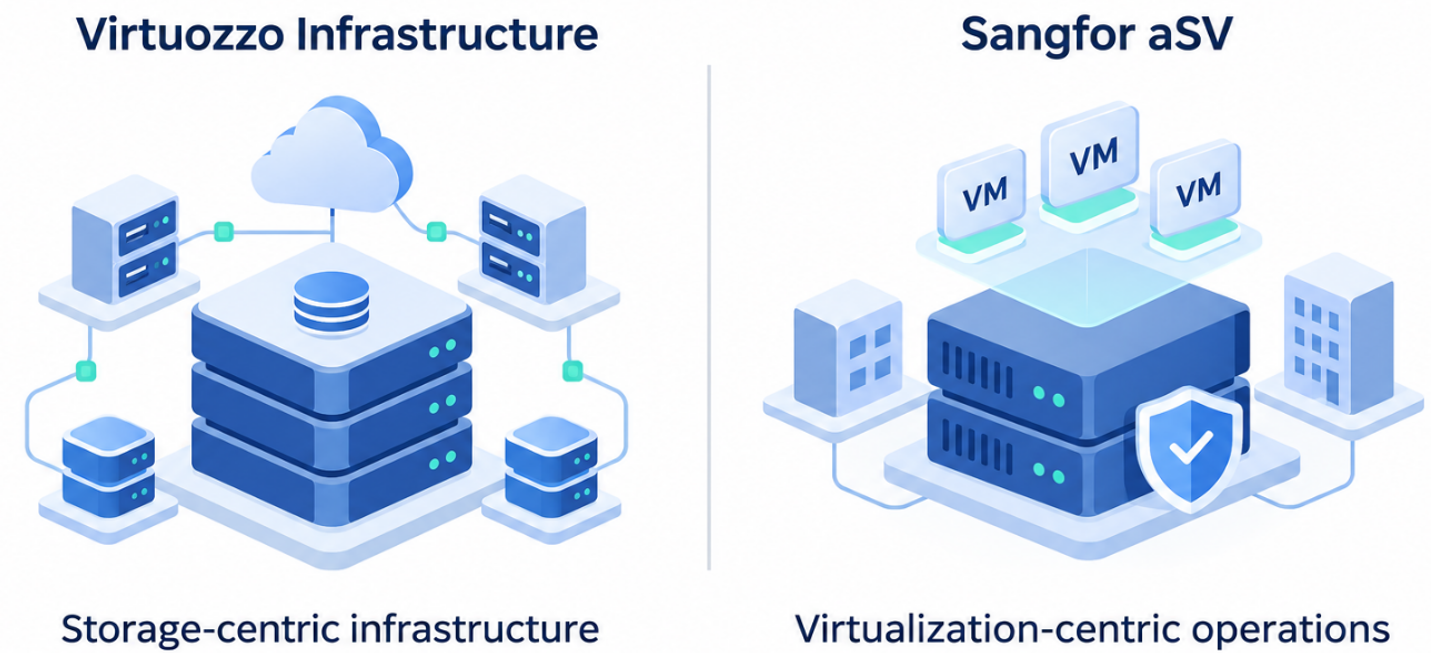
1. Architecture Philosophy: Storage-Centric Infrastructure vs. Virtualization-Centric Operations
A useful way to frame the difference is storage-centric infrastructure versus virtualization-centric enterprise operations.
Virtuozzo Infrastructure starts with distributed infrastructure and storage. Storage policies, redundancy mechanisms, failure domains, storage tiers, and scale-out behavior are therefore central to the platform design.
Sangfor aSV starts with enterprise virtualization. When deployed as part of Sangfor HCI, the virtualization layer expands into an integrated stack through aSV, aSAN, aNET, aSEC, backup, and disaster recovery.
That leads to two different design priorities.
If storage architecture, capacity efficiency, object storage, and independent compute/storage scaling are at the top of the requirements list, Virtuozzo Infrastructure offers a strong foundation.
If virtualization operations, VMware-like administration, workload migration, security, business continuity, and gradual infrastructure modernization are more important, aSV is the more natural fit.
2. Storage: Distributed Storage and Scale vs. Existing Storage Investment
Storage is one of the clearest architectural differences between the two platforms.
Virtuozzo Storage supports replication and erasure coding, configurable storage policies, multiple storage tiers, and failure-domain-aware data placement. Its object-storage architecture also supports large-scale S3 deployments with different erasure-coding schemes and storage tiers.
This makes Virtuozzo particularly relevant when storage efficiency and scale-out growth are major design objectives.
Sangfor aSV takes a different approach.
When deployed with Sangfor HCI, aSV uses aSAN as its integrated software-defined storage layer. At the same time, aSV can integrate directly with external enterprise storage through FC, iSCSI, and NFS.
That gives enterprises more than one path forward. A customer can modernize the virtualization layer while keeping an existing SAN in place, and later move toward aSAN-based HCI if that becomes the preferred architecture.
For organizations with a recently refreshed SAN, the ability to protect that investment can have a direct impact on project cost, timing, and risk.
Three-Tier Deployment: Protecting Existing Storage Investment
Many enterprises do not want to replace their hypervisor and storage platform at the same time.
That is particularly common when a high-end FC or iSCSI SAN has been deployed recently and still has years of useful life ahead of it.
Sangfor aSV supports this model directly. The hypervisor can run on enterprise servers while VM storage remains on external FC, iSCSI, or NFS infrastructure. This lets organizations modernize virtualization first and adopt HCI later if and when the business requires it.
Virtuozzo Infrastructure also supports disaggregated compute with external storage, including existing SAN environments.
So the question is not simply whether external storage is supported. Both platforms can do that.
The more useful question is:
Which platform gives you the cleanest path from today's infrastructure to tomorrow's architecture?
For customers looking for a VMware Alternative + existing SAN reuse + a future path to HCI, aSV provides a particularly straightforward architecture.
3. Reliability: Resilience Plus Proactive Infrastructure Management
Both platforms provide the mechanisms needed to maintain availability when infrastructure components fail. The difference is how much emphasis each places on detecting problems early and minimizing the impact before a full failure occurs.
Virtuozzo Infrastructure uses redundant storage policies, failure domains, rebuild mechanisms, and compute high availability to maintain workloads through infrastructure failures. Its storage architecture supports both replication and erasure coding, allowing policies to be selected according to workload and capacity requirements.
Sangfor aSV adds proactive infrastructure health management to conventional HA.
aSV includes Proactive HA 2.0, using multi-vector health detection to identify infrastructure risks and proactively protect workloads. Sangfor HCI also provides slow-disk handling, disk health monitoring, hardware health detection, live migration, and maintenance mechanisms designed to minimize service disruption.
For business-critical environments, this distinction matters. The question is not only whether the platform can recover after a failure, but also whether it can detect a degrading component early enough to protect the workload before the failure becomes service-impacting.
For databases, ERP, healthcare, manufacturing, government, and other systems with limited maintenance windows, that can make a measurable difference.
4. Security: Native Infrastructure Protection vs. an Integrated Security Architecture
Virtuozzo Infrastructure includes native infrastructure security capabilities such as encryption, firewalling, security groups, and hardening controls.
Sangfor takes a broader approach by bringing security directly into the HCI architecture through aSEC.
aSEC provides capabilities including:
- Micro-segmentation
- Distributed security controls
- VM isolation
- Security monitoring
- Vulnerability protection
- Ransomware-related protection and recovery workflows
- Integration with broader Sangfor security technologies
So the difference is not simply whether the platform provides security. Both do.
The more important question is how closely security is integrated with the infrastructure itself.
With Sangfor HCI, compute, storage, networking, security, backup, and disaster recovery are managed as part of the same platform. That reduces the number of independent layers an IT team has to coordinate and gives security policies a direct place in the infrastructure operating model.
For organizations looking to converge infrastructure and security operations, this is an important architectural advantage.
5. Migration and Operational Experience
For enterprises evaluating virtualization platforms, feature coverage is only part of the decision. The day-to-day operating experience matters just as much.
aSV is designed to provide a VMware-like enterprise virtualization experience, including familiar workflows for VM lifecycle management, cluster administration, migration, and virtual networking. More than 230 VMware-compatible or PowerCLI-equivalent commands also help organizations reuse existing automation practices.
aSV delivers 94.8% feature parity with VMware vSphere, covering the core virtualization capabilities enterprises expect from an enterprise hypervisor. The goal is not simply to reproduce individual features. It is to make the move from VMware to aSV less disruptive for the IT team responsible for operating the environment.
By comparison, Virtuozzo Infrastructure 7.4 includes a Migration Service, which the current documentation identifies as an early-access feature intended for evaluation rather than production use.
When evaluating migration readiness, the discussion should go beyond simply asking, “Can the VM be moved?” The more useful questions are:
- How mature is the migration tooling?
- How much of the existing automation can be reused?
- How are networks and storage mapped?
- What happens to application dependencies?
- What is the expected cutover process?
- How is rollback handled?
- What changes for administrators after migration?
This is where aSV's VMware-like operating experience becomes a practical differentiator.
Migration Process: VMware to Sangfor aSV
For organizations adopting aSV as a VMware Alternative, the migration process should cover:
- VMware workload discovery
- Hardware and guest OS compatibility
- Storage and network mapping
- VM conversion and synchronization
- Application dependency validation
- Cutover planning
- Rollback procedures
- Post-migration operational validation
Sangfor provides migration tools for VMware workloads, including agentless and agent-based options depending on the scenario. Workloads can be synchronized while running, followed by a controlled cutover.
The objective is not simply to move the VM from one platform to another. The objective is to move the workload into an environment where administrators can continue working with familiar virtualization concepts and automation practices.
Scenario-Based Evaluation
| Scenario | Primary Evaluation | Why |
| Distributed storage and S3 are major requirements | Virtuozzo Infrastructure | Strong distributed-storage and object-storage architecture |
| Core enterprise VM workloads | Evaluate both against real workloads | Both provide enterprise virtualization, HA, and live migration |
| A recently refreshed FC/iSCSI SAN must be retained | aSV and Virtuozzo | Both support external-storage architectures |
| A VMware Alternative with minimal operational retraining is required | aSV | VMware-like experience and PowerCLI-compatible automation |
| Integrated infrastructure security is a priority | Sangfor HCI / aSV | aSEC integrates security with the infrastructure stack |
| Compute and storage need to scale independently | Virtuozzo Infrastructure | Disaggregated architectures support independent scaling |
| A gradual path from virtualization to HCI is preferred | aSV | Standalone virtualization can evolve into Sangfor HCI |
| Managed Kubernetes is a core infrastructure requirement | Virtuozzo Infrastructure | Managed Kubernetes is integrated as an infrastructure service |
| Existing infrastructure investment must be protected | aSV | External FC/iSCSI/NFS storage support enables infrastructure reuse |
| A large-scale VMware Alternative project is required | aSV | High feature parity, familiar operations, migration capabilities, and HCI integration |
Licensing and TCO Considerations
Licensing should be compared at the solution level rather than by hypervisor price alone.
Virtuozzo Infrastructure supports lease, annual, and perpetual licensing. Its licensing model uses resource limits including physical CPU capacity and logical storage capacity for Virtuozzo Storage.
Sangfor provides perpetual and subscription licensing options across its virtualization and HCI portfolio.
A meaningful TCO comparison should include:
- Hypervisor licensing
- Storage licensing
- Security licensing
- Backup and disaster recovery
- Existing hardware reuse
- Existing SAN reuse
- Migration services
- Support and maintenance
- Subscription or renewal costs
- Three- to five-year operating costs
The number that matters is not simply the hypervisor license price. It is the total infrastructure cost required to deliver the same business outcome.
Choosing the Right Platform
Where Virtuozzo Infrastructure Is Particularly Strong
A fair comparison should also be clear about where Virtuozzo has real advantages.
1. Distributed Storage
Virtuozzo Storage provides multiple redundancy models, erasure coding, storage tiers, and failure-domain-aware placement. These capabilities give infrastructure teams a great deal of flexibility when storage efficiency and scale are central design goals.
2. Object Storage
S3-compatible object storage is an integrated service. This makes Virtuozzo relevant to environments where VM infrastructure and object workloads need to coexist within the same overall platform.
3. Disaggregated Infrastructure
Virtuozzo Infrastructure supports HCI as well as storage-only, compute-only, and mixed architectures. Compute and storage can therefore grow independently when workload requirements are not aligned.
4. Multi-Tenant Infrastructure
Projects, domains, self-service capabilities, and metering make Virtuozzo Infrastructure well suited to service-provider and private-cloud operating models.
5. Kubernetes
Managed Kubernetes is available as an integrated service, making the platform relevant to organizations operating both virtual machines and cloud-native workloads.
The fair takeaway is that Virtuozzo Infrastructure is a full-stack infrastructure platform with distributed storage at the center of its architecture.
Where Sangfor aSV Is Particularly Strong
1. VMware Alternative Experience
aSV is designed for enterprises looking for a VMware Alternative while preserving a familiar virtualization experience.
The management experience follows familiar VMware-style workflows, while PowerCLI-compatible commands help organizations reuse existing automation practices.
2. Existing SAN Reuse
aSV supports FC, iSCSI, and NFS external storage, allowing customers to continue using existing storage infrastructure while modernizing the virtualization layer.
3. Integrated HCI
aSV can evolve from standalone virtualization into the broader Sangfor HCI platform, adding aSAN, aNET, aSEC, backup, disaster recovery, and cloud-native services.
4. Business Continuity
aSV combines HA, Proactive HA 2.0, live migration, backup, and CDP capabilities to protect business-critical workloads.
5. Integrated Security
aSEC brings security capabilities directly into the infrastructure architecture, allowing compute, storage, networking, and security operations to work within a unified platform.
Conclusion
Virtuozzo Infrastructure and Sangfor aSV both address modern enterprise virtualization and infrastructure requirements, but they start from different points.
Virtuozzo Infrastructure is better suited for storage-centric environments that prioritize distributed storage, object storage, and independent compute/storage scaling.
Sangfor aSV starts with enterprise virtualization and extends it into a complete HCI architecture through aSAN, aNET, aSEC, backup, disaster recovery, and cloud-native services.
Sangfor aSV is better suited for organizations seeking a VMware alternative, with a broader ecosystem that includes aSAN, aNET, aSEC, backup, disaster recovery, and cloud-native services.
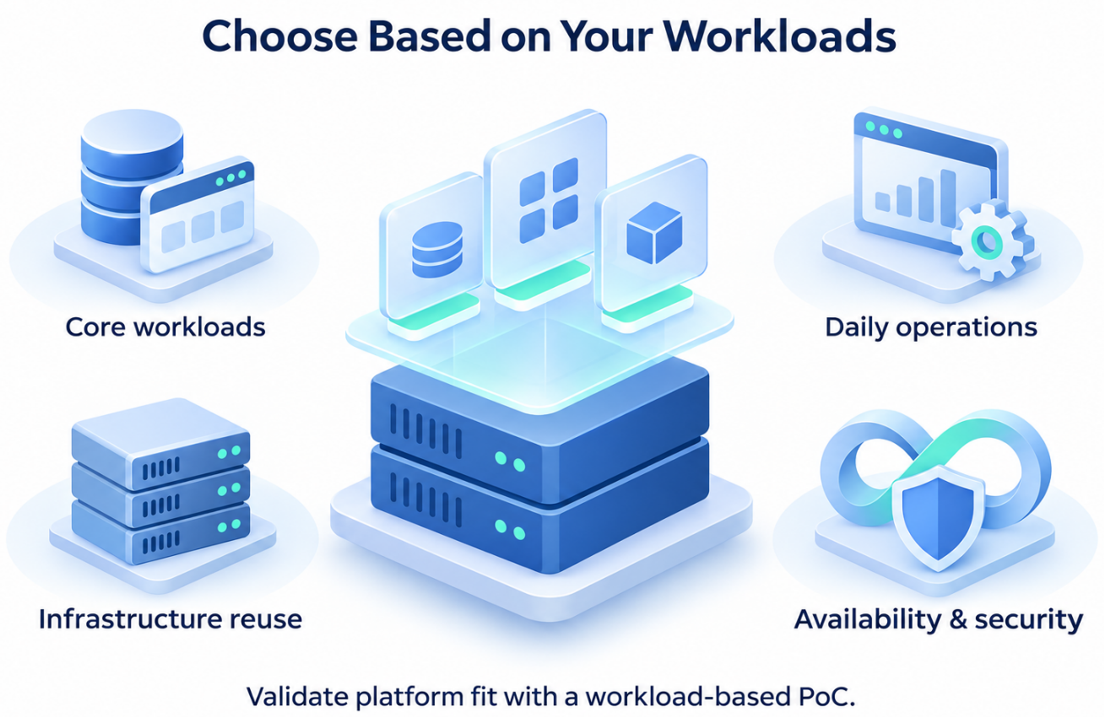
In the end, the most useful comparison is not a feature-counting exercise. It is a question of fit:
- Can the platform run your core workloads?
- Can it protect your existing infrastructure investment?
- Can your administrators operate it efficiently?
- Can it meet your availability and security requirements?
- Does it give you a practical path to the infrastructure you want next?
A workload-based PoC is the best way to answer those questions.
Frequently Asked Questions
Yes.
Both platforms use KVM-based virtualization technology, but the surrounding storage, networking, security, management, data-protection, and operating models are different.
No.
Virtuozzo Infrastructure supports HCI, compute-focused deployments, external storage, S3, NFS, iSCSI, backup, and managed Kubernetes. Its architecture simply places distributed infrastructure and storage at the center.
Yes.
Virtuozzo Infrastructure supports disaggregated compute architectures in which compute nodes consume external storage, including external iSCSI storage. Its storage guidance also covers external FC and NFS scenarios.
Yes.
aSV supports FC, iSCSI, and NFS external storage, including shared-storage scenarios for HA and live migration.
Yes.
aSV is an enterprise VMware Alternative built on a Type 1, KVM-based hypervisor. It provides a VMware-like operational experience, 94.8% feature parity with vSphere, VMware-compatible automation capabilities, external-storage support, and VMware workload migration capabilities.
Yes.
Virtuozzo Infrastructure provides managed Kubernetes as an integrated service.
Yes.
Sangfor provides Kubernetes and container capabilities through SKE and the broader Sangfor Cloud Platform, while aSV remains the core virtualization engine within Sangfor HCI.
Both platforms provide native infrastructure security.
Virtuozzo Infrastructure includes encryption, firewalling, security groups, and hardening capabilities. Sangfor integrates aSEC directly into the HCI architecture with capabilities including micro-segmentation, security monitoring, isolation, and ransomware protection.
The meaningful comparison is therefore not a single security score. It is how well each platform's security capabilities match the organization's policies, operating model, and threat requirements.