
Summarize this blog article with AI:
 Ask ChatGPT
 Ask Grok
 Ask Perplexity
 Ask Claude
 Ask Google AI
The 2026 Asia-Pacific Economic Cooperation (APEC) CEO Summit has concluded in Shenzhen. As business leaders explored new drivers of economic growth across the Asia-Pacific, building an open and inclusive AI innovation ecosystem emerged as a key topic of discussion.
The summit also saw the release of the Shenzhen Initiative, which calls for open, inclusive and responsible AI development and stronger digital and AI capabilities, particularly in developing economies and among micro, small and medium-sized enterprises (MSMEs). It emphasizes AI's role in supporting economic development, improving public governance and enhancing people's well-being. Making AI more widely accessible is becoming a shared priority for the region's future prosperity.
AI Adoption Accelerates, While Computing Power Remains a Practical Barrier
AI progress should not be confined to breakthroughs achieved by a small group of pioneers. Its value must reach businesses and communities, allowing more people to benefit from innovation and translating technological advances into broader economic and social impact.
Making AI more accessible means lowering technical barriers and widening access to the resources required to put it to work. Across finance, healthcare, manufacturing, education and public services, more organizations are already incorporating AI into their operations and delivering tangible results.
Yet even as AI adoption expands, the computing resources that power it remain difficult for many organizations to access and use effectively.
Open-source models continue to emerge, and cloud-based AI services are increasingly available. Although organizations now have more options for obtaining AI compute, many still face rising investment costs, the complexity of managing resources across different platforms and underutilized infrastructure.
At the same time, some regions and large institutions have built AI computing centers without fully utilizing their capacity, while many smaller businesses and local institutions lack the funding or expertise to secure a stable supply of compute resources. This gap between available capacity and access to it has created a 'compute divide' that limits the wider adoption of AI.
Making AI compute as accessible as essential utilities such as electricity and water is an important direction for infrastructure development. Achieving this will require continued innovation in technology and service models, more effective allocation of existing resources and easier access to AI for organizations of different sizes and capabilities.
Supporting Diverse AI Needs to Drive Broader Innovation
Bridging the compute divide requires an understanding of real business needs and challenges, as well as the broader expectations of industry and society. Through continued innovation, Sangfor aims to help organizations get more value from every compute resource and extend the benefits of AI to more industries and institutions.
Smarter Hybrid AI Compute Management for More Efficient, Sustainable Innovation
As AI becomes more deeply embedded in business operations, organizations need an efficient and sustainable approach to managing compute resources. They must be able to allocate capacity flexibly, improve utilization and continuously optimize performance while keeping investment under control. Sangfor sees two priorities: overcoming fragmented management across multiple compute sources and optimizing model usage to unlock more value from existing resources.
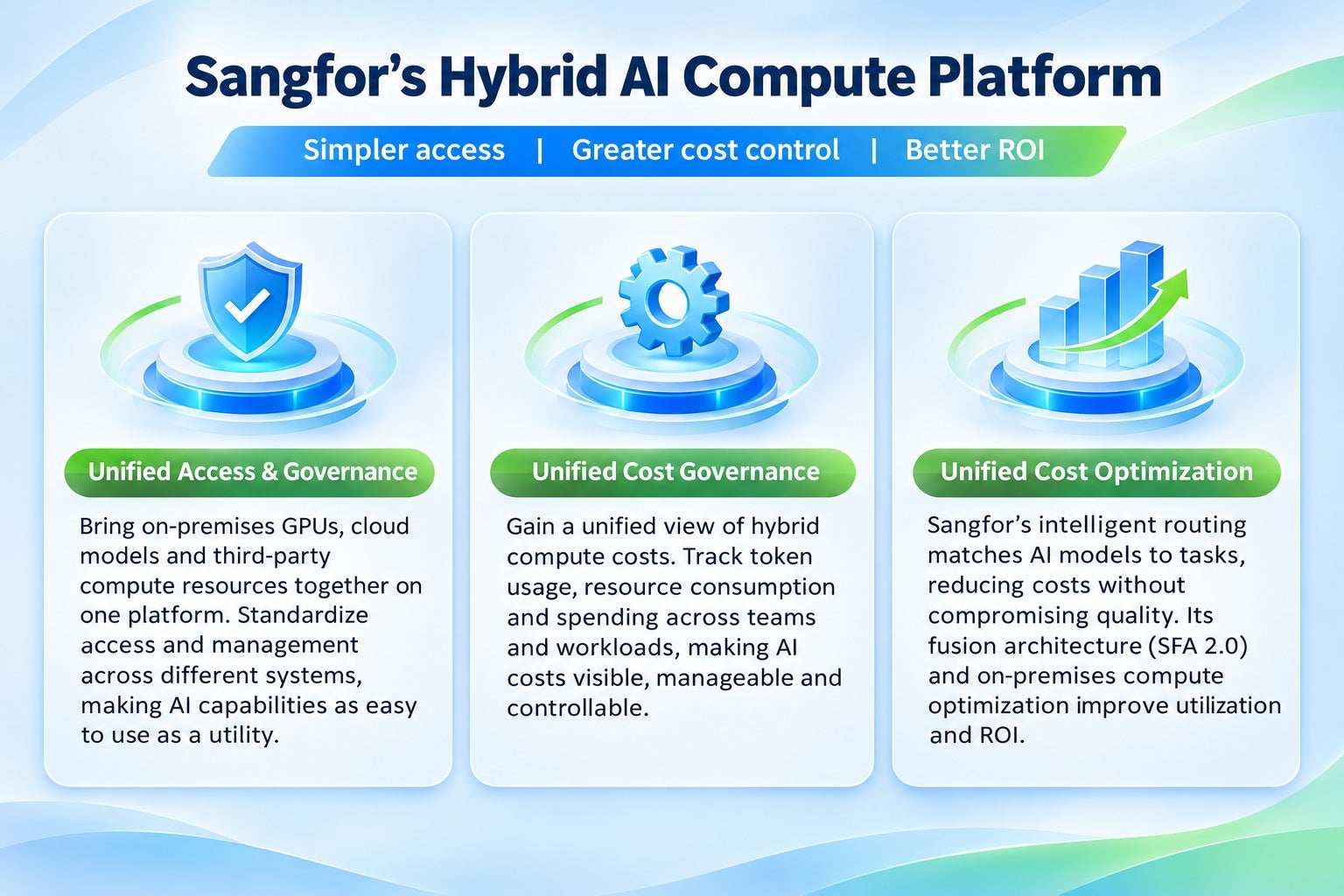
To address these challenges, Sangfor has developed a hybrid AI compute platform that brings diverse computing resources and AI models together through unified access and governance. A consolidated cost view gives organizations visibility into resource consumption and spending across workloads, enabling more precise cost management. Meanwhile, Sangfor's proprietary intelligent routing engine and optimization of on-premises compute performance help balance AI output quality with operational efficiency.
These capabilities are already delivering measurable results in real-world enterprise environments.
At a major state-owned enterprise, Sangfor's platform enabled a threefold increase in concurrent AI requests using the same China-developed compute hardware and AI model, while maintaining the expected user experience. The improvement could save more than RMB 10 million in additional hardware investment, allowing the organization to pursue further research and innovation at a more sustainable cost.
A leading consumer electronics manufacturer used intelligent token routing, optimization and usage controls to reduce annual token costs by nearly RMB 10 million, while maintaining the quality of AI outputs.
At a large technology company, hybrid compute scheduling and optimization increased the utilization of on-premises compute resources approximately sixfold. The company also saved more than RMB 10 million in annual token costs, significantly reduced overall AI investment and achieved a threefold improvement in return on investment (ROI).
When compute resources can be orchestrated and used more efficiently, organizations have greater room to innovate. Lower costs can create opportunities for sustained investment in AI, while better utilization of existing infrastructure can raise productivity and accelerate innovation.
Sharing Compute Resources to Make AI More Widely Available
Demand for AI innovation exists across countless business settings. Another important path toward more inclusive AI is to pool high-quality compute resources and ensure a consistent, reliable supply of capacity. This can make AI services more accessible, flexible and dependable for smaller businesses and local institutions.

Efforts to make this possible are already taking shape across multiple sectors.
Across China, regions are exploring initiatives known as 'token factories', bringing AI computing resources together and coordinating capacity across networks to develop more convenient, flexible and inclusive delivery models.
At the industry level, financial groups can use a unified hybrid AI compute platform to provide branches with stable, cost-effective model services and strengthen intelligent risk management and financial services. In education, shared compute resources can bring high-quality teaching and research capabilities to more schools. Government agencies can centrally deploy AI models to extend digital service guidance and policy advisory services to local communities, helping technological progress reach more people.
For industry- and region-wide deployments, Sangfor's hybrid AI compute platform provides integrated support for unified access governance, cost governance and cost optimization. Built-in safeguards are designed to ensure production-grade reliability and a stable supply of AI computing resources, helping critical AI services run continuously.
In a regional healthcare AI resource-sharing initiative, Sangfor's platform used the compute resources of one hospital as a foundation to centrally manage more than 40 heterogeneous compute resources and over 20 AI model services. It provides reliable AI capabilities to more than 10 public hospitals and nearly 200 community health centers across the region. Participating healthcare organizations can quickly access the resources they need, reducing fragmented infrastructure and duplicated model deployments while expanding AI use in community-level healthcare.

Ultimately, the value of technological innovation is measured by the real needs it meets and the challenges it helps society overcome. Inclusive AI is about ensuring that more people benefit from progress, extending the reach of technology to communities and organizations that have traditionally had less access to advanced digital capabilities.
Across the Asia-Pacific, efforts to make AI more inclusive reflect a shared commitment to openness, cooperation and broader access to development opportunities. When technology can overcome geographical and resource constraints, innovation becomes a powerful means of connecting communities and advancing shared prosperity.
From Shenzhen to the world, Sangfor will continue to advance AI innovation in line with APEC's priorities of openness, innovation and cooperation. Working alongside customers and partners across industries, Sangfor aims to help more organizations benefit from AI, bring practical innovation to more communities and contribute to a more inclusive and prosperous Asia-Pacific.