
Summarize this blog article with AI:
 Ask ChatGPT
 Ask Grok
 Ask Perplexity
 Ask Claude
 Ask Google AI
As organizations evaluate alternatives to VMware, snapshot capability is often treated as a checklist item. However, the underlying snapshot architecture can have a direct impact on application consistency, recovery efficiency, performance, and cyber resilience.
What is Redirect-on-Write (ROW)?
Redirect-on-Write (ROW) is the snapshot technology used by VMware.
Redirect-on-Write (ROW) is central to VMware Migration evaluation.
When new data is written, the write is redirected to newly allocated snapshot storage while the original data remains in the source volume. This mechanism can significantly reduce write amplification and read/write I/O, helping improve write speed and overall performance.
ROW also introduces potential challenges that should be evaluated carefully:
- I/O fluctuation: Because a ROW snapshot is not a complete independent volume, deleting snapshots requires metadata-chain consolidation. In a large-scale cluster, this process may cause temporary I/O fluctuations.
- Recovery overhead: Managing multiple snapshots in a chain may also introduce performance overhead during recovery operations.
Selecting the right ROW implementation is therefore critical in a VMware migration project.
A suitable solution should combine the architectural advantages of ROW with production-grade optimization, security integration, and recovery capabilities. This article examines the key selection criteria and the engineering practices behind an optimized implementation.
How to Select a ROW Snapshot Solution That Meets Business Requirements
As a core capability of storage virtualization, an effective ROW snapshot solution should protect strong data consistency and continuous business operations while meeting the security requirements needed to safeguard data during migration.
Organizations evaluating ROW snapshot technology should focus on the following dimensions:
1. Align Snapshot Capabilities with Workload Requirements
- Strong-consistency workloads, such as Oracle RAC and MySQL clusters: Verify whether the platform supports consistency-group snapshots. In particular, confirm that it can provide snapshot consistency for shared virtual disks so that distributed application data remains aligned.
- High-change environments, such as development and testing or temporary service deployments: Evaluate scheduled snapshot capabilities to ensure frequent recovery points are available for rapidly changing environments.
2. Evaluate Snapshot Performance Under Real Workloads
During VMware Migration, performance stability is essential to business continuity. The following metrics should be validated carefully:
- Snapshot performance impact: For modern databases such as TiDB and OceanBase, which commonly use 8 KB data blocks, test ROW write performance with an 8 KB block size. Pay particular attention to how the metadata-management strategy affects I/O latency.
- Snapshot recovery efficiency: Based on the required recovery time objective (RTO), test single-snapshot rollback and recovery through a multi-snapshot chain. Stability during multi-snapshot consolidation should be validated in particular.
3. Assess Cyber Resilience and Recovery Readiness
Assess how snapshot technology integrates with broader security controls, including ransomware protection. For business-critical systems, evaluate both ransomware-defense capabilities and data recovery. Regular attack simulations and recovery exercises should be conducted to verify protection effectiveness, snapshot usability, and recovery efficiency.
By evaluating these dimensions together, organizations can identify a ROW snapshot solution suited to transition more smoothly from a traditional virtualization platform to a modern infrastructure architecture.
Advanced ROW Snapshot Optimization and Scenario Expansion
ROW snapshots are widely used across virtualization and hyperconverged infrastructure platforms. However, implementations differ in snapshot metadata management, performance optimization, and block-size strategy, resulting in different levels of impact on business I/O performance.
1. Multi-Snapshot Consolidation Performance Optimization
Sangfor HCI uses ROW by default when its aSV compute virtualization layer accesses virtual storage provided by aSAN. To address transient I/O latency caused by extensive metadata updates and capacity reclamation after multiple snapshots are deleted, Sangfor has optimized the multi-snapshot consolidation strategy in the following ways:
- Intelligent bitmap merging: The platform calculates the bitmaps of two snapshot files and merges from the snapshot with fewer bitmap entries into the one with more entries. This reduces the amount of data to be processed and improves consolidation efficiency.
- Multi-snapshot consolidation optimization: When several snapshots are deleted within a short period, the platform retains the snapshot file with the larger bitmap where appropriate and simplifies multiple merge tasks into a single operation, avoiding repeated I/O consumption.
- Tier-aware I/O scheduling: In non-all-flash deployments, consolidation I/O is directed to the capacity disk tier, preventing it from competing for SSD performance and helping maintain stability during peak business periods.
Together, these three optimizations substantially improve ROW snapshot stability in high-frequency deletion scenarios. Building on this foundation, Sangfor HCI provides diversified snapshot policies and integrates snapshot technology with key platform capabilities.
2. Diverse Snapshot Policies and Extended Platform Capabilities
Consistency-Group Snapshots: Precise Data Synchronization for Tightly Coupled Applications
Complex business environments, including Oracle RAC databases, distributed applications, and typical application VM + middleware + database architectures, require a high level of data consistency.
Sangfor HCI provides consistency-group snapshots and supports snapshots for shared virtual disks. This enables consistent snapshot protection for distributed workloads such as Oracle RAC, together with group cloning, snapshot creation, snapshot recovery, and snapshot cloning.
Scheduled Snapshots: Automated Data Protection That Reduces Operational Workload
Organizations can configure VM snapshot schedules and retention periods according to business requirements. Expired snapshots are deleted automatically to release storage capacity. If a VM is compromised or corrupted, administrators can quickly roll back to an unaffected snapshot point, reducing business disruption and operational effort.
Extended Capabilities Powered by Snapshot Technology
Sangfor HCI snapshot technology supports more than basic data protection. It is also integrated into several core platform capabilities:
- Ransomware protection snapshots: When a ransomware attack is detected, the cloud platform can automatically create a virtual-storage snapshot to protect data and preserve daily snapshots so they are not overwritten. After comprehensive validation, administrators can roll back to a known-safe recovery point.
- Snapshot-based virtual storage also supports rapid full clones and linked clones, enabling cloning to be completed within seconds under suitable conditions.
Sangfor ROW Snapshot Technology in Production-Style Testing
How does the optimized Sangfor ROW snapshot solution perform under a demanding business workload?
The following test used an Oracle OLTP model with 1,000 concurrent users:
Workload Performance During Snapshot Creation
SwingBench | 1,000 concurrent users
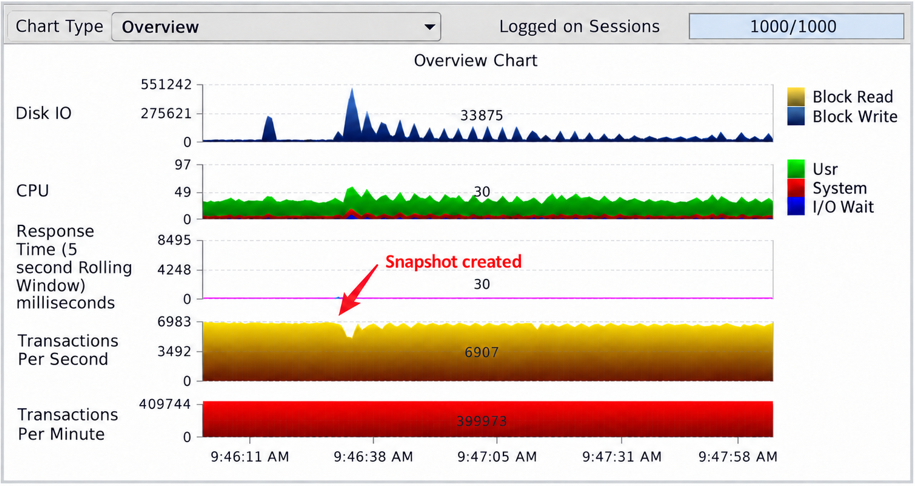
[Snapshot Creation] Under a load of 1,000 concurrent users, performance showed only a minor fluctuation lasting approximately three seconds, with little overall impact.
Workload Performance During Snapshot Deletion
SwingBench | 1,000 concurrent users
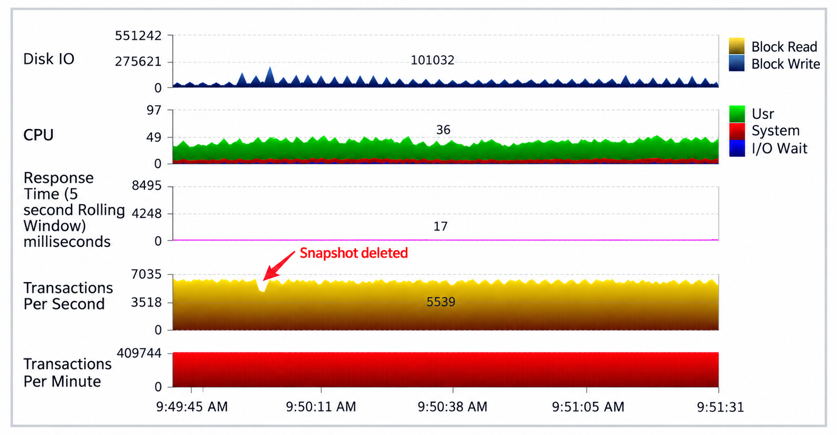
[Snapshot Deletion] Business performance remained stable, with no significant fluctuation observed.
Overall, the test results demonstrate that Sangfor HCI's ROW snapshot architecture can maintain stable application performance during both snapshot creation and deletion under a high-concurrency Oracle OLTP workload. The observed performance fluctuations were brief and recovered quickly, indicating that snapshot operations introduce minimal disruption to ongoing business services. These results suggest that a well-optimized ROW implementation can effectively balance data protection requirements with the performance demands of production environments.
Conclusion
More importantly, the evaluation highlights that ROW snapshot capability should not be assessed solely by whether snapshots can be created or restored. For projects involving VMware alternative, organizations need to consider a broader set of factors, including application consistency, workload performance, recovery efficiency, and ransomware resilience, as these capabilities directly affect operational stability and business continuity.
Through consistency-aware snapshot mechanisms, optimized metadata management, and integrated security protection features, Sangfor HCI is designed to address these requirements while minimizing the operational challenges commonly associated with snapshot technologies.
As organizations modernize their virtualization infrastructure, evaluating the real-world effectiveness of a snapshot architecture can be just as important as evaluating the platform itself. A mature ROW implementation should not only provide reliable data protection, but also maintain performance, accelerate recovery, and support long-term infrastructure resilience.
Explore More for VMware Migration Evaluation
Planning to migrate from VMware? Explore these related articles for practical insights into key migration considerations, virtualization compatibility, and how to prepare for a successful transition.
- 10 Things VMware Admins Must Know Before Switching to Sangfor Virtualization
- VMware Migration Made Practical: How Sangfor Virtualization Solves the Compatibility Challenge
Talk to Sangfor’s VMware Migration Experts
FAQs About Redirect-on-Write (ROW) Snapshots & VMware Migration
Redirect-on-Write (ROW) is a snapshot technology used by VMware. It redirects new writes to newly allocated snapshot storage while preserving the original data. During VMware migration, enterprises should evaluate snapshot performance, data consistency, and recovery efficiency.
Key considerations include snapshot performance, data consistency, recovery efficiency, and ransomware protection. Enterprises should also evaluate consistency-group snapshots, I/O latency under real workloads, and performance stability during multi-snapshot consolidation.
Sangfor HCI uses intelligent bitmap merging, multi-snapshot consolidation optimization, and tier-aware I/O scheduling to reduce I/O fluctuations and improve consolidation efficiency. These optimizations help maintain performance during snapshot deletion.
In an Oracle OLTP test with 1,000 concurrent users, Sangfor HCI experienced only a minor performance fluctuation lasting approximately three seconds during snapshot creation. Snapshot deletion showed no significant performance fluctuation under the tested conditions.