
Summarize this news article with AI:
 Ask ChatGPT
 Ask Grok
 Ask Perplexity
 Ask Claude
 Ask Google AI
This article explores the evolution of Earth Day, tracing its journey from grassroots to environmental protests in the 1970s to its current role as a technological mandate in the digital era. By examining historical milestones—such as Rachel Carson’s Silent Spring and the establishment of the EPA—the text connects the origins of environmental advocacy with today’s urgent need for Green IT.
A central focus is placed on Sangfor Technologies’ strategic vision, which posits that digital transformation must be inherently synonymous with sustainability. The article highlights how cloud-based services and data center efficiencies have become pivotal indicators of environmental performance. Ultimately, it emphasizes that while Earth Day serves as a global symbol, long-term ecological success depends on integrating energy-efficient infrastructure and conscious digital habits into the daily operations of forward-thinking organizations.
Introduction: A Global Call to Action
Every year on April 22, more than a billion people in over 190 countries unite for Earth Day. It is the largest secular observance in the world, serving as a critical platform for raising awareness of the environmental crises facing our planet, from climate change to biodiversity loss. The theme for 2026, “Our Power, Our Planet,” emphasizes that the power to drive change is no longer just in the hands of policymakers but is fueled by the collective intelligence, daily choices, and technological innovations of global citizens and forward-thinking organizations.

The Origins: From Protest to Global Movement
The movement traces its roots back to the late 1960s, a time when environmental issues were largely ignored by the political establishment. Inspired by the anti-war "teach-ins" on college campuses, Senator Gaylord Nelson and activist Denis Hayes organized the first Earth Day on April 22, 1970.
The timing was crucial: the 1962 publication of Rachel Carson’s Silent Spring had already begun to awaken public consciousness regarding the link between pollution and public health. The 1969 Cuyahoga River fire, in which the river literally caught fire due to industrial waste, served as the final catalyst. On that first Earth Day, 20 million Americans took to the streets, leading to the creation of the U.S. Environmental Protection Agency (EPA) and the passage of landmark legislation like the Clean Air Act and the Endangered Species Act. By 1990, Hayes took the movement global, mobilizing 200 million people and paving the way for the 1992 UN Earth Summit in Rio de Janeiro.
A Collective Commitment: From Communities to Nations
Today, contributions to Earth Day take the form of a diverse array of actions spanning borders and cultures. At the governmental level, many nations use this day to announce new climate commitments or launch massive reforestation campaigns, such as India and Ethiopia’s initiatives to plant millions of trees. In line with the above, the European Union stands as a global pioneer with the European Green Deal, committing to becoming the first climate-neutral continent by 2050 through strict carbon regulations and significant investments in circular economies. The United States contributes significantly through the “America the Beautiful” initiative, a national goal to conserve 30% of its lands and waters by 2030, while also leading in green technology innovation. China has also emerged as a global leader in this effort, accounting for a significant portion of the world's new green leaf area since 2000; the country has committed to planting 70 billion trees by 2032 as part of the “1 trillion Trees” initiative. Therefore, alongside government-led initiatives, civil society plays a vital role, from individuals worldwide advocating for sustainability to indigenous groups in the Amazon utilizing digital tools to monitor and safeguard their lands. Across schools on every continent, millions of students engage in educational projects, turning awareness into tangible action through local beach and park cleanups. This global effort shows that although environmental issues are universal, the movement’s strength depends on each person’s capacity to act locally to achieve a global effect.
Earth Day celebrations worldwide underscore that protecting the environment is a shared responsibility, driven by community participation and everyday sustainable practices. Merging grassroots movements with large-scale policies which is essential to building a sustainable future.
Technology for a Greener Future: The Sangfor Vision
As we progress deeper into the digital era, the battleground of environmentalism has widened into the online realm. Sangfor Technologies recognizes that digital transformation must be synonymous with sustainability. According to research published in The American Journal of Engineering and Technology, cloud-based services and data center efficiencies are now pivotal indicators of a nation's environmental performance.
Sangfor aligns its vision with these scientific findings by championing Hyper-Converged Infrastructure (HCI). Indeed, academic studies on “Green Cloud Computing” indicate that consolidated architectures such as HCI can reduce data center energy consumption by up to 25% compared to traditional legacy systems. By integrating compute, storage, and networking into a single software-defined unit, Sangfor helps enterprises:
- Minimizing IT Carbon Footprint: Transitioning to cloud-based infrastructure and utilizing Sangfor’s AI-powered management reduces reliance on physical hardware. The AI dynamically scales resources based on real-time demand, ensuring that no energy is wasted on idle servers. This maximizes resource utilization, lowers energy consumption, and mitigates electronic waste, directly supporting the Earth Day mission of responsible consumption.
- Optimize Energy Density: Research from the Lawrence Berkeley National Laboratory highlights that data center cooling accounts for nearly 40% of total energy use. Sangfor’s streamlined infrastructure generates less heat, while its AI-driven monitoring predicts thermal peaks, allowing for smarter cooling strategies that significantly reduce the energy required for thermal management.
- Empower Remote Efficiency: By providing AI-enhanced VDI (Virtual Desktop Infrastructure) and optimized network tools like SD-WAN, Sangfor supports the decarbonization of the workforce. These tools enable a seamless remote work experience that maintains high security and performance, effectively reducing the carbon emissions associated with daily commuting and physical office maintenance.
How You Can Make a Difference
While companies like Sangfor innovate at the infrastructure level, individual actions remain the core action of the movement. Here is how you can actively contribute using the right tools:
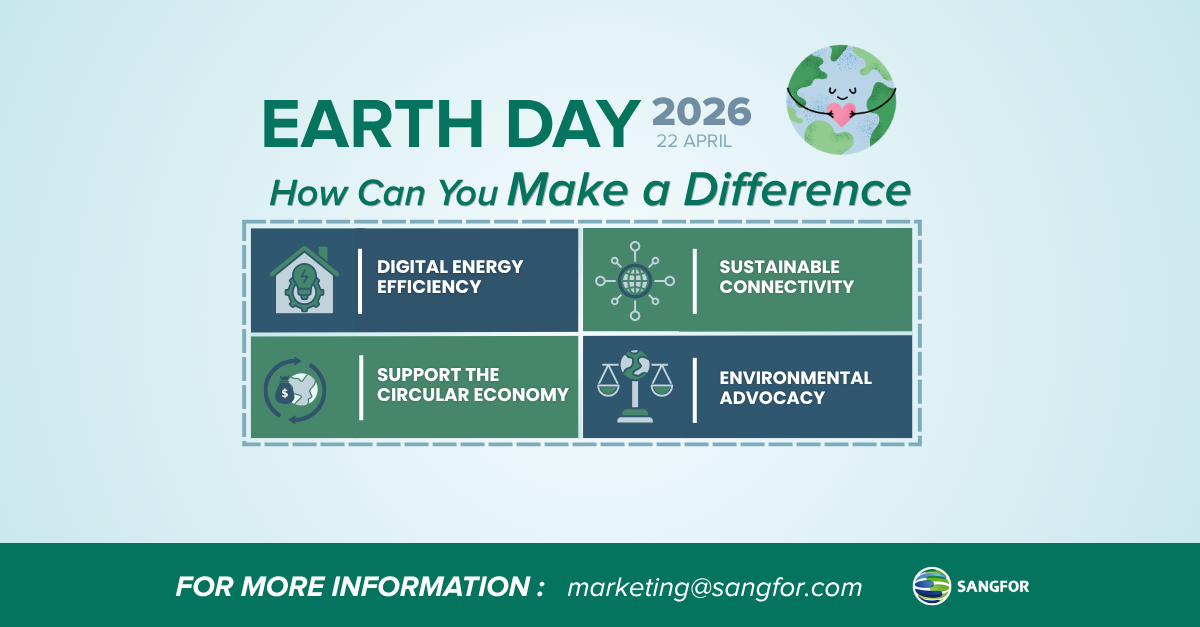
- Digital Energy Efficiency: Optimize your data storage. Deleting unnecessary files from the cloud reduces the energy demand of global servers. By leveraging Sangfor Managed Cloud Services, organizations can gain better visibility into their data, ensuring that storage is used efficiently, and digital waste is minimized to limit the web's invisible emissions.
- Support the Circular Economy: Choose brands that prioritize hardware recycling and long-term product durability. Sangfor’s Hyperconverged Infrastructure (HCI) supports this by allowing businesses to run more workloads on fewer physical servers, significantly extending the lifecycle of existing hardware and reducing electronic waste (e-waste).
- Sustainable Connectivity: Use digital collaboration tools to reduce unnecessary business travel. By utilizing Sangfor VDI (Virtual Desktop Infrastructure), employees can work securely from anywhere with high performance, leveraging technology to drastically cut CO2 emissions from daily commuting and transport.
- Environmental Advocacy: Use your voice to demand sustainable practices in both the physical and digital sectors. Promote a green habits corporate culture by encouraging the adoption of energy-efficient solutions like Sangfor’s AI-powered security and networking, which optimize performance while reducing the overall carbon footprint of the IT department.
Conclusion: A Shared Legacy, A Digital Future
Earth Day is much more than a date on the calendar; it is a powerful symbol of our global responsibility. However, true transformation does not happen in a single day. It is the result of a consistent commitment to daily standards, the small, incremental improvements in how we manage our digital resources that lead to extraordinary long-term results.
The transition to a sustainable world requires a dual approach. We need the passion for environmental activism to set up the vision, but we also need the precision of Green IT to build the necessary infrastructure. By adopting more conscious digital habits every day, we aren’t just protecting the environment—we are safeguarding the systems that support human life, health, and prosperity.
As your partner in this journey, Sangfor Technologies is dedicated to turning these daily efforts into measurable impact. Through our energy-efficient solutions and sustainable product portfolio, we provide the tools to make sustainability the default setting for your business.
Let’s remember that Power is not an abstract concept. It is the power of a streamlined data center, the power of a single conscious choice, and the power of a community committed to doing better every single day. This April 22, let’s pledge to protect our planet not as a resource to be exhausted, but as a legacy to be preserved for the future.
Frequently Asked Questions
The movement gained momentum in the late 1960s and early 1970s, fueled by catalysts like Rachel Carson’s Silent Spring and the 1969 Cuyahoga River fire. This collective action led to the first Earth Day in 1970, which mobilized 20 million people and helped create the U.S. Environmental Protection Agency (EPA) and landmark laws such as the Clean Air Act.
While early environmentalism focused on physical industrial waste and pollution, the battleground has now expanded into the online realm. In the digital age, sustainability is increasingly measured by the efficiency of cloud-based services, AI tools, and the carbon footprint of the massive data centers that power our global connectivity.
Sangfor recognizes that digital transformation and sustainability must go hand in hand. The company champions the Green IT movement by developing infrastructure solutions, such as Hyper-Converged Infrastructure (HCI), designed to maximize resource utilization and reduce energy consumption and physical hardware dependency of modern enterprises. Additionally, Sangfor is integrating AI to enhance system efficiency and predictive analytics, further supporting sustainable digital growth.
Sangfor facilitates the decarbonization of work by optimizing data storage through Managed Cloud Services and reducing electronic waste via Hyperconverged Infrastructure (HCI), which consolidates workloads onto fewer physical servers. Additionally, the company enables reduced travel emissions through Virtual Desktop Infrastructure (VDI) and improves IT energy efficiency with AI-powered networking and security solutions. You can read the full analysis of their sustainable solutions on the Sangfor website.
The theme “Our Power, Our Planet” emphasizes that the power to drive change is no longer just with policymakers. It is found in collective intelligence and daily choices, from an individual deleting unnecessary cloud files to a community adopting streamlined data centers.

