
Summarize this blog article with AI:
 Ask ChatGPT
  Ask Grok
  Ask Perplexity
  Ask Claude
  Ask Google AI
 Abstract
The global technology sector has reached a structural turning point in 2026. Despite record-breaking profits driven by generative AI, the industry is witnessing a profound paradox: a radical reallocation of capital from human labor to machine infrastructure.
Using Meta as a primary case study, with its 20% workforce reduction alongside a staggering $600 billion investment in AI clusters, this article explores the “job displacement effect” currently reshaping Big Tech. Following the "Meta Model," giants like Amazon and X are moving away from human-centric management toward high-density GPU clusters and autonomous agents. However, as Nobel laureate Daron Acemoglu warns, this transition risks falling into the trap of “so-so AI”: automation that displaces workers without creating new high-productivity tasks.
This strategic analysis examines whether this massive CapEx intensification will lead to true digital resilience or merely social and operational friction. The era of asking if AI will replace jobs is over; the challenge for 2026 is managing the consequences of this novel coexistence.
Introduction: The Radical Reallocation of Capital
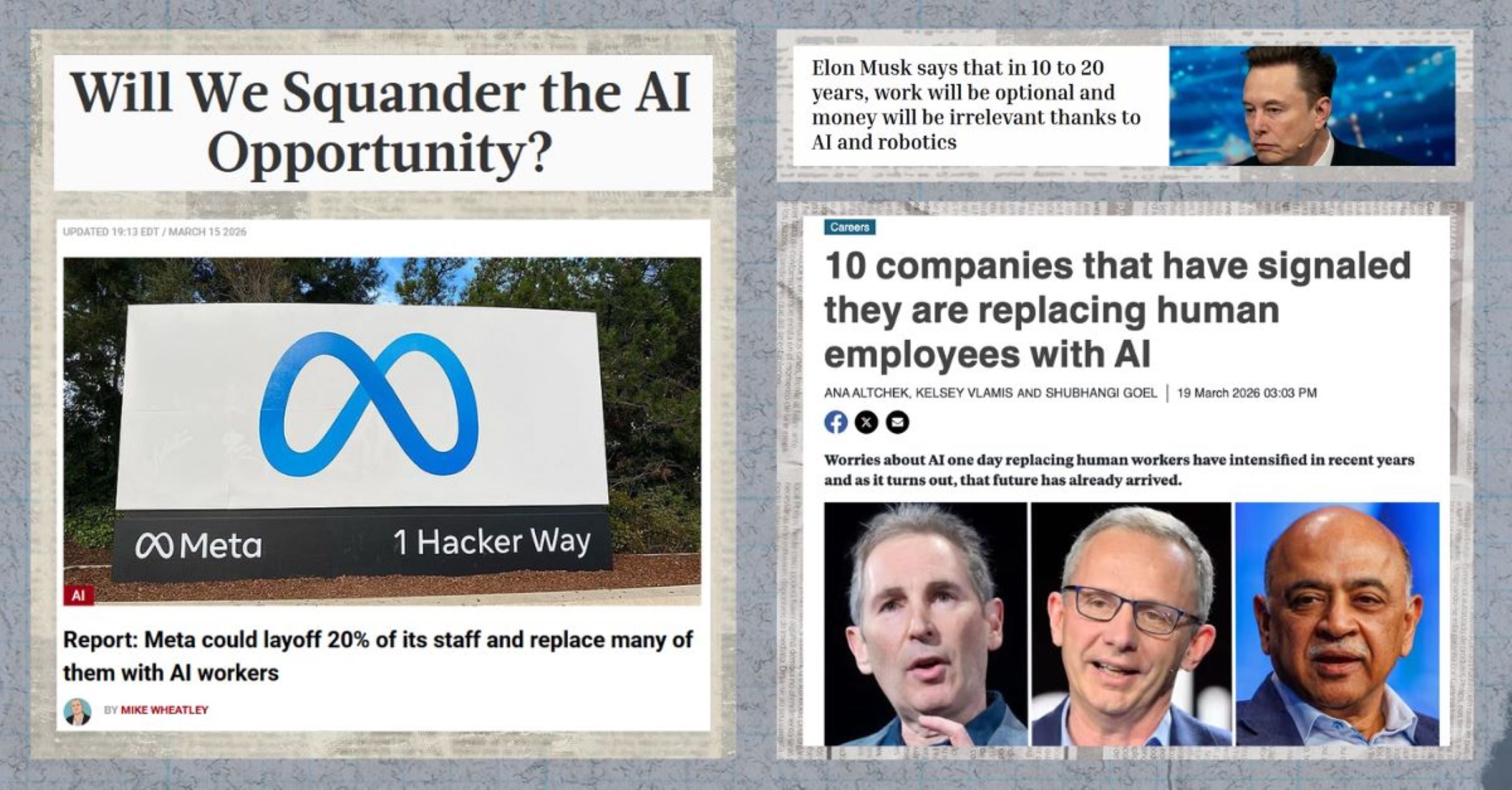
In early 2026, the global technology sector reached a definitive structural turning point. While corporate balance sheets showed record-breaking profits driven by the first wave of generative AI monetization, the labor market experienced a profound and unsettling paradox. Meta, the social media giant, became the primary case study for this new era, announcing a strategic workforce reduction of approximately 20%.
This move, however, was not a sign of financial distress or a reaction to a cooling economy. On the contrary, Meta confirmed a commitment to invest nearly $600 billion in AI infrastructure (such as building data centers) through 2028. This transition signifies a radical reallocation of capital. As noted by Nobel laureate Daron Acemoglu in his research on the macroeconomics of AI, we are witnessing a “displacement effect” where firms re-architect their entire operational core. Indeed, companies are moving budgets from human-centric administrative and middle-management roles toward high-density GPU clusters and autonomous AI agents.
Moreover, in 2025, Acemoglu already warned that if this transition focuses solely on “so-so AI” (a term that he and Simon Johnson coined to describe technologies that automate without creating new high-productivity tasks) the broader economic benefit may be limited despite massive capital expenditure.
The Meta Model – The “Big Tech” Domino Effect triggering Workforce Shift
In recent years, the “Meta Model” has emerged as a reference point across the tech industry, reinforced by similar strategic shifts at companies like Amazon and X. These firms are not just optimizing operations but rebuilding their core infrastructures around artificial intelligence and large-scale computing.
The transformation of Meta began with the “Year of Efficiency” in 2023 and has since evolved into a long-term structural shift. The company is moving away from a labor-intensive social media model toward an “infrastructure-first” approach, where value creation depends increasingly on data, AI systems, and computational capacity rather than human labor.
AI now plays a central operational role, automating functions such as content moderation, advertising, and software development. This enables greater scalability and cost efficiency, while supporting Meta’s growing capital investments in AI infrastructure, including data centers and custom hardware. By March 2026, reports suggest the company may reduce its workforce by an additional 20% (around 16,000 jobs), reflecting a broader reallocation of resources from labor to computation.
This shift highlights a wider industry trend: the gradual substitution of human work with AI-driven systems. While this model enhances productivity and innovation, it also raises important questions about employment and the evolving balance between labor and capital.
Let us take a closer look at what these companies are facing amid this significant socio-economic shift in the workplace:
Amazon: From Logistics to “CapEx Intensification”
Between late 2025 and early 2026, Amazon executed a massive structural shift, cutting approximately 30,000 corporate roles while simultaneously announcing a $125 billion investment in AI infrastructure. President & CEO of Amazon, Andy Jassy, articulated this as a move to remove layers and bureaucracy to move faster, nevertheless the financial reality is a direct correlation between workforce reduction and the funding of custom AI silicon, such as Trainium and Inferentia chips.
This shift is the definitive execution of the so called Productivity J-Curve theory from Brynjolfsson et al. (2021). The theory explains that powerful technologies like AI do not work out of the box: they require a period where productivity actually dips because the company must stop doing things the old way to build new and invisible foundations. For Amazon, these intangible investments are the 30,000 eliminated roles. The company is dismantling its human bureaucracy to favor the creation of a new, automated operating model.
This period of corporate contraction is not a sign of failure but a necessary catalyst for the rapid, automated growth expected in the next decade, once technology and new organizational structures finally synchronize (For further insights: https://laweconcenter.org/resources/ai-productivity-and-labor-markets-a-review-of-the-empirical-evidence/ ).
X (formerly Twitter): The Radical Experiment in Algorithmic Efficiency
Under the direction of Elon Musk, X has served as a “radical experiment” in algorithmic efficiency. By early 2026, X demonstrated its ability to maintain platform operations with roughly 20% of its original workforce. This substantial reduction was achieved by rigorously following Musk’s “Five-Step Algorithm” for engineering: challenging each requirement, eliminating non-essential components, and automating only as a decisive step. From a structural perspective, X has become the primary case study for the Human-to-AI Leverage Ratio (HAILR) model . This framework suggests that in software-defined environments, a single human supervisor can trigger years of automated output, effectively decoupling platform stability from headcount. Furthermore, by early 2026, X's role has shifted from a mere social network to a cornerstone of X Holdings, where xAI’s Grok models act as the central nervous system, automating content moderation and engineering tasks that once required thousands of employees.
Ultimately, Musk’s strategy aligns with his 2026 prediction that AI will eventually “make work optional”, suggesting a gradual transition in employment. In this evolving landscape, human roles are being redefined toward high-level oversight and creative direction. Rather than a simple reduction in staff, this reflects a shift toward a collaborative model where human ingenuity is empowered by autonomous systems, aiming for a future where labor is driven more by choice and strategic intent than by operational necessity.
Google (Alphabet): The End of the "Human-in-the-Loop" Phase
Another company that is moving forward is Google. It is a strategic shift that shows a trend moving human expertise from active data training to high-level supervision. By early 2026, Google significantly reduced its reliance on external contractor networks. This move included the termination of major data-labeling partnerships with providers like Appen. This reflects a transition where Gemini models use synthetic data for self-improvement. This moves the architecture from “Human-Assisted” toward a more autonomous framework.
In line with the above, this evolution is based on the scientific framework of Self-Rewarding Language Models (Yuan et al., 2024). This study has become the industry-wide benchmark, used by companies including Google, to justify the shift from human-generated feedback to synthetic data scaling. By using autonomous feedback loops, Google separates AI progress from the constraints of global labor markets. Moreover, according to David Autor (MIT, 2024), such shifts do not signal the end of work, but rather a restoration of the value of human expertise, where AI handles routine tasks, allowing human labor to focus on more complex problem solving.
This transition marks the emergence of Architectural Oversight. In this context, as observed in Ben Shneiderman’s Human-Centered AI (2022), the goal is a system where the machine manages its own learning efficiency while humans maintain high-level control over ethical and strategic boundaries. This reflects a new collaborative model: the machine manages the how of learning, while human ingenuity remains the guardian of the why, curating the AI’s purpose and its impact on society.
Oracle’s AI Expansion and Workforce Impact
The recent layoffs at Oracle highlight how artificial intelligence is transforming the tech industry. The company is cutting thousands of positions while increasing its spending on AI infrastructure, such as data centers, in order to compete with other cloud providers. However, these investments are expensive and have raised concerns about rising debt and falling cash flow, especially as Oracle’s stock has dropped significantly this year.
From a social sustainability perspective, this situation shows a clear tension between innovation and workforce stability. While AI offers long-term growth and new business opportunities, it can also lead to job losses and uncertainty for employees. Across the tech sector, many companies are reallocating resources toward AI, often at the expense of workers, which raises concerns about inequality and job security. Overall, Oracle’s case illustrates a broader trend: companies are prioritizing technological advancement, but they must also consider their social responsibility by supporting workers through this transition, for example with retraining programs or more sustainable employment strategies.
Social ESG Concerns: What Happens to the Displaced Workforce?
The AI Transition and the ESG Framework: Balancing Innovation with the “Social” Pillar
The shift from human talent to AI power is reshaping the traditional ESG (Environmental, Social, and Governance) landscape. In 2026, this transition is increasingly viewed as a complex realignment of capital allocations, where the “Social” (S) pillar must adapt to the new infrastructure requirements of the AI era. According to Gillan, Koch, and Starks (2021) the “Social” component is often the most challenging to quantify but remains a critical driver of long-term corporate risk and firm value. As companies invest heavily in proprietary silicon, they face the delicate task of balancing technological growth with the preservation of human capital.
The Evolution of the Corporate Social Contract
Rather than a simple trade-off, this period represents a re-evaluation of the social contract. Companies are navigating a transition where “Governance” (G) now focuses on algorithmic transparency, while the “Social” (S) pillar faces three constructive challenges:
1. Skills Transformation and Social Materiality
Building on the foundational research of Autor & Dorn (2013), it is evident that technological change is fundamentally reshaping job tasks. Current ESG research highlights that human capital materiality, the strategic value of employees, is more critical than ever. As AI increasingly absorbs administrative duties, the focus of the workforce is shifting toward architectural oversight. Rather than viewing this as simple displacement, Bofinger et al. (2022) argue that digitalization necessitates a new form of “Social Sustainability,” where companies must proactively manage workforce transitions to maintain their ESG ratings and investor confidence.
2. Navigating the Social License to Operate
The trust between a company and its community is a vital asset. During periods of major structural change, such as those seen at Amazon or Meta, maintaining this license is essential for protecting brand equity. Providing a balanced approach to this challenge, Alex Edmans (2021) demonstrates in “Grow the Pie” that companies prioritizing social impact, specifically employee well-being, actually deliver higher long-term returns to shareholders. By treating workers as partners in the AI transition, firms can protect their social standing while simultaneously pursuing efficiency.
3. Global Divergence in Social Sustainability
The social dimension of ESG is entering a transformative phase that encourages a broader dialogue on the role of innovation in modern society. This transition is not uniform across the globe: it depends significantly on how different nations align their economic goals with their respective levels of technological maturity. As organizations move toward more automated models, the focus of social sustainability is shifting from traditional metrics toward a more integrated approach to progress. This international dialogue is essential for ensuring that the benefits of technological advancement contribute to long-term stability and reflect a shared commitment to a balanced future in an ever-changing global landscape.
What Companies Should Do: ESG-Aligned AI Transformation
A responsible AI transformation is increasingly recognized not just as an ethical imperative, but as a strategic necessity for maintaining long-term stability and regulatory compliance. As global governance matures, the Social (S) pillar of ESG is being reinforced by supranational standards that demand a more structured and transparent approach to technological transitions:
- Radical Transparency and Regulatory Compliance: Companies must move away from silent downsizing and explicitly link workforce transitions to their AI roadmaps. European union has included transparency as a core requirement of the EU AI Act (2024), the very first European regulation on artificial intelligence. It specifically regarding high-risk AI systems used in employment and worker management (see more on Article no.14), which mandates human oversight and clear disclosure. Following this line, also the International Financial Reporting Standards (IFRS), in their IFRS S1 General Requirements, now encourage firms to disclose how sustainability-related risks, such as the social impact of automation, could affect their financial prospects, making transparency a prerequisite for investor trust.
- Human Capital Refactoring and Social Materiality: Many companies face high turnover cycle, now firms are encouraged to invest in Human Capital Refactoring, reskilling internal talent to manage and audit new AI agents. This practice is directly aligned with the GRI Sustainability Reporting Standards (hereafter, GRI Standards). The GRI Standards enable an organization to report information about its most significant impacts on the economy, environment, and people, including impacts on their human rights, and how it manages these impacts. Regarding the human capital refactoring, the GRI 404-2 Standard (Programs for upgrading employee skills), provides a framework for reporting on transition assistance and lifelong learning. By treating human capital as a material asset rather than a variable cost, companies fulfill the Social (S) requirement of providing professional resilience during periods of technological disruption.
- Social Sustainability & the Human-Centric Benchmark: The ultimate goal for an ESG-aligned firm where technology handles routine tasks while humans maintain strategic and ethical oversight. This approach is codified in the OECD AI Principles (2024 Update), which advocates for the “Human-Centric AI” that respects human rights and shared values. By adopting these benchmarks, companies ensure that AI acts as a force multiplier for human ingenuity, creating a Human-AI collaborative model that protects the brand's social license to operate in an increasingly automated economy.
Therefore,in 2026, the Social (S) pillar of ESG has moved beyond voluntary commitments to become a professionalized, data-driven legal requirement. By aligning AI strategies with these global benchmarks, companies do more than just mitigate risk; they foster a novel transition where technological growth and human dignity coexist. This holistic approach ensures that the dividends of automation lead to shared prosperity, positioning social responsibility as the ultimate competitive advantage in the silicon-driven market.
How Sangfor Solutions enable Social Sustainability with Digital Infrastructure?
As organizations navigate the complexities of Intelligent Infrastructure Evolution, the underlying technology must be more than just powerful: it must be resilient, secure, and sustainable. Sangfor Technologies provides the critical bridge between legacy operations and an AI-enhanced future, ensuring that digital growth is fast, efficient, and tailor-made to align with the highest standards of security.
AI-Powered Cyber Defense and Autonomous Security
As organizations become more decentralized, the threat landscape continues to grow. Sangfor addresses this with an AI-first approach: Athena NDR offers Sangfor Security GPT’s detection model—Detection GPT—as an add-on. Detection GPT leverages GenAI capabilities to enhance the detection of zero-day and unknown threats. Most NDR vendors do not offer GenAI options for their products.
Building on this, Security GPT integrates Generative AI into cybersecurity, enabling faster investigations, proactive threat hunting, and simplified, chat-based incident response. It achieves 99% threat detection accuracy within minutes, reduces alert noise by 90% through intelligent correlation, and cuts investigation time by 90% with autonomous analysis.
Together, these solutions deliver a smarter, faster, and more efficient AI-driven cybersecurity ecosystem.
Embracing the AI Wave: Sangfor Unveils Enterprise-Grade Assistant Costrict
Sangfor has officially launched Costrict, an enterprise-grade AI development platform specifically designed for serious engineering scenarios. It deeply integrates four core capabilities—code generation, intelligent assistance, auto-completion, and code review—to empower the entire software development lifecycle. By transforming AI into tangible productivity, Costrict helps enterprises achieve a leap in development efficiency amidst the AI revolution.
Green Compute and Infrastructure Efficiency for ESG
To address the environmental challenges of the global AI surge, Sangfor Hyperconverged Infrastructure (HCI) and Sangfor’s Virtualization Solutions offer a highly optimized, software-defined approach. By consolidating compute, storage, and networking into a single energy-efficient platform, Sangfor helps organizations reach their ESG sustainability goals faster. Our tailor-made infrastructure reduces the physical hardware footprint while providing the massive computational power required for modern operations without unnecessary complexity.
Disaster Recovery and Business Continuity
Sangfor offers a comprehensive disaster recovery solution between Sangfor HCI and MCS based on customer’s RPO and RTO requirements which are essential for Business Continuity. In an automated landscape where uptime is critical, Sangfor’s Disaster Recovery Solutions provides the foundation for "Digital Core" stability. It matches the customer’s RPO and RTO requirements. Through automated disaster recovery and high-availability architectures, Sangfor ensures that essential services remain functional 24/7 for business continuity. This reliability allows managers and technicians to focus on growth rather than troubleshooting, mitigating operational risks through a stable, long-term digital environment.
Sangfor believes that AI should support people: not replace them. Advanced technology takes care of routine, and repetitive tasks. This allows people —from engineers to executives, to work faster and smarter. It also allows them to focus on strategic, creative, and more importantly focusing on the ethical decision‑making.
Capital Reallocation and Social Sustainability through Digital Infrastructure
Recent changes to VMware’s licensing model have created unexpected financial pressure for many medium and large enterprises. Combined with rising inflation driven by global conflicts and geopolitical instability, multinational companies are finding it increasingly difficult to maintain profitability and long‑term resilience.
To address these challenges, Sangfor provides organizations with a smooth migration path from VMware to the Sangfor Cloud Platform. Recognized as one of the top VMware alternatives, Sangfor delivers similar capabilities with simpler operations and more cost‑effective licensing. As a result, more enterprises are choosing Sangfor to strengthen their digital infrastructure, reduce costs, and support sustainable growth.
Conclusion: The Path Toward Sustainable Efficiency
The massive pivot by global tech leaders like Meta, Amazon, and X is a clarion call for a fundamental Strategic Digital Realignment. We are not witnessing a substitution of human value, but rather an intelligent evolution of infrastructure. While AI can process data at an unprecedented scale, it remains a tool of execution, not of vision. Efficiency without responsibility is a short-term gain that leads to long-term instability. The real winners of 2026 will not be the companies that prioritize displacement, but those that successfully re-engineer their organizations to blend the raw power of AI with the irreplaceable depth of Human Ingenuity.
There is a profound cognitive capital that AI can never replicate: the ability to navigate moral ambiguity, the spark of creative intuition, and the exercise of empathetic judgment. While algorithms excel at optimizing execution, it is human intuition that establishes the intent, shaping the ethical framework and strategic vision that turn data into meaningful impact. Equally important is the consideration of is the sustainable growth in the AI era, which is not about narrowing the workforce, it is about expanding human potential by offloading routine complexity to autonomous systems.
By partnering with a leader in digital resilience and secure infrastructure like Sangfor Technologies, organizations can ensure that their digital transformation is not a cost-cutting exercise, but a sustainable leap into a more innovative future. Sangfor Technologies provides the secure, high-efficiency foundation, from next-generation virtualization infrastructure to AI-powered Cybersecurity solutions, that allows businesses to scale with confidence. Choosing Sangfor means choosing a path where technological resilience protects the human core, enabling enterprises to grow responsibly, innovate fearlessly, and lead a future where progress is measured by both technological power and human flourishing.
Frequently Asked Questions
The tech industry is undergoing a radical reallocation of capital, where companies are shifting investments from human labor to AI infrastructure. Firms like Meta Platforms and Amazon are reducing workforce layers while massively increasing spending on data centers, GPUs, and AI systems. This marks a transition toward an infrastructure-first operating model.
Workforce reductions are not driven by crisis, but by strategic transformation. Companies are replacing repetitive and administrative roles with AI-driven automation to improve scalability and efficiency. This aligns with the “displacement effect” described by Daron Acemoglu, where capital is red.
AI is shifting human roles from execution to oversight. Instead of performing routine tasks, employees are increasingly responsible for supervising AI systems, setting strategic direction, and ensuring ethical alignment. This creates a hybrid model where human intelligence complements machine efficiency.
The biggest challenge lies in the “Social” pillar of ESG, particularly managing workforce displacement and reskilling. Companies must maintain trust, ensure transparency, and invest in human capital. Numerous research shows that firms prioritizing employees can achieve stronger long-term performance.
Sangfor Technologies enables organizations to transition into AI-driven infrastructure while maintaining security, efficiency, and sustainability. Its solutions, such as hyperconverged infrastructure (HCI), AI-powered cybersecurity, and disaster recovery, help businesses modernize operations without compromising stability or ESG commitments. In addition, Costrict extends AI capabilities from infrastructure to application development, providing a full-stack AI assistant that comprehensively boosts enterprise digital productivity.
Sangfor stands out by combining advanced digital infrastructure with a human-centric approach. It helps companies reduce costs, optimize performance, and securely scale AI adoption, while empowering employees through tools like virtual desktop infrastructure. This positions Sangfor as a key enabler of sustainable, resilient, and responsible digital transformation.

