
Summarize this blog article with AI:
 Ask ChatGPT
  Ask Grok
  Ask Perplexity
  Ask Claude
  Ask Google AI
 As the AI industry shifts from experimentation to real-world deployment, infrastructure has become the key bottleneck, a trend highlighted in recent agentic AI news. While early innovation focused on building smarter models, the current challenge lies in running these systems safely and reliably in production.
This is the context in which NVIDIA introduced NemoClaw at NVIDIA GTC 2026, positioning it as part of its broader AI agent infrastructure strategy. Emerging from the broader OpenClaw AI agent ecosystem, NemoClaw represents a transition from open experimentation to enterprise-grade deployment. It reflects a growing demand for platforms that can operationalize AI agents with security, governance, and scalability.
Rather than focusing purely on model performance, and building on components such as the NVIDIA AI agent toolkit, NemoClaw addresses the practical realities of commercialization—how AI systems can be deployed, controlled, and integrated into business environments.
Image Source: NVIDIA NemoClaw Official Webiste
What Is NVIDIA NemoClaw?
NVIDIA NemoClaw is a framework designed to enable the secure and scalable deployment of AI agents in production environments, as described in the official announcement. It provides a structured runtime that allows agents to execute tasks, interact with external systems, and operate within controlled boundaries.
Unlike traditional AI tooling, which primarily focuses on model training or inference, NemoClaw is built around execution and orchestration. It manages how AI agents plan, act, and interact with tools and data while enforcing policies and operational constraints. This builds on NVIDIA’s broader ecosystem, including its AI agent toolkit, which provides foundational components for agent development.
This makes it particularly valuable for organizations integrating AI into critical workflows. By combining flexibility with governance, NemoClaw ensures that AI systems can operate autonomously while remaining reliable, auditable, and aligned with enterprise requirements.
Differences between NemoClaw and OpenClaw
While OpenClaw serves as an open ecosystem for experimentation, NemoClaw is designed for deployment.
OpenClaw allows developers to build and test AI agents in a flexible environment, encouraging rapid innovation. NemoClaw takes these innovations and adds the layers necessary for real-world use, including security controls, validation mechanisms, and operational stability.
This distinction highlights NVIDIA’s broader strategy: enabling innovation at the ecosystem level while providing structured tools for commercialization, supported by platforms such as the NemoClaw development hub.
From OpenClaw to NemoClaw: Commercialization of AI Infrastructure
NemoClaw reflects a broader shift in the AI industry from experimentation toward operationalization, a direction reinforced during NVIDIA GTC 2026.
In the early stages of AI development, the focus was on building more powerful models. As these models mature, the challenge shifts toward how they can be deployed, governed, and integrated into real-world systems.
Rather than representing a fully commercialized product, NemoClaw serves as an enabling layer for this transition, a direction also highlighted in industry analysis of NemoClaw. It provides the infrastructure needed to move AI agents from prototypes into structured, controllable environments.
This shift has important implications for the software industry. Instead of simply adding AI features, organizations are beginning to build systems where intelligence is embedded into workflows and execution layers.
By bridging the gap between experimentation and deployment, NemoClaw helps organizations unlock the practical value of AI while maintaining control, visibility, and security.
How NVIDIA NemoClaw Works: An Accelerated Agent Stack With Added Safety Controls
The NemoClaw architecture is driven by a TypeScript plugin and a Python blueprint, functioning as an Accelerated Agent Stack built on the three pillars of OpenShell: Security, Control, and Performance.
By following the Blueprint Lifecycle (Resolve, Verify, Plan, Apply, and Status), the framework ensures seamless resource orchestration and maintains strict enterprise-grade guardrails throughout the environment.
Agents operate in a restricted Sandbox Environment where network egress is strictly limited by openclaw-sandbox.yaml, and filesystem read-write access is confined to /sandbox and /tmp.
The core security control is maintained via Inference Routing:
──▶
──▶
This design ensures that requests never leave the sandbox directly, allowing autonomous agents to maintain Intelligence and Speed while remaining securely isolated and aligned with enterprise security policies.
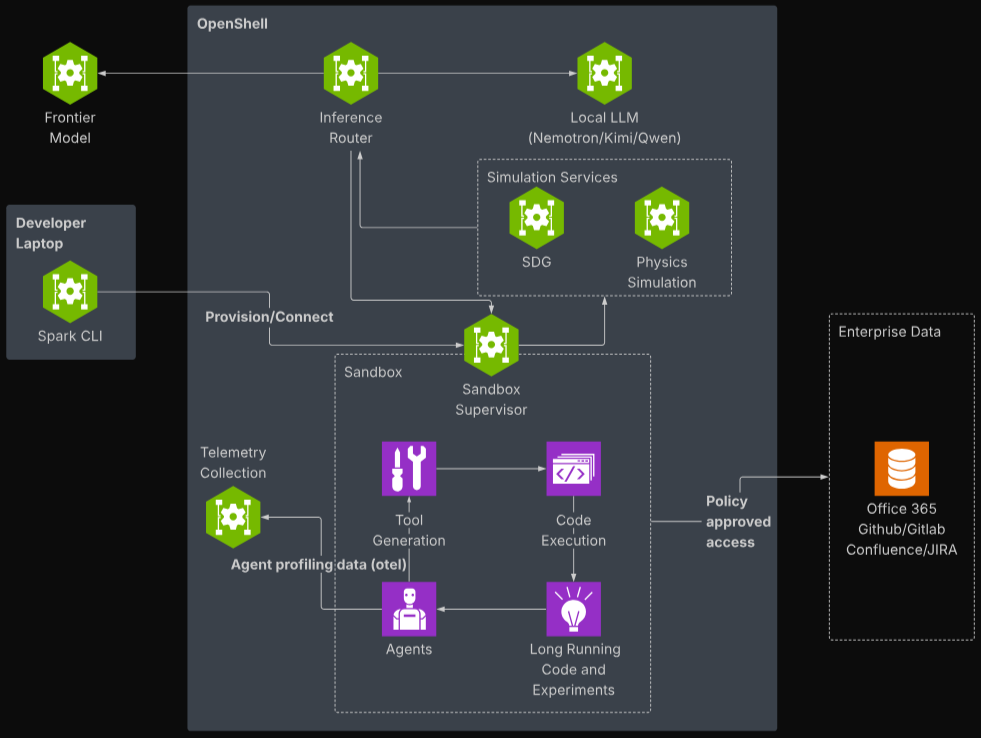
OpenShell Architecture Component Diagram
Reference and Image Source: NVIDIA
Benefits of NemoClaw
NemoClaw introduces a new approach to deploying AI systems, offering both significant advantages as the ecosystem continues to evolve.
- Isolated & Seamless Integration: Run OpenClaw as your agent in an Isolated Sandbox with no code changes required, ensuring a secure deployment without re-engineering your existing workflows.
- Private & Hybrid Inference: Achieve Private Inference by Default by utilizing local open models (such as NVIDIA Nemotron) on-device for sensitive tasks, while leveraging frontier cloud models only when needed for complex reasoning and planning.
- Zero-Trust Governance: Implement Deny-by-Default Access, where agents start with zero permissions. Every action must be explicitly approved based on specific intent and organizational governance, ensuring high-level security.
- Persistent & Cost-Effective Operations: Benefit from Always-on capabilities where agents continue working on DGX Spark or Station even after you close your laptop. This significantly reduces overhead by eliminating per-token cloud costs for local inference.
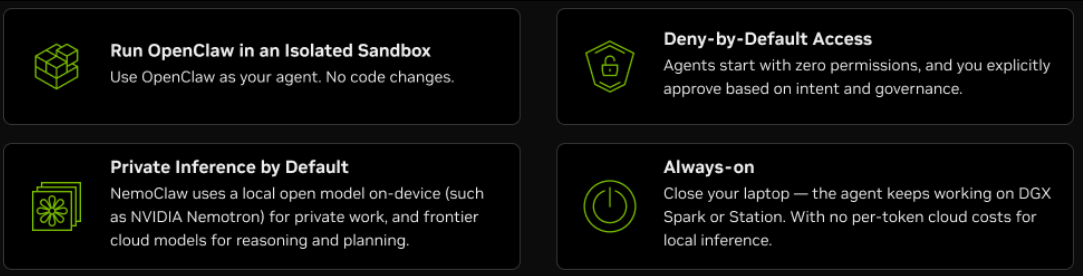
Reference and Image Source: NVIDIA NemoClaw Overview Page
Looking Ahead: The Future of SaaS with AI Agents
Looking ahead, the role of AI infrastructure will continue to expand.
Frameworks like NemoClaw are likely to become foundational components in AI-native systems, particularly as organizations seek more control over how autonomous agents operate.
As reliance on AI-driven processes increases, the demand for structured execution environments, governance mechanisms, and scalable orchestration will grow.
Rather than focusing solely on individual tools, the future of software will be defined by integrated systems that combine data, models, and execution layers. NemoClaw represents an early step in this direction, offering insight into how AI-powered systems may evolve.
Frequently Asked Questions
NemoClaw is a framework designed to securely deploy and manage AI agents in production environments, particularly for enterprise use.
OpenClaw focuses on experimentation and ecosystem development, while NemoClaw provides structured, secure deployment for real-world applications.
They automate complex workflows, improve response times, and enhance customer experiences, all of which contribute to higher efficiency and revenue growth.
Yes, but adoption may require investment in infrastructure and technical expertise.
At NVIDIA GTC 2026, the company introduced a comprehensive AI agent infrastructure strategy centered around the NVIDIA Agent Toolkit, which includes NemoClaw as its secure runtime layer. The toolkit combines multiple components such as the NemoClaw execution framework, the Nemotron family of open models, and AI-Q blueprints for agent workflows.
NemoClaw itself was announced as part of this ecosystem to provide a secure and scalable environment for running autonomous AI agents. It integrates with the OpenShell runtime and supports policy-based execution, enabling organizations to deploy “always-on” agents with built-in security and privacy controls.
More broadly, GTC 2026 highlighted NVIDIA’s shift toward agentic AI infrastructure, positioning AI agents not just as applications but as a foundational layer of future software systems.