
Summarize this blog article with AI:
 Ask ChatGPT
 Ask Grok
 Ask Perplexity
 Ask Claude
 Ask Google AI
Most enterprise security systems are designed to stop attackers from entering. Firewalls, endpoint protection, identity controls, and email security all play a role in preventing compromise. But even a well-defended organization can experience a breach. Unlike those perimeter security measures, network segmentation is responsible for limiting what happens once the attackers are already inside. While you can protect your organization on the outside, you still need solid defenses on the inside as well.
In this article, we explain how segmentation works, why it matters to business resilience, how traditional VLANs differ from micro-segmentation, and how to build a practical segmentation strategy. We also examine the role of segmentation in virtualized infrastructure and how Sangfor's enterprise-grade platform supports security across physical and virtual environments. For now, let’s get a better understanding of what network segmentation is.
What Is Network Segmentation?
Network segmentation is the practice of dividing a computer network into smaller, controlled subnetworks or security zones. Communication between those zones is then governed by security policies enforced through firewalls, access control lists, or software-defined networking. Rather than allowing every device and application to communicate freely, segmentation establishes rules about which systems may exchange traffic, what services they may use, and under what conditions.
The core benefit is blast-radius reduction. If one workstation is compromised, segmentation can prevent that device from reaching the HR database or a manufacturing network. The attacker may still have access to the compromised workstation, but the next steps require additional permissions or successful access across a security boundary.
Consider the pattern behind the 2013 Target breach. Here, attackers stole credentials from a third-party vendor, moved into Target's network, and eventually accessed payment card data. The incident illustrates why protecting the perimeter alone is not enough. Once an attacker obtains a foothold, the ability to move between systems becomes a separate security concern.
This is the same principle used in ransomware. An attacker who compromises one employee's laptop doesn’t necessarily need to encrypt that laptop to cause serious damage. It might be more valuable to reach further down the rabbit hole to domain controllers, backup systems, file servers, and business-critical applications. This is essentially the lateral movement problem, where attackers use an initial compromise to expand their access across the environment. Now, in a flat network, broad connectivity can make that expansion much easier.
Why Is Network Segmentation Important?
Effective network segmentation introduces controlled boundaries, limiting the systems an attacker can reach and the damage a compromised account or workload can cause. In 2026, enterprises are also struggling under the weight of managing hybrid cloud, virtual machines, containers, remote access, and increasingly automated attacks. These environments make network segmentation security much more complex, but they also make it much more important.
Now, network segmentation can be further categorized into two groups: macro-segmentation vs. micro-segmentation. Macro-segmentation divides an environment into broad zones, like corporate IT, production, development, the DMZ, and operational technology. It’s often implemented with VLANs, firewalls, and routing controls.
Micro-segmentation, on the other hand, applies more granular policies to individual workloads, applications, or groups of workloads. Two virtual machines on the same host, for example, may be restricted from communicating even though they share the same physical infrastructure. Both approaches have a role. Macro-segmentation establishes the main security boundaries, while micro-segmentation adds controls within those boundaries.
While network segmentation allows controlled communication between zones, there is a more restrictive approach called network isolation, which prevents communication altogether or allows only tightly managed connections. This is useful in air-gapped environments, highly sensitive systems, and certain operational technology networks. However, neither approach makes a system completely immune to compromise. Remember, the goal is to control the consequences of compromise.
The Business Perspective: What Segmentation Actually Prevents
Network segmentation is not a replacement for endpoint protection, identity security, or incident response. Its business value is that it limits the consequences of those controls failing. Here are some business-centered benefits of using the approach:
Ransomware Blast-Radius Containment
Ransomware attackers often need to discover systems, obtain additional credentials, and reach shared resources before they can cause widespread disruption. Now, a segmented environment can restrict those paths. For example, if an attacker compromises a workstation in the finance department, policy may prevent it from accessing backup management servers or production databases. The attacker would need to overcome additional controls rather than simply traverse the network.
While this does not guarantee that the ransomware will remain confined to one device or department, it does limit the risk. Still, misconfigured rules, compromised privileged accounts, and shared management infrastructure can create pathways. Segmentation is most effective when paired with tested backups, endpoint controls, identity security, and incident response.
Lateral Movement Prevention
The MITRE ATT&CK framework identifies lateral movement as a distinct stage of an attack. Attackers may use remote services, valid accounts, or stolen authentication material to move from one system to another. Segmentation makes these techniques harder by reducing the number of reachable systems and services. Reducing unnecessary legitimate connectivity can also reduce the opportunities an attacker has to exploit.
Limiting the Breach Scope
Segmentation helps separate sensitive information from less trusted environments. A development workload should not automatically have access to production customer records, and an internet-facing application should not have unrestricted access to internal administration systems.
A well-designed policy limits communication to the services and destinations required for the business function. This can reduce the number of systems involved in an investigation and help responders identify the affected zone more quickly.
Compliance and Audit Scope
Network segmentation can also support compliance programs. PCI DSS uses segmentation as a way to reduce the scope of systems subject to cardholder data requirements, provided the controls are properly designed and validated. MITRE's guidance similarly recommends identifying critical systems, separating them with logical or physical controls, and testing whether unauthorized access is blocked.
Segmentation is not a substitute for compliance. An organization still needs to validate its architecture, access controls, logging, and applicable requirements. However, separating systems according to data sensitivity and business function can make the compliance boundary easier to define and maintain.
Now that we have a firmer grasp on how segmentation helps, let’s explore the different approaches and how choosing the right approach starts with understanding what each one actually controls.
Network Segmentation Approaches: From VLANs to Micro-Segmentation
Different approaches solve different problems. The right network segmentation tools for your organization will depend on the environment, traffic patterns, and level of control required. These are some of the main approaches you could come across in the field:
| Approach | Primary Role | Key Consideration |
| VLAN-based segmentation | Separates broad network zones | Routing and firewall policy must prevent unwanted inter-VLAN access. |
| Firewall-based zones | Controls traffic between networks | Rule complexity and east-west inspection capacity matter at scale. |
| Software-defined networking | Centralizes policy across physical and virtual infrastructure | Requires suitable infrastructure and operational expertise. |
| Micro-segmentation | Restricts communication between individual workloads | Needs accurate application dependencies and granular policy enforcement. |
| Identity-based segmentation | Applies access based on users, devices, and context | Requires reliable identity, device, and policy integration. |
VLAN-Based Segmentation
VLANs divide Layer 2 network traffic into logical broadcast domains. They are widely used to separate departments, server environments, and other broad groups of systems. This approach remains useful because it’s familiar, widely supported, and relatively straightforward to implement. However, a VLAN is not automatically a complete security boundary. Inter-VLAN routing, permissive firewall rules, and shared services can still allow traffic between zones.
As an enterprise grows, the number of VLANs and associated rules can also become difficult to manage. The question is not how many VLANs an organization has, but whether the resulting traffic policy meaningfully restricts access.
Firewall-Based Zone Segmentation
Firewalls enforce rules at the boundaries between zones. It commonly places public-facing services in a secure subnetwork, or DMZ, separating corporate users from production systems and restricting access to operational technology.
This approach provides stronger enforcement than VLAN separation alone. Its challenge is maintaining rules as applications change. A firewall rule that was correct when an application was deployed may become unnecessary or overly permissive after a migration, a new dependency, or a change in ownership.
Software-Defined Networking
Software-defined networking, or SDN, separates network policy from the physical hardware that forwards traffic. Administrators can define policies centrally and apply them across supported physical and virtual infrastructure. This is particularly useful in dynamic environments where virtual machines move between hosts or workloads are provisioned frequently. The policy can follow the workload rather than relying entirely on a fixed physical port or network location.
Micro-Segmentation
Micro-segmentation applies controls at a workload or application level. A web server may communicate with an application server on a specific port, while the application server is allowed to access only its designated database. Other traffic is denied unless explicitly authorized. This approach is valuable for east-west traffic, which moves between internal systems rather than between the enterprise and the internet. Traditional network segmentation may leave gaps when workloads share a host or when traffic bypasses physical network enforcement points.
VMware NSX and Sangfor aNET are examples of software-defined networking technologies used to support granular segmentation in virtualized environments. Their capabilities, architecture, licensing, and operational requirements should be evaluated against the organization's infrastructure and security objectives.
Identity-Based Segmentation
Identity-based segmentation adds context to network access decisions. Instead of relying solely on IP addresses, a policy can consider the identity of the user, the device's security posture, or the application being accessed. This also aligns with Zero Trust segmentation, where access is continuously evaluated against defined policy rather than granted simply because a user or workload is inside a trusted network. Network segmentation remains one part of that model, alongside identity, device security, and application controls.
After seeing all the different segmentation approaches, let’s look at how you can implement a framework in a practical and efficient way. Remember, turning these approaches into a working program comes down to sequencing, not implementing everything at once.
Implementing Network Segmentation: A Practical Framework
The most common segmentation mistake is treating the project as a one-time network redesign. A more sustainable approach starts with business risk, establishes manageable boundaries, and expands controls as the organization learns more about its traffic. To help implement segmentation for your organization, we’ve designed a simple framework to follow:
Step 1: Map Existing Traffic Flows
Before changing access rules, you need to understand what communicates with what. Network flow monitoring can reveal application dependencies, remote administration paths, database connections, and unexpected traffic between systems.
CISA recommends maintaining network diagrams that describe major networks, data flows, interdependencies, and connections to third parties and cloud environments. These records also support incident response by showing where responders should focus their attention. The objective here is to map actual traffic, not merely the network as it was designed on paper.
Step 2: Define Zones Based on Business Risk
Group systems according to sensitivity, function, and business impact. A useful starting point includes corporate users, production applications, development, internet-facing services, and restricted infrastructure such as identity and backup systems. For each zone, ask:
- Which systems need to communicate?
- Which services are required?
- Which connections would create unacceptable risk
- Who owns the policy?
- How would access be verified during an incident?
A risk-based approach avoids spending the same implementation efforts on every system. High-value assets deserve more restrictive boundaries and more frequent validation.
Step 3: Start With Macro-Segmentation
Broad boundaries provide a manageable foundation. Now it’s time to separate corporate, production, DMZ, development, and OT environments where appropriate, then validate that business applications continue to function. This is also a practical way to build organizational confidence. In this way, network segmentation becomes a series of measurable changes rather than a large, disruptive project that attempts to redesign every connection simultaneously.
Step 4: Progressively Add Micro-Segmentation
Once macro-segmentation is working, extend controls to the highest-value workloads and applications. Begin with systems that present significant risk or have relatively clear communication requirements. For example, you could first restrict access to backup management servers, then add workload-level controls around payment processing applications and sensitive databases. This allows the security team to refine policy while reducing the risk of breaking critical business services.
Step 5: Monitor, Test, and Maintain
Segmentation policies drift as new workloads are deployed, applications change, and infrastructure is migrated. CISA and MITRE both emphasize maintaining network documentation, monitoring access, and testing whether segmentation controls work as intended. A mature program should include periodic policy reviews, access testing, and validation of the paths between restricted zones. A rule that exists in a firewall console is not proof that the intended boundary is effective.
While this is a comprehensive approach to segmentation, in the modern tech landscape, your company must also understand segmentation as it applies to virtualized and HCI environments.
Network Segmentation in Virtualized and HCI Environments
Because virtualization changes how workloads communicate, it also changes where network security needs to be enforced. In a traditional physical environment, traffic between servers commonly passes through switches, routers, or firewalls. However, within a hypervisor environment, two virtual machines on the same physical host can communicate without that traffic traversing the physical network. This creates a new approach to enterprise network segmentation where a policy enforced only at the physical network boundary may not control every internal communication path.
A virtualized environment can host many applications and workloads on a small number of physical servers. However, the convenience of shared infrastructure also means that a compromised virtual machine may have access to other workloads unless controls are applied at the appropriate layer.
To help, workload-level segmentation can restrict which virtual machines communicate, which ports are permitted, and how policy follows a workload when it moves between hosts. This is especially relevant to HCI, where compute, storage, and networking are integrated into a common infrastructure platform. Sangfor’s aNET component supports software-defined networking and micro-segmentation within Sangfor HCI environments, providing enterprise-grade virtualization and security for organizations operating across physical, virtual, and cloud environments.
At its core, the purpose of aNET is to give administrators a way to apply granular network policy to virtualized workloads, helping control east-west traffic without relying exclusively on physical network devices. For enterprises evaluating a VMware Alternative, this is an important architectural consideration. Network segmentation should be evaluated alongside the hypervisor, storage, management, and security controls rather than treated as an isolated networking purchase.
aNET vs. VMware NSX
VMware NSX and Sangfor aNET are examples of software-defined networking technologies used to support granular segmentation in virtualized environments. Their capabilities, architecture, licensing, and operational requirements should be evaluated against the organization's infrastructure and security objectives.
Deploying and operating NSX at scale also typically requires dedicated networking expertise, in addition to the underlying vSphere and vSAN licensing.
On the other hand, Sangfor aNET is designed to provide integrated networking and micro-segmentation as part of the HCI platform. aNET features no additional licensing requirements or separate management consoles, and ensures operational simplicity alongside the full aSV, aSAN, and Sangfor Cloud Platform stack.
Most VMware migration projects create a specific segmentation risk with policies that may be documented in the source environment but are not reproduced accurately in the destination. In that way, a workload that previously had restricted access could unintentionally receive broader connectivity after migration. Sangfor HCI, using aNET's software-defined networking capabilities, provides a framework for applying segmentation policy to migrated virtual machines.
How Sangfor Delivers Network Segmentation Across the Security Stack
Segmentation works best when enforcement and detection operate together. A firewall can restrict traffic, but security teams also need to know when an unusual connection occurs, when a policy is bypassed, or when a compromised account attempts to reach restricted infrastructure. Sangfor's security and infrastructure portfolio provides several components that can contribute to a coordinated segmentation program.
Sangfor’s Athena NGFW plays a crucial role in segmentation by enforcing access controls at network boundaries, including between corporate, production, DMZ, and external environments. Firewall-based segmentation can also be used to restrict access to sensitive systems and control traffic between zones.
Sangfor aNET then extends segmentation into the virtualized environment. By applying software-defined networking and micro-segmentation at the workload level, it can help enforce traffic policy between virtual machines and applications within Sangfor HCI. This addresses a common limitation of perimeter-only segmentation where traffic between workloads on the same host may never reach the physical firewall.
Sangfor’s Athena NDR helps security teams investigate suspicious activity and identify potential threats across the environment. In a segmentation program, this can complement enforcement controls by providing visibility into anomalous traffic, attempted lateral movement, or suspicious activity involving restricted systems. Segmentation defines what communication should be allowed; monitoring helps identify when activity does not match that policy.
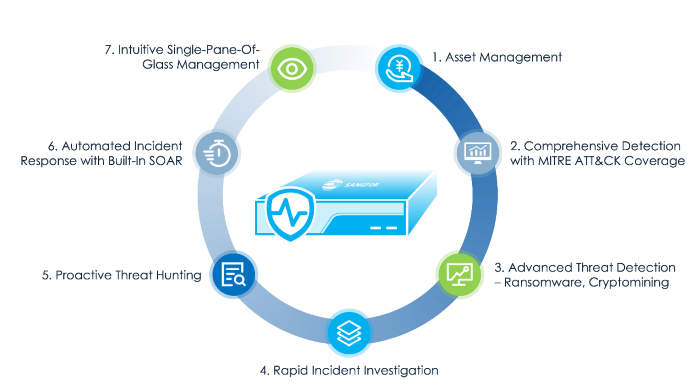
How Athena NDR Works at a Glance
A practical architecture combines zone-level firewall controls with workload-level policy and security monitoring. This provides multiple opportunities to restrict and detect unauthorized access. For example, an enterprise might use Sangfor’s Athena NGFW to restrict access to a production network, aNET to control communication between application workloads, and Athena NDR to investigate suspicious traffic involving those systems. The exact integration and capabilities should be validated against the organization's deployment requirements.
For enterprises considering VMware alternatives, the relevant question is not simply whether a platform offers a hypervisor or firewall. It is whether the overall architecture can support the organization's security, availability, operational, and migration requirements.
Network segmentation should be included in that evaluation from the beginning. It is a foundational approach that affects how workloads are connected, how incidents are contained, and how infrastructure changes can be managed safely. Ultimately, network segmentation should be a prime practice in your 2026 IT infrastructure toolkit.
FAQ
The practice of dividing a computer network into smaller zones and controlling communication between them to limit unnecessary access between systems and reduce the potential impact of a security breach.
Network segmentation generally creates broad boundaries between groups of systems, such as corporate IT, production, and the DMZ. Micro-segmentation applies more granular controls to individual workloads or applications, including systems that share the same physical host.
It reduces the number of systems an attacker can reach after gaining initial access. It helps limit lateral movement, protect sensitive resources, and reduce the potential scope of a breach.
By restricting the connections that attackers may use to spread ransomware between systems. It can limit access to file servers, backup infrastructure, and other critical assets, although it cannot guarantee that ransomware will be contained.
VLANs separate network traffic into logical Layer 2 networks and are commonly used for broad zone separation. Micro-segmentation enforces more granular, workload-level communication policies, making it suitable for controlling traffic within virtualized and cloud environments.