
Summarize this blog article with AI:
 Ask ChatGPT
 Ask Grok
 Ask Perplexity
 Ask Claude
 Ask Google AI
If your organization's most valuable data is powering AI, who controls the infrastructure it runs on?
A few years ago, this question wasn’t really on the radar. The trend was to move workloads to the cloud and focus on innovation rather than on how core systems were managed. AI complicates matters.
LLMs are extending their footprint in heavily-regulated sectors, and discussions about data residency and intellectual property are getting louder. Enterprises are grappling with rising infrastructure costs. Demand for compute is intensifying. Add a backdrop of geopolitical uncertainty, and it's easy to understand why technology leaders are rethinking where their AI workloads should run.
Those concerns have pushed sovereign AI onto the agenda. While governments build long-term national AI strategies, enterprises face a right-now challenge: how to strengthen their hold on the data and system architectures their AI initiatives depend on.
The stakes are high. McKinsey estimates that 30-40% of AI's future value is tied to sovereign or "sovereign-enough" environments; that is, deployments that give organizations a clear say over where and how their AI initiatives run. Gartner forecasts that global sovereign cloud IaaS spending alone could reach $80 billion by the end of this year.
Whether these predictions prove accurate or not, the direction of travel is clear. The most valuable AI use cases are turning up in mission-critical environments where control matters as much as capability.
So the conversation is shifting. If success in AI was once determined by the sophistication of the model, it's now being shaped by where data lives and how workloads are governed. In the past, AI was inexorably tied to the cloud. The future may depend on bringing some of it closer to home.
What Is Sovereign AI?
Sovereign AI refers to an organization's ability to build, implement, and govern AI while keeping a firm grip on the infrastructure that supports it. The objective is to ensure appropriate visibility and control, from the top of the enabling tech stack to the bottom.
Corporate board meetings offer a useful analogy. They’re often held in public venues, and under normal circumstances that works well. But if discussions involve strategic plans, intellectual property, mergers, or other commercially sensitive topics, executives will opt for a location where access, security, and governance can be tightly controlled.
Sovereign AI brings similar thinking to AI workloads. Enterprises gain more control over how AI systems are deployed, how data is managed, and how governance policies are enforced across the business.
Let’s look at the issues using three lenses: data sovereignty, infrastructure sovereignty, and AI governance.
Data Sovereignty
Data sovereignty refers to the ability to direct where data is stored, processed, and accessed. Whether enterprises are training models or running inference workloads, the quality and accessibility of data have a direct bearing on the outcome.
Organizations in highly-regulated industries feel it first. They face a growing burden of regulatory and certification requirements related to data residency, privacy, and protection. But AI sovereignty is about more than compliance.
Demands for greater data sovereignty are already influencing decisions about AI deployment models. As firms look to pull more value from their information assets, more attention is being paid to the environments where data is housed and processed.
Infrastructure Sovereignty
Infrastructure sovereignty refers to an organization's ability to control the underlying computing architecture that AI workloads run on, i.e., cloud platforms, virtualization layers, storage systems, and networking. That doesn’t require large language models to run entirely on-premises, but it does mean establishing the right levels of operational control.
The AI boom has amplified how important these decisions are strategically. Hyperscalers are hungry for compute, and GPU manufacturers are running into production bottlenecks. It's simply sound risk management to apply greater scrutiny to cloud dependencies.
That doesn't mean public cloud platforms have no role to play in enterprise AI. It simply means that when workloads require tighter governance or stronger oversight over data and operations, private and hybrid cloud architectures are gaining traction.
AI Governance
AI governance refers to the policies, processes, and tools that IT departments use to achieve sovereign AI objectives. It defines how AI systems access data, enforces security controls, tracks how models are used – and who uses them.
As AI systems become more embedded in business-critical processes, regulators, customers, and investors all want to see more accountability. That makes strong governance a prerequisite for scaling AI successfully. Demonstrate clear oversight of AI environments, and key stakeholders can feel confident that innovation sits in balance with operational resilience.
The trio of data sovereignty, infrastructure sovereignty, and AI governance form the foundation of Sovereign AI. The concept emerged from national efforts to build strategic AI capabilities. Now its significance for enterprises is becoming clear.
The conversation has moved beyond what AI can do to how it is operated. Increasingly, the question is being answered through infrastructure decisions.
Why Are Enterprises Moving AI Infrastructure Closer to Home?
AI typically starts as a data science initiative, but as projects move from pilot to production-scale, questions about how best to manage infrastructure, security, and cost can’t be easily separated from strategy. The answers are defined by five commercial realities:
Regulatory Compliance
Businesses face an expanding array of AI-relevant data privacy laws, sector-specific requirements, and governance frameworks across multiple jurisdictions.
That makes where infrastructure is located a vital consideration with a direct impact on compliance obligations. As a result, organizations are naturally paying closer attention to where AI workloads are processed and how the underlying architecture is managed.
Data Protection Requirements
AI systems are often trained on sensitive datasets that include customer, financial, healthcare, intellectual property, or proprietary business information.
Protecting these assets requires more than cybersecurity controls alone. Organizations increasingly want a more granular understanding of where data is processed, who can access it, and how it is governed throughout the AI lifecycle.
Intellectual Property Concerns
Many of the most valuable AI applications are built on proprietary knowledge. It lives in documents, CAD files, software code, research data, and operational expertise, all of which are being fed into AI systems. The greater the strategic value of that information, the greater the emphasis on maintaining control over how it is used, stored, and accessed.
For some organizations, protecting intellectual property is becoming a key factor in AI infrastructure decisions.
AI Governance
As organizations deploy AI across more business functions, company leaders are being asked new questions about accountability. Issues of transparency, bias, compliance, and risk are rapidly moving from the IT department to the boardroom. Understanding how AI systems are trained, how decisions are made, and how outcomes can be monitored is becoming an essential part of enterprise governance.
These concerns are encouraging many organizations to seek greater oversight of the data that supports AI initiatives and the infrastructure that processes it.
Why Public Cloud Alone May Not Be Enough for Enterprise AI
Can AI still run entirely in the public cloud? The short answer is yes. Organizations deploy AI applications on public cloud platforms every day. Public cloud providers play a critical role in accelerating AI innovation.
But should every AI workload operate in a hyperscaler’s data center? That requires a more considered answer.
As more AI projects come online, organizations are learning that some workloads have specific requirements and managing them can be operationally complex. Factors like data sensitivity, regulation, performance needs, and governance influence where and how different AI workloads are deployed.
Those variable needs are prompting many enterprises to complement public cloud environments with private and hybrid infrastructure.
Cost Considerations
Public cloud offers exceptional flexibility for experimentation and scaling-up quickly. However, AI introduces cost considerations such as high-performance computing, persistent storage, large-scale inference, and data transfer costs. Any of these could influence the total cost of ownership over time. AI imposes them all at once.
By 2028, IDC predicts 60% of multinational firms will split AI stacks across sovereign zones, potentially tripling integration costs as regulatory fragmentation and supply chain risks slow down scaling. As AI sovereignty expands, organizations need to decide which workloads benefit most from cloud elasticity and which may be better suited to environments that offer greater cost predictability.
Data Gravity
Corporate data tends to cluster around core business processes. Moving large volumes of data between what are typically high-activity environments can introduce complexity, increase costs, and create new governance worries.
For AI workloads that depend on frequent access to big data repositories, it may be more practical to bring compute closer to the data, rather than bring data closer to the compute.
Compliance Requirements
Organizations in regulated industries face strict requirements about how data is stored, processed, and protected.
Public cloud providers offer extensive compliance capabilities. But some organizations need more, especially in areas like data residency, access policies, and audit. These can influence where certain AI workloads are deployed and how they are governed.
Latency and Performance
Some AI workloads can’t tolerate the delays associated with moving data across networks or between regions. Applications promising real-time decision-making or richer customer experiences may need low-latency access to data and compute.
In these scenarios, infrastructure located closer to users, devices, or data sources can help keep performance and responsiveness running at GenAI speeds.
Governance and Control
Not every AI workload carries the same level of risk or sensitivity. A customer-facing chatbot may have very different governance requirements than an internal knowledge assistant trained on proprietary information, or an AI agent supporting regulated business processes.
That’s why many enterprises are now looking for a better balance between innovation and control. Public cloud remains essential – particularly for access to advanced AI services – but organizations are increasingly evaluating which workloads will benefit from greater oversight and stronger controls.
Policies and frameworks matter, but they must be backed by visibility into how AI systems operate. The challenge now is to create an AI operating model that allows workloads to run in the environments best suited to the business’s wider needs.
The Rise of Hybrid Cloud for Enterprise AI
One size rarely fits all in enterprise AI. Some workloads demand strict control over data and governance. Others benefit from virtually unlimited scale. Still others need to operate close to users, devices, or operational systems.
As a result, enterprises are increasingly adopting hybrid cloud architectures that allow AI workloads to run where they make the most sense.
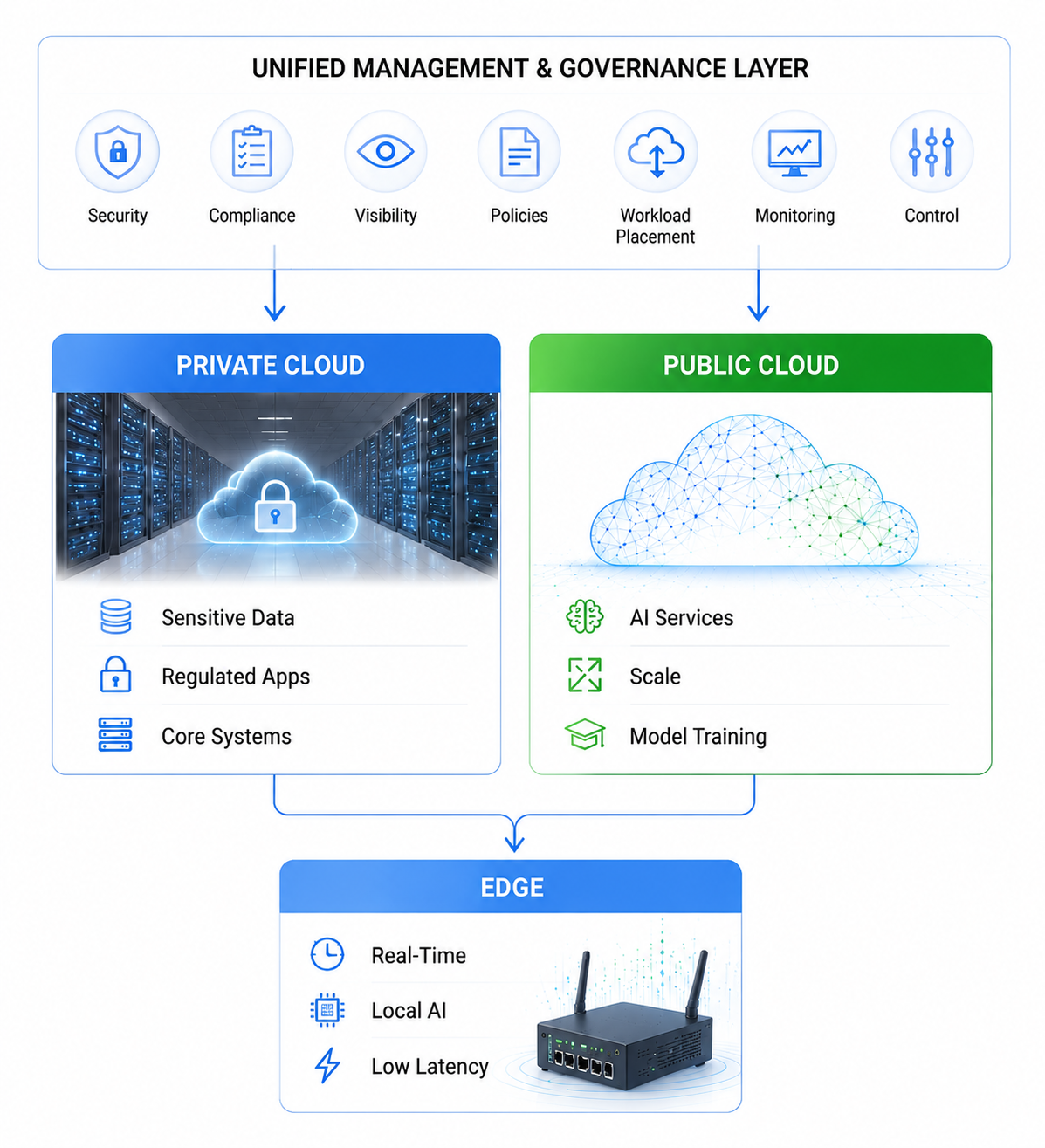
Private Cloud: Control Where It Matters
For many enterprises, private cloud is becoming the home for their most valuable data and AI assets. Sensitive data, regulated information, proprietary intellectual property, and business-critical applications often demand stricter governance and security. Private cloud helps maintain closer oversight of these workloads while supporting Sovereign AI objectives.
Edge Infrastructure: AI at the Action Point
Some actions simply can’t wait. As AI moves into operational environments like hospitals, retail outlets, and factories, AI may need to operate close to where data is created. Processing workloads at the edge can reduce latency and improve responsiveness while also supporting local data handling requirements.
Hybrid Cloud: Bringing It All Together
In a hybrid cloud model, IT teams get the freedom to segment workloads according to specific needs. More sensitive processes might be better handled in a private cloud environment, while compute-hungry workloads benefit from public cloud scalability. If an application needs less latency, it can run at the edge. The end result is more control and a more adaptable technical foundation.
Building an AI-Ready Infrastructure Foundation
Hybrid cloud may provide the optimal operating model for sovereign AI, but AI at scale requires infrastructure that can manage complex demands across multiple environments. The more sophisticated the AI ambition is, the more important the underlying foundation becomes.
High-Performance Virtualization
Organizations need virtualization platforms capable of delivering maximum operational efficiency across a changing mix of applications and workloads. At the same time, IT teams are expected to find new ways to simplify management and make better use of current resources.
A modern virtualization layer provides the flexibility to deploy and manage workloads consistently while supporting the performance requirements of enterprise AI.
Unified Compute and Storage
Training, inference, analytics, and data-intensive applications all consume AI infrastructure resources quickly. Managing them through siloed systems often increases complexity and adds to operational overhead.
A unified approach to computing and storage helps improve resource utilization and create a more scalable foundation for AI workloads.
Container and VM Support
Enterprise AI rarely starts with a clean slate. Most organizations have a mix of modern cloud-native applications sitting alongside older systems. Some AI workloads are deployed in containers, while other applications operate within virtual machines.
Supporting both environments lets companies modernize at their own pace without creating unnecessary complexity or disrupting existing operations.
AI Resource Management
Growing demand for GPUs, rising infrastructure costs, and increasing pressure to demonstrate ROI have made compute a strategic asset. That’s pushing organizations to think more carefully about resource allocation, meaning AI workloads must compete with other business priorities.
When AI resources are managed well, workloads are prioritized appropriately, and teams can scale AI initiatives without diminishing operational control.
Enterprise Security and Reliability
Security and reliability are becoming essential requirements for successful AI adoption. Organizations need infrastructure capable of protecting sensitive data and resilient enough to maintain operational stability.
Sovereign AI objectives need platforms that can combine performance, flexibility, governance, and operational simplicity across different deployment models.
Building that foundation is becoming a critical step in turning sovereign AI ambitions into operational reality.
What Mid-Market and Large Enterprises Should Look for in an AI Platform
Running a successful AI pilot is one thing. Supporting business-critical operations with AI is another. As organizations pursue Sovereign AI objectives, the platform decisions will shape the organization's ability to scale AI, govern it effectively, and adapt as requirements evolve.
When evaluating AI-ready infrastructure, enterprises should seek out these capabilities:
Enterprise-Grade Virtualization
Virtualization remains the foundation of modern IT environments. Organizations should look for platforms that can support high-performance workloads, simplify administration, and provide the flexibility to run applications consistently across private cloud, public cloud, and hybrid environments.
Enterprise-Grade Hyperconverged Infrastructure
An AI strategy is only as strong as the infrastructure supporting it. As AI workloads grow, infrastructure complexity can grow too. Hyperconverged infrastructure (HCI) helps consolidate compute, storage, networking, and management into a unified platform. Operations are simplified, and resource utilization improves.
Support for Containers and Virtual Machines
Most enterprises operate a mix of traditional and cloud-native applications. The ability to support both virtual machines and containers enables organizations to modernize infrastructure without disrupting existing systems. It also provides greater flexibility when deploying AI applications across different environments.
Unified Cloud Management
Hybrid cloud offers flexibility, but it can also introduce complexity. Organizations should look for platforms that offer unified management across multiple environments. Bringing multiple systems under one master control panel simplifies operations. It also supports security and workload portability objectives.
Built-In Security and Governance
AI can only be trusted if the infrastructure behind it is trustworthy. That means having a granular view into who is accessing data, how workloads are behaving, and where the potential risks are. Built-in security controls and continuous monitoring help pave the way to scaling AI with confidence.
Operational Simplicity
AI’s job is to create business value but often adds an administrative burden. The most effective infrastructure platforms help IT teams spend less time managing complexity and more time supporting innovation. Simplified administration, centralized management, and automation can make it easier to scale AI initiatives without scaling operational headaches.
An AI-Ready Architecture
As AI adoption expands, organizations should look for architectures designed to support expansion from day one. An AI-ready architecture will be scalable across private cloud, public cloud, and edge environments. It should demonstrate flexibility for evolving workload requirements and integrate with existing systems.
Sovereign AI Needs Sovereign Infrastructure
One of the inherent risks in the AI surge adoption is that infrastructure complexity will grow with adoption.
Organizations need to support a mix of virtual machines, containerized applications, and traditional business systems – some spread across different geographies and environments. In the rush to embrace innovation, enterprises could end up with a fragmented architecture that works well enough today, but isn't future-proofed for change.
This is where infrastructure decisions become strategic. Alongside ample compute and storage capacity, the underlying systems must provide:
- Proactive and reliable stability
- Consistent experience based on a seamless ecosystem
- Robust, built-in security
While making it easier for AI applications to be governed at scale.
Sangfor brings a unique and proven approach to these challenges. Sangfor HCI combines virtualization, storage, networking, security, and management in one unified platform. It supports virtual machines and containers natively and protects data and systems with built-in security. IT teams can better protect workloads, maintain visibility, and simplify management across increasingly distributed environments.
Together with Sangfor Cloud Platform and Sangfor Hypervisor, organizations gain a secure, scalable, and enterprise-grade foundation for AI across private, public, and hybrid cloud deployments.
AI's future will be shaped both by the models organizations adopt – and by the infrastructure they choose to trust. Sangfor is proud to be recognized as a Representative Vendor in the 2026 Gartner® Market Guide for Cloud Infrastructure Sovereign Solutions. This recognition reinforces our commitment to providing the secure, sovereign, and transparent infrastructure necessary for organizations to regain control over their data and AI operations—enabling them to innovate in the AI era while meeting the highest standards of digital sovereignty.
Advancing the Sovereign AI Conversation
Sovereign AI is often framed in terms of models, regulations, and data. As the concept moves from idea to implementation, deciding which cloud platforms, virtualization technologies, and architectures support governance and operational control will determine who embraces sovereign AI successfully.
Sangfor continues to explore these trends and the role infrastructure plays in supporting enterprise AI at scale. Explore our latest insights to learn more about the foundations supporting sovereign AI environments.
Frequently Asked Questions
Sovereign AI refers to the ability of organizations to develop and deploy AI systems while maintaining control over the data, infrastructure, and policies that support them. It combines principles of data sovereignty, infrastructure sovereignty, and AI governance.
Many firms successfully run AI workloads in the public cloud. However, factors such as compliance, latency, and security may require some workloads to deploy in private cloud, hybrid cloud, or edge environments.
Hybrid cloud allows organizations to place AI workloads in the environments best suited to their requirements. Sensitive data can remain in controlled private environments, while public cloud resources can provide scalability and access to advanced AI services.
Organizations should look for enterprise-grade virtualization, hyperconverged infrastructure, support for containers and virtual machines, unified management and visibility, and built-in security and reliability.
Infrastructure – the underlying compute, storage, networking, virtualization, and cloud resources that enable AI applications and workloads to run – provides the visibility and control needed to enforce AI governance policies.