
Summarize this article with AI:
 Ask ChatGPT
 Ask Grok
 Ask Perplexity
 Ask Claude
 Ask Google AI
For decades, many organizations standardized on a handful of infrastructure vendors.
Today, the rules are changing. AI workloads, changing software licensing models, geopolitical uncertainty, and budget pressures are forcing CIOs to rethink long-standing procurement strategies.
However, the rules have changed significantly since then, following rapid digital transformation, the emergence of AI workloads, and fluctuating virtualization software licensing models, alongside geopolitical uncertainty and budget constraints that have forced CIOs to reconsider the beaten path and create their own IT procurement strategy. Today, we’ll be looking at why organizations are changing the way they approach enterprise IT infrastructure and how it's shaping the sector for good.
Why Are Enterprises Reconsidering Traditional IT Infrastructure Vendors?
Organizations are changing their IT infrastructure vendors due to AI infrastructure requirements, rising costs, and the need for flexibility in volatile times. With increasing supply chain uncertainty and VMware licensing changes reshaping the industry, companies are also looking to manage risks by prioritizing agility and interoperability across virtualization software and cloud environments.
The AI wave seems to be the biggest contributor to the mass movement away from traditional IT vendors. Industry research by Gartner showed that 54% of Infrastructure and Operations leaders state that cost optimization is their top goal for adopting AI. As more companies look to join the fast lane of digital transformation in the AI age, IT leaders are no longer evaluating infrastructure solely on technical performance. Instead, they are prioritizing long-term adaptability and strategic control over their technology stack.
How Vendor Lock-In Became One of the Biggest Infrastructure Risks
In today’s rapidly evolving digital landscape, vendor lock-in has evolved from a technical concern into a strategic business risk. As more enterprises shift to expand their digital ecosystems, depending on a single service provider can significantly affect innovation potential and operational efficiency.
What Is Vendor Lock-in?
Vendor lock-in refers to when an organization becomes completely or heavily reliant on a single vendor for their services. For most companies, this can quickly become an expensive endeavor that ultimately limits flexibility and increases the risk of systemic vulnerabilities and failure.
The Hidden Costs of Infrastructure Lock-In
While you might think that sticking to a single vendor would simplify and reduce your budget, it can actually lead to long-term expenses further down the line. The core costly concerns of lock-in include:
Unpredictable changes in licensing and subscription models. Consider the rush to find VMware alternatives following their price changes.
- Increased difficulty in migrating workloads.
- Reduced negotiation leverage when looking at contract and subscription renewals.
- Limited access to innovation outside of your chosen single-vendor ecosystem.
Constraints on adopting modern virtualization software and AI-enabled architectures.
These vendor lock-in risks are suddenly becoming more relevant as organizations move to modernize infrastructure to meet a rapidly evolving digital landscape.
Why Are Multi-Vendor Strategies Becoming More Popular?
To combat single-vendor lock-in and ensure a flexible IT infrastructure, many companies are adopting multi-vendor and hybrid infrastructure strategies across their IT ecosystems. This trend can be seen across cloud infrastructure, cybersecurity vendors, and enterprise virtualization providers.
- Cloud Providers: To help with expenses and single-vendor dependency, organizations are distributing workloads across multiple clouds.
- Cybersecurity Platforms: To ensure fewer vulnerabilities and reduce single points of failure, integrating multiple security tools can improve an enterprise’s cybersecurity.
- Enterprise Virtualization: Hot on the heels of the search for VMware alternatives, businesses are looking for AI-enabled and flexible virtualization platforms to diversify their infrastructure.
It’s important to note that the objective of multi-vendor IT strategies is not to eliminate compatible vendor partnerships but to avoid structural dependency that limits long-term flexibility and innovation. Now, let’s look at how AI has been shaping the way we approach IT infrastructure.
How Is AI Changing the Way Enterprises Buy Infrastructure?
Unlike traditional workloads, AI infrastructure requires GPU-intensive compute, secure and sovereign data management, hybrid cloud flexibility, and simplified operational models that can support rapidly evolving AI workloads across enterprise environments. This also includes elastic scalability for unpredictable AI demand cycles and hybrid cloud architectures that span edge, private, and public cloud environments.
According to a 2025 IBM Institute for Business Value report, a more fundamental challenge for AI projects remains a fragmented technology foundation that cannot support the needs of production AI use cases. According to their research, executives have reported that vendor lapses are the top reason AI infrastructure efforts fall short. They state that partners must be chosen strategically, ensuring they bring both an understanding of an organization’s business context and technical capabilities.
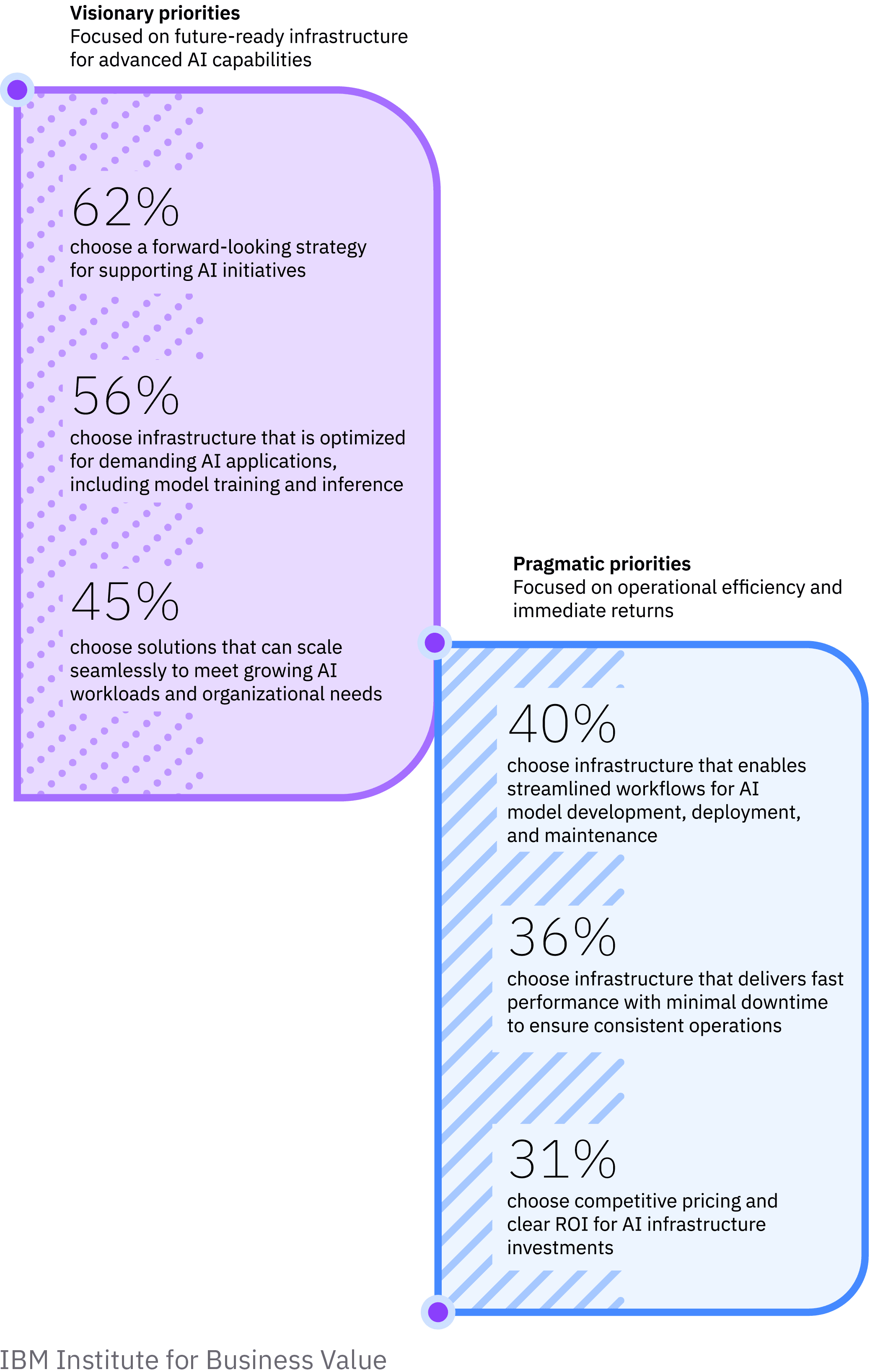
Sourced from IBM Institute for Business Value
These demands have pushed organizations to invest in infrastructure differently, aiming for modern enterprise virtualization and software strategies that can keep up with AI workloads. Traditional environments designed for static workloads are increasingly being challenged by dynamic AI-driven demands. To truly prepare for this modern era, let’s look at the top five characteristics you'd find in a future-ready infrastructure vendor.
Five Characteristics of Future-Ready Infrastructure Platforms
To truly streamline your organization’s infrastructure modernization, five key characteristics can be used to consistently define future-ready platforms. These elements are central to infrastructure selection criteria across CIO and procurement teams.
1. Predictable Cost Models
Navigating volatile licensing fee tiers and subscriptions can take its toll on developing efficient infrastructure. A dependable provider ensures stable and transparent cost structures to improve your organization’s long-term financial planning and reduce the risk of sudden pricing shifts.
2. Open Ecosystems and Integrations
To allow your infrastructure to integrate seamlessly with existing cloud, security, and automation tools, your ideal provider should allow an open ecosystem, reducing dependency on proprietary architectures and allowing companies to adopt adaptive solutions across their technology stack without vendor lock-in fears.
3. Hybrid Cloud Flexibility
The hybrid cloud is now a default architecture rather than a transition strategy for most organizations. Enterprises require flexibility that supports seamless workload mobility across private and public cloud environments.
4. AI-Ready Architecture
To truly be prepared for the AI era, infrastructure providers should ensure future-ready platforms designed to natively support AI infrastructure requirements, including high-performance compute and GPU support.
5. Operational Simplicity
To ensure simplicity and ease of operations, the ideal infrastructure vendor should ensure seamless and integrated solutions that are easy to navigate and use. The Hyper-Converged Infrastructure (HCI) is an excellent example of an integrated and effortless virtualization platform that helps to reduce complexity by consolidating compute, storage, and networking into unified management layers.
Now, let’s look at what the CIOs in charge of everything should be thinking about before they put all their eggs in one basket for their IT infrastructure investment.
What CIOs Should Consider Before Their Next Infrastructure Investment
CIOs can reduce infrastructure risk for efficient AI infrastructure adoption by considering several factors, including migration flexibility, licensing exposure, and long-term compatibility. To simplify this process further, we’ve created a handy checklist for CIOs to assess their infrastructure risk:
- Assess current licensing exposure and cost variability
- Evaluate your organization’s migration flexibility
- Review AI infrastructure readiness and GPU scalability
- Assess ecosystem compatibility and integration capabilities
- Analyze supply chain resilience and infrastructure sourcing diversity
- Calculate long-term Total Cost of Ownership (TCO)
- Review governance, compliance, and data sovereignty requirements
- Define a clear infrastructure modernization roadmap
This detailed framework and guideline should ensure that your infrastructure procurement decisions are aligned with both current operational needs and future AI-driven transformation.
The Future of Enterprise IT Procurement Is Choice, Not Dependency
The enterprise infrastructure landscape is being reshaped and molded into something new and exciting with every technological innovation made. As the market changes, organizations need to seek out flexible, resilient, and future-ready infrastructure to stay ahead. With the AI era sweeping through the industry, companies should be looking towards diversification of IT solutions, improving agility, and accelerating infrastructure modernization.
Companies and CIOs who prioritize the flexibility and interoperability of their infrastructure to keep up with the rapidly evolving times are bound to be more equipped to handle AI-driven growth and innovation in the future. Ultimately, your infrastructure partner of choice should be able to adapt to these changing times with future-proof infrastructure strategies.
Sangfor Cloud Solutions: Resilient Cloud Infrastructure
As organizations face rising infrastructure costs driven by energy price volatility, memory inflation, cloud spending, and growing AI demands, Sangfor helps enterprises build more cost-resilient IT environments through its integrated server virtualization, Hyper-Converged Infrastructure (HCI), and private cloud platform.
Trusted by over 28,000 customers worldwide, Sangfor enables organizations to consolidate compute, storage, networking, backup, and disaster recovery within a unified architecture, improving resource utilization while reducing infrastructure complexity and operational overhead. Built-in capabilities such as Continuous Data Protection (CDP), High Availability (HA), Disaster Recovery Services (DRS), and seamless migration from physical servers, VMware, Hyper-V, KVM, and public cloud environments help organizations modernize existing infrastructure investments while maintaining business continuity and long-term operational resilience.
Frequently Asked Questions
Vendor lock-in occurs when an organization becomes heavily dependent on a single infrastructure provider, making it difficult and costly to migrate to alternative platforms without operational disruption.
AI increases the demand for GPU resources, scalable computing, and hybrid environments, pushing organizations to rethink traditional virtualization software and adopt more flexible, secure, and simplified architectures.
To prevent the risk of vendor lock-in, to avoid fluctuating licensing costs, and to invest in modernized infrastructure that is AI-ready and scalable.
Hyperconverged infrastructure simplifies IT operations by integrating compute, storage, and networking, supporting both traditional workloads and AI infrastructure requirements.
To reduce infrastructure risk, CIOs can diversify their vendor options, assess their licensing exposure, ensure seamless workload portability, and adopt hybrid cloud strategies aligned with long-term, AI-ready modernization goals.
For CIOs looking to invest in future-ready infrastructure, you should consider a vendor that provides predictable subscription models, open ecosystems with seamless migration options, hybrid cloud flexibility, AI-ready architecture, and user simplicity.