
Introduction
In 2025, IT leaders face mounting pressure to streamline operations, reduce costs, and enhance security amidst evolving data center demands. The Broadcom acquisition of VMware has intensified scrutiny, with enterprises grappling with complex licensing models, escalating costs, and fragmented support. Sangfor SDDC (Sangfor HCI product Family for software-defined data center) has emerged as a solution to simplify IT architecture, consolidating compute, storage, and networking into a unified platform. It stands out as a compelling alternative to VMware, offering an all-in-one solution that eliminates silos and reduces reliance on third-party tools. Recognized by Gartner as a Sample Vendor for VMware alternatives , Sangfor SDDC delivers simplicity, scalability, and cost-efficiency for modern enterprises. This blog explores how Sangfor’s integrated approach addresses VMware’s complexity, empowering organizations to modernize their IT infrastructure effectively.
Market Landscape & Industry Trends
The current IT environment is defined by rising cloud expenses, concerns over vendor lock-in, and the need for flexible, scalable infrastructure. Broadcom’s acquisition of VMware has disrupted the market, with changes like the shift to subscription-based licensing, minimum core purchase requirements, and reduced support tiers creating uncertainty for businesses. According to Gartner, “I&O Leaders Must Rapidly Identify the Most Suitable VMware Alternatives for Their Environment,” highlighting the urgency for alternatives that balance performance and simplicity. Sangfor SDDC Stack is gaining traction as organizations seek unified platforms to support diverse workloads, from AI to edge computing. Sangfor aligns with these trends, that integrates compute, storage, networking, and security, reducing complexity and Total Cost of Ownership (TCO).
Comparative Analysis: Sangfor SDDC vs. VMware
Sangfor SDDC and VMware differ significantly in their approach to IT architecture simplification. Below is a feature comparison:
| Feature | Sangfor SDDC | VMware |
|---|---|---|
| Licensing | Simple, all-in-one licensing model | Complex, subscription-based with tiers |
| Cost | Up to 70% lower TCO | High upfront and recurring costs |
| Integration | Compute, storage, networking, security | Requires third-party tools for full SDDC |
| Security | Built-in NFV: NGFW, WAF, IPS, EDR with Anti-Ransomware Snapshot and connecting to Home grown NDR | Fragmented across vCenter, NSX, vRealize and 3rd Party Backup Solution |
| Management | Single-pane-of-glass GUI, WYDIWYG editor (Drag-n-Drop Networking Configuration) | Multiple management interfaces |
| Support | Localized, responsive support | Limited post-acquisition support |
Sangfor SDDC’s integrated platform eliminates the need for multiple vendors, reducing complexity and costs. VMware’s reliance on add-ons for security and networking creates silos, while Sangfor’s all-in-one stack ensures seamless interoperability.
Sangfor’s Solution: Features & Benefits
Sangfor SDDC consolidates critical data center functions into a single platform, offering:
- Unified Architecture: Integrates aSV hypervisor, aSAN storage, aNET networking, and SCP management, eliminating silos.
- Cost Efficiency: Reduces TCO with a “one edition fits all” licensing model.
- Integrated Security: Includes Next-Generation Firewall (Network Access), Web Application Firewall (WAF), and Built-in Endpoint Detection and Response (EDR) for comprehensive protection.
- Ease of Use: A visualized GUI and WYDIWYG topology editor simplify network management.
- Seamless Migration: VMware-like architecture minimizes retraining and supports tools like Netbackup or Veeam (coming soon) for easy transitions. Sangfor SDDC’s certifications, including Gartner recognition, validate its enterprise-grade reliability. Explore product details at Sangfor SDDC Compatibility.
Analyst & Industry Recognition
Sangfor’s success has earned it a place in the 2025 Gartner Market Guide as a Representative Vendor for Full-Stack Hyperconverged Infrastructure, and as a Sample Vendor for VMware Alternatives.
With a 100% Willingness to Recommend, Sangfor was also peer-recognized as a “Strong Performer” in the 2024 Gartner Peer Insights™ Voice of the Customer for Full-Stack Hyperconverged Infrastructure Software . Peer-based feedback highlights the ease of use, exceptional integration, lower TCO, and the ability to fulfill business agility requirements for modern use cases. Sangfor’s product evolution is also lauded for frequent, meaningful updates, often based on direct customer input.
Migration Strategies: Smoother Transitions from VMware to Sangfor SDDC
Gartner specifically recommends Sangfor SDDC for organizations seeking to replace VMware with seamless migration and minimal risk. Migrating from VMware to Sangfor is a three-step journey, supported by Sangfor’s built-in and partner tooling:
- Hybrid Coexistence
- Run VMware and Sangfor in parallel.
- Migrate non-critical workloads Sangfor SDDC for pre-prod proof of concept.
- Phased Migration and DR
- Incrementally transition key workloads.
- Use near-zero-downtime migration tools: agentless or agent-based, supporting vCenter integration, snapshot-based transfer, or hot backup with continuous data protection.
- Built-in DR and rollback capabilities ensure operational continuity and minimize business risk.
- Full Cutover
- Decommission VMware infrastructure after validating Sangfor performance and savings.
- Centralize operations on Sangfor’s unified stack, supported by 24/7 managed services, with proactive monitoring and health checks.
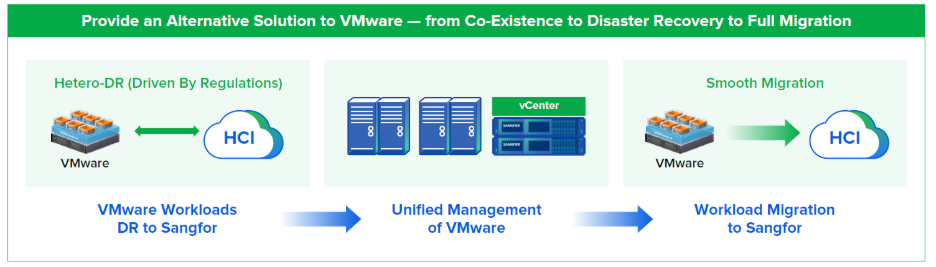
Sangfor provides detailed migration kits, user handbooks, and zero-cost consultancy to ensure a smooth, risk-averse migration.
The economic benefit of Sangfor SDDC is consistently highlighted by customers and analysts:
- Up to 50% reduction in total cost of ownership (TCO):
- Lower CapEx: fewer hardware purchases, less over-provisioning
- Lower OpEx: reduced data center space, power, and cooling requirements; IT team focus on high value business deliverables.
- Significant software/licensing savings versus VMware’s multi-SKU model
- Single-vendor support: removes the need for multi-party troubleshooting or cross-vendor support contracts, further reducing support costs and time to resolution
Customers report rapid ROI through lower licensing costs, streamlined management, and the ability to scale or pivot without costly hardware refresh cycles or multi-tier licensing traps.
Real-World Use Case: Transitioning to Sangfor SDDC Solution
A mid-sized financial institution in Asia faced challenges with VMware’s escalating costs and complex management. With VMware setup, the IT team struggled with siloed storage and security tools, leading to inefficiencies. After evaluating alternatives, they migrated to Sangfor SDDC Solution in 2024. The transition, supported by Sangfor’s migration assessment tools, was completed in three months with minimal disruption. Key outcomes included:
| TCO of SME | Sangfor | VMware |
|---|---|---|
| Servers & Storage | $30,000 | $50,000 |
| Power & Cooling (3 yrs) | $6,000 | $15,000 |
| IT Labor (3 yrs) | $18,000 | $36,000 |
| Licensing & Support (3 yrs) | $12,000 | $45,000 |
| Maintenance & Upgrades | $4,000 | $12,000 |
| Total TCO (3 yrs) | $70,000 | $158,000 |
| TCO of Large Corp | Sangfor | VMware |
|---|---|---|
| Servers & Storage | $150,000 | $250,000 |
| Power & Cooling (3 yrs) | $30,000 | $60,000 |
| IT Labor (3 yrs) | $90,000 | $180,000 |
| Licensing & Support (3 yrs) | $60,000 | $180,000 |
| Maintenance & Upgrades | $20,000 | $60,000 |
| Total TCO (3 yrs) | $350,000 | $730,000 |
* Disclaimer: The Total Cost of Ownership (TCO) insights presented derived from Sangfor’s internal evaluations and real-world deployments. Results may vary depending on specific environments and configurations.
- 50% Cost Reduction: Simplified licensing and lower TCO.
- Unified Management: A single GUI streamlined operations.
- Enhanced Security: Built-in firewall and IPS eliminated third-party dependencies.
- Improved Uptime: Native multi-copy mechanisms ensured high availability. The CIO noted, “Sangfor HCI transformed our IT operations, reducing complexity and freeing resources for innovation.” A full case study is available on our website.
Future Outlook & Strategic Recommendations
As IT trends shift toward AI, edge computing, and hybrid cloud, Sangfor SDDC is well-positioned with its scalable, flexible platform. Its R&D investments focus on supporting AI workloads and edge deployments, ensuring future-readiness. IT leaders should:
- Assess VMware Costs: Evaluate TCO against Sangfor’s cost-saving model.
- Test Parallel Operations: Run Sangfor SDDC alongside VMware for non-critical workloads to ensure compatibility.
- Leverage Migration Tools: Use Sangfor’s assessment services, with built-in DIY and batch migration tool for seamless transitions.
- Prioritize Security: Opt for integrated solutions to reduce third-party dependencies. Sangfor’s roadmap includes enhanced AI integration, promising further simplification.
Conclusion
Sangfor SDDC (HCI & Product Family) offers a powerful alternative to VMware, eliminating silos, reducing costs, and simplifying IT architecture with its all-in-one platform. By integrating compute, storage, networking, and security, it addresses VMware’s complexity and post-acquisition challenges. Enterprises seeking agility and efficiency in 2025 should consider Sangfor. Request a demo at Sangfor’s website to explore how Sangfor can transform your IT stack.
Contact Us for Business Inquiry
FAQs
Sangfor integrates compute, storage, networking, and agentless built-in security into a single platform, eliminating silos and third-party dependencies. It also has Enterprise Distributed Storage (aStor) and VDI solutions that are seamlessly integrated with the CMP - Sangfor Cloud Platform to provide Enterprise-Grade Private Cloud with true multi-level multitenancy.
Yes, its VMware-like architecture supports seamless migration with minimal retraining or even acts as auto failover DR of existing vSphere workloads.
Built-in Security and virtual NGFW, WAF, and EDR provide comprehensive protection without add-ons.
Yes, its scalable architecture supports vertical and horizontal expansion for diverse workloads.