
VMware FAQs: Your Questions Answered
Choosing a VMware alternative involves more than comparing hypervisors. Enterprises need to consider virtualization capabilities, infrastructure architecture, migration, scalability, security, licensing, and long-term IT strategy.
This FAQ brings together common questions about VMware alternatives and leading VMware competitors, covering virtualization platforms, hypervisors, HCI solutions, VMware licensing explanation, and migration guide.
If you are evaluating a VMware alternative or planning a VMware migration, contact a Sangfor cloud expert for guidance on your infrastructure and migration requirements.
VMware Alternative FAQs
VMware Alternative Basics: What is it? Why? How to choose?
A VMware alternative is a virtualization platform or infrastructure solution that provides similar capabilities to VMware, including virtual machine management, workload hosting, and infrastructure management.
Following Broadcom’s acquisition of VMware in 2023, many organizations have reassessed their virtualization strategies. Enterprises are evaluating VMware alternatives due to changing licensing models, infrastructure modernization needs, cost considerations, and the demand for more flexible IT environments.
VMware alternatives can be categorized into several types, including HCI platforms, traditional hypervisors, open-source virtualization platforms, and cloud-native virtualization solutions.
Enterprises should consider virtualization capabilities, migration support, workload compatibility, scalability, security, management experience, and total cost of ownership. They should also evaluate migration risks, downtime requirements, backup, and disaster recovery capabilities to ensure a smooth transition.
The best VMware alternatives in 2026 depend on workload requirements, infrastructure strategy, budget, and migration needs. Options include integrated HCI platforms such as Sangfor HCI and Nutanix Cloud Infrastructure, hypervisors such as Microsoft Hyper-V, and open-source or cloud-native platforms such as Proxmox VE and Red Hat OpenShift Virtualization.
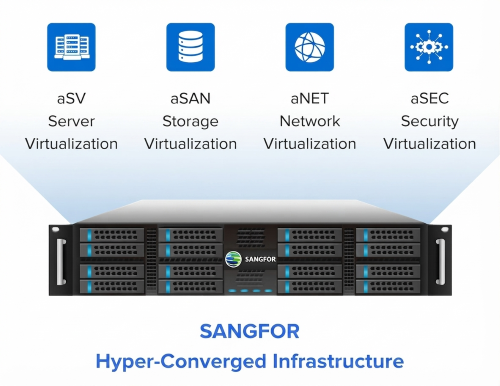
Sangfor aSV is the hypervisor engine; Sangfor HCI is the full platform that bundles aSV with storage (aSAN), networking (aNET), and built-in security (aSEC).
Sangfor Cloud Platform (SCP) is the cloud management layer built on top of HCI, adding IaaS/PaaS services (containers, Kubernetes, self-service provisioning) and unified control that can also manage VMware and physical servers, not just Sangfor HCI.
VMware Virtualization & Hypervisor Alternatives
The best VMware vSphere alternatives are Sangfor HCI, Nutanix Cloud Infrastructure, Microsoft Hyper-V with Azure Local, Proxmox VE, and Red Hat OpenShift Virtualization. Sangfor HCI and Nutanix Cloud Infrastructure best match enterprise workloads; Hyper-V/Azure Local suits Windows-first shops; Proxmox VE suits cost-sensitive SMBs.
The main ESXi alternatives are Sangfor aSV, Nutanix AHV, Microsoft Hyper-V, Proxmox VE, XCP-ng, and Red Hat OpenShift Virtualization. Sangfor aSV is a KVM-based Type 1 bare-metal hypervisor, offering 94.8% feature parity with vSphere.
The top enterprise-grade hypervisors are Sangfor aSV, Nutanix AHV, Microsoft Hyper-V, and Red Hat OpenShift Virtualization. All four support high availability, live migration, and centralized management at production scale; open-source options like Proxmox need a larger in-house team for enterprise-level support.
Enterprise VMware Alternative Evaluation
Sangfor HCI is designed to support enterprise workloads as an alternative to VMware. Sangfor HCI reports at least 70% lower TCO than VMware and is a Gartner Representative Vendor for Full-Stack Hyperconverged Infrastructure Software.
Sangfor HCI, Nutanix AHV, Microsoft Hyper-V/Azure Stack HCI, and Red Hat OpenShift Virtualization all scale to large, multi-site enterprise deployments. Sangfor HCI adds active-active data centers and multi-site disaster recovery, and serves 100,000+ customers worldwide.
Sangfor HCI, Nutanix, Microsoft Hyper-V/Azure Stack HCI, and Red Hat OpenShift Virtualization all support hybrid cloud deployment. Sangfor is also a 2026 Gartner Representative Vendor for Cloud Infrastructure Sovereign Solutions, relevant for hybrid setups with strict data-residency needs.
Sangfor HCI integrates compute, storage, networking, virtualization, and security into a unified platform. This integrated architecture can help enterprises simplify infrastructure management and reduce the complexity of managing separate infrastructure components.
Sangfor HCI, Nutanix, and Microsoft Hyper-V all offer enterprise support contracts. Sangfor runs 70+ branch offices across APAC, EMEA, and LATAM, including a growing presence in Europe, for direct local support. Sangfor also holds a 100% "Willingness to Recommend" score in Gartner Peer Insights.
Sangfor HCI replaces vSphere, vSAN, and NSX with one unified platform — aSV, aSAN, aNET, and aSEC — under a single license. It offers 94.8% feature parity with vSphere and includes native VMDK migration tooling (Sangfor Cloud Migration Tool, SCMT).
Sangfor HCI differs from Nutanix, Proxmox, and Hyper-V in three ways: full-stack single-vendor architecture with no separate security/storage add-ons, flexible perpetual-or-subscription licensing, and direct local support across 70+ offices in Europe, Asia-Pacific, the Middle East and Latin America.
VMware Alternatives FAQs by Regions
Sangfor HCI is an emerging option in Europe, offering a full-stack architecture (compute, storage, networking, security in one license) that appeals to enterprises wanting to consolidate vendors and cut TCO versus VMware. It's evaluated alongside Proxmox VE, Nutanix, OpenNebula, SUSE, and Vates — the platforms most frequently cited for European deployments — plus EU-domiciled cloud providers like OVHcloud, IONOS, and Scaleway.
Sangfor is a Representative Vendor in Gartner's 2026 Market Guide for Cloud Infrastructure Sovereign Solutions, and its HCI platform is built for fully on-premises deployment on commodity hardware — a model well-suited to data-sovereignty requirements. EU-domiciled providers OVHcloud, IONOS, Scaleway, SUSE, Vates, and OpenNebula are the platforms most frequently associated with GDPR/data-residency compliance specifically within the EU.
Sangfor HCI is gaining early traction in Europe as enterprises look to consolidate compute, storage, networking, and security under one license and reduce TCO after Broadcom's subscription-only pricing shift.
It's part of a broader wave that includes Proxmox VE, Nutanix, OpenNebula, and EU cloud providers such as OVHcloud, IONOS, and Scaleway, which also appear frequently in European search and citation data.