
The Deadly "Polite" Lock
A remote-access trust-check failure can turn an untrusted VPN session into “access inventory” for the RaaS supply chain.
Summary:
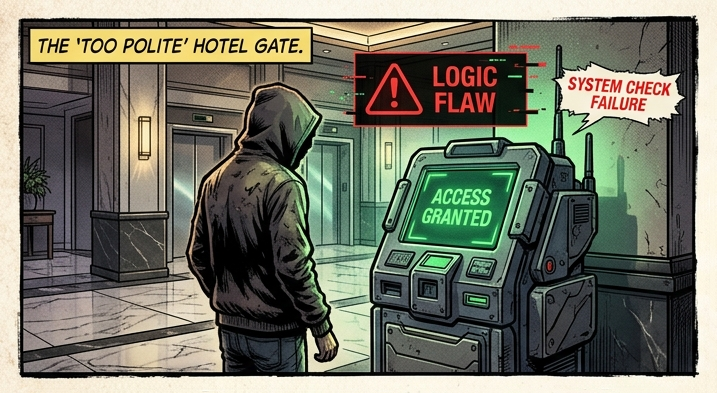
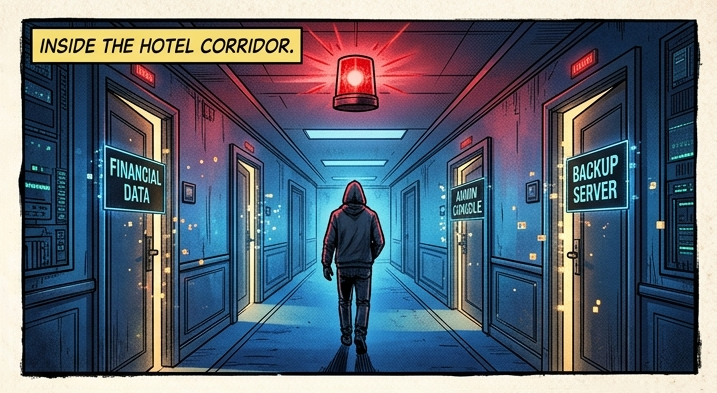
If your network were a hotel, a quiet but dangerous VPN logic flaw would be like a check-in system that is "too polite". By automatically welcoming anyone who approaches—even without a keycard—it bypasses the most basic authentication requirement.
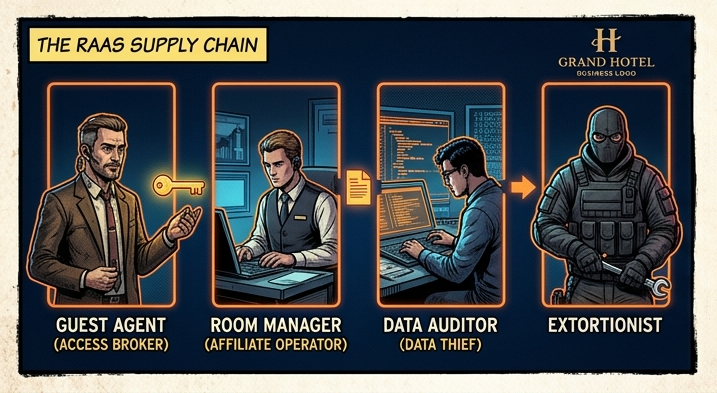
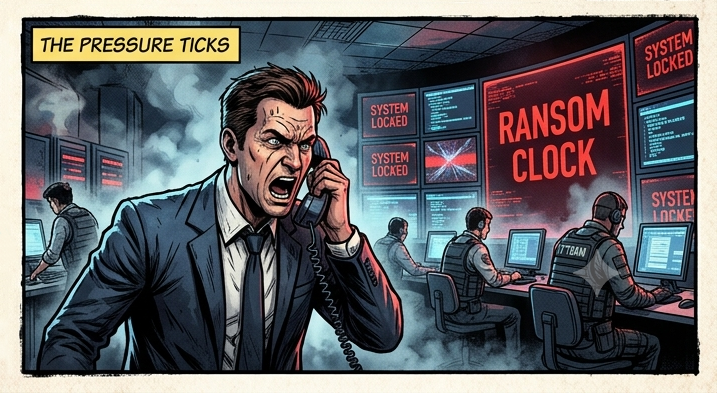
This fictional story illustrates how a simple logic flaw in a VPN’s trust-check mechanism acts as a critical entry point for modern ransomware operations. By mistakenly authenticating untrusted sessions, the system allows attackers to bypass password requirements and gain a questionable remote-access foothold near the trust boundary. Once inside, this access is treated as "inventory" within the Ransomware-as-a-Service (RaaS) supply chain, where specialized criminal roles collaborate to escalate the breach into a full-scale attack. Ultimately, the business impact, such as operational downtime and recovery pressure, arrives rapidly, proving that such vulnerabilities are not just patching issues, but significant business threats.
Vulnerability Overview
CVE-2026-50751 is a critical authentication bypass vulnerability affecting certain Check Point Remote Access VPN, Mobile Access / SSL VPN, and Spark Firewall deployments that use the deprecated IKEv1 key exchange protocol.
The vulnerability involves a logic flow weakness in Remote Access and Mobile Access certificate validation during deprecated IKEv1 key exchange. In affected configurations, an unauthenticated remote attacker may bypass user authentication and establish a remote-access VPN connection without a valid user password.
The plain-English version is simple:
The VPN gateway should check the user’s identity before issuing access. Because of a logic flaw in the certificate-validation flow, the gateway can be tricked into accepting the session without the expected password-based authentication.
This does not mean every Check Point VPN deployment is automatically exploitable. Public advisories indicate that exposure depends on specific configuration conditions, including deprecated IKEv1 remote-access usage, legacy Remote Access client support, and whether machine certificate authentication is required.
Business Impact Summary
The direct technical impact of CVE-2026-50751 is unauthorized remote-access VPN session establishment. The business risk comes from what that session may enable next.
A successful exploit does not automatically mean full internal compromise, data theft, backup deletion, or ransomware deployment. However, because VPN gateways sit at the remote-access edge, an unauthorized session can place an attacker closer to business-critical systems, sensitive data, file shares, administrative tools, and backup paths than intended.
If internal segmentation, identity controls, monitoring, and privileged access boundaries are weak, the issue can escalate from a VPN security flaw into broader business risk. Potential consequences may include operational disruption, recovery delays, extortion pressure, regulatory or legal exposure, financial loss, and damage to customer trust.
This is why CVE-2026-50751 should not be treated only as a product patching issue. It should also trigger exposure validation, log review, compromise assessment, and ransomware-readiness checks.
What Public Advisories Confirm — and What They Do Not
| Question | What Public Advisories Support | What Should Not Be Inferred |
| Was CVE-2026-50751 exploited in the wild? | Public advisories state that in-the-wild exploitation has been observed. | This does not indicate that every Check Point VPN deployment was compromised. |
| Does exploitation require stolen credentials? | In affected configurations, an attacker may establish a VPN session without a valid user password. | This does not indicate that the attacker fully replicated or assumed a legitimate employee identity. |
| Is Qilin relevant to the threat context? | At least one investigated case involved post-compromise activity associated with a Qilin ransomware affiliate. | This does not mean all exploitation activity should be attributed to Qilin. |
| Does VPN access automatically result in ransomware impact? | A remote-access session can serve as an initial foothold for follow-on activity. | This does not mean the vulnerability directly or automatically causes data theft, backup deletion, or encryption. |
RaaS Context: Why One VPN Foothold Can Feed Multiple Criminal Roles
The ransomware context is relevant because public reporting links at least one investigated post-compromise case to activity associated with a Qilin ransomware affiliate.
Ransomware-as-a-Service (RaaS) is not always a single attacker performing every step. One role may find or broker access. Another may operate inside the environment. Another may identify business data, backup paths, and administrative dependencies as pressure points. Another may handle extortion and proceeds.
This division of labor changes how defenders should think about entry-point vulnerabilities. A VPN authentication weakness can become inventory for a criminal supply chain: useful not only to the attacker who first establishes access, but also to other operators who can expand, monetize, or weaponize that foothold.
| RaaS Risk Element | What It Means in This Scenario | Defender Takeaway |
| Initial access value | An unauthorized VPN session can become a valuable foothold, even if it does not immediately result in full internal compromise. | Treat suspicious remote-access sessions as potential intrusion starting points, not just VPN anomalies. |
| Criminal specialization | In a ransomware-as-a-service model, different actors may focus on different parts of the operation, such as access, expansion, leverage, extortion, or proceeds. | Do not treat the issue as a single-stage VPN event; assess whether follow-on activity may involve different tools, infrastructure, or operators. |
| Access handoff and reuse | The actor who gains access may not be the same actor who later uses, sells, expands, or weaponizes it. | Investigate whether the foothold was followed by activity from new infrastructure, new accounts, or different behavioral patterns. |
| Leverage building | Business data, backup paths, administrative dependencies, and critical systems can become pressure points for extortion. | Prioritize visibility around sensitive repositories, backup infrastructure, privileged tools, and business-critical assets. |
| Business pressure | The visible impact may arrive as disruption, recovery delays, data exposure concerns, extortion pressure, or executive escalation. | Prepare both technical response actions and business-level decision paths before an incident escalates. |
Attack Chain and MITRE ATT&CK Mapping
| Attack Stage | What May Happen | Relevant ATT&CK Techniques | Detection and Investigation Signals |
| Initial VPN access | A remote-access authentication weakness allows a VPN session to be established without the expected user-password authentication path. | T1133 External Remote Services; T1190 Exploit Public-Facing Application, where applicable. | Unusual VPN session creation, suspicious source infrastructure, abnormal login timing, unexpected geography, and accepted sessions with authentication context mismatch. |
| Internal access from VPN | The unauthorized session may provide reachability into internal systems, depending on VPN policy and segmentation. | T1021 Remote Services; T1078 Valid Accounts only where legitimate credentials are later abused. | Connections from VPN address pools to internal services, new access paths, segmentation crossing, and unexpected administrative access attempts. |
| Discovery and enumeration | The attacker may identify users, systems, groups, file shares, and reachable services. | T1087 Account Discovery; T1069 Permission Groups Discovery; T1018 Remote System Discovery; T1046 Network Service Discovery, where observed. | Account discovery, group enumeration, internal scanning, file-share browsing, and unusual access to directory or management services. |
| Data and backup targeting | The attacker may look for business data, repositories, administrative dependencies, or backup paths. | T1005 Data from Local System; T1213 Data from Information Repositories; T1490 Inhibit System Recovery, only where confirmed. | Unusual file access, archive creation, backup-path exploration, access to backup servers, snapshot tampering, or recovery-system interference. |
| Confirmed ransomware or exfiltration activity | The incident may escalate into encryption, data theft, or extortion-related activity if follow-on actions succeed. | T1486 Data Encrypted for Impact, where encryption is confirmed; T1041 or T1567 where exfiltration is confirmed. | Locked files, ransom artifacts, large outbound transfers, unusual cloud uploads, operational disruption, and confirmed data-staging or encryption activity. |
Self-Evaluation: Questions Every Organization Should Ask
- Do any remote-access gateways still support legacy or deprecated compatibility modes?
- Do VPN and remote-access configurations require MFA, conditional access, device trust, and certificate controls where applicable?
- Can the security team detect suspicious VPN session creation and context mismatch?
- Are file shares, admin consoles, and backup-related systems segmented from ordinary remote-access paths?
- If one foothold appears, can the team detect the second stage: internal reach, business-data targeting, or backup-path exposure?
- Do playbooks treat remote-access weaknesses as potential ransomware entry signals rather than isolated patching events?
- Do technical and executive teams understand that RaaS can involve different criminal roles across access, expansion, leverage, and extortion?
Recommended Actions
Treat remote-access trust-check failures as exposure-validation and follow-on-risk problems, not only patching problems.
- Patch the [CVE] if you have deployed the associated Check Point products.
- Reassess legacy remote-access compatibility.
- Strengthen remote-access trust with MFA, conditional access, device trust, certificate policy where applicable, and privileged account separation.
- Validate post-session controls: segmentation, administrative paths, file-share exposure, and backup-path access.
- Retain and correlate VPN, identity, endpoint, server, DNS, and network telemetry.
- Hunt for second-stage signals such as account discovery, privilege exploration, and backup-path access.
- Prepare for business pressure by aligning technical, operational, legal, communications, and leadership response plans.
How Sangfor Helps
| Problem | Our Solution |
| Identity & Access Risks • Uncertain remote trust boundaries • Suspicious sessions & identity misuse |
Athena SASE • Absolute Zero Trust Access: MFA, device posture checks, and continuous abnormal login detection. • Exposure Minimization: Tightening firewall policies and remote-access trust boundaries. |
| Operational & Visibility Gaps • Slow detection of follow-on lateral movement • Limited internal capacity for 24/7 analysis |
Athena XDR and Athena MDR • Unified Telemetry Correlation: XDR telemetry across identity, endpoints, servers, and network. • 24/7 Expert Operations: MDR threat hunting, instant alert verification, and continuous defense. |