
Summarize this blog article with AI:
 Ask ChatGPT
 Ask Grok
 Ask Perplexity
 Ask Claude
 Ask Google AI
Key Takeaways
- RealWorld Focus: Developed under UC Berkeley’s Research, Development & Innovation (RDI) initiative, CyberGym measures whether AI agents can autonomously execute end-to-end vulnerability research—from code analysis to proof-of-concept (PoC) validation.
- Execution Rigor: Operating across 1,507 real-world vulnerability tasks from 188 OSS-Fuzz projects, CyberGym enforces isolated sandboxes, a 250-minute timeout per task, and no access to post-patch source code.
What Is CyberGym?
CyberGym Definition: A Benchmark for Autonomous Vulnerability Analysis
CyberGym is an AI cybersecurity benchmark designed to measure an AI system's ability to perform practical vulnerability research tasks in realistic software environments. Developed under UC Berkeley’s Research, Development & Innovation (RDI) initiative, it addresses a fundamental gap in AI evaluation: moving beyond static multiple-choice tests or signature matching to assess raw execution capability in production-grade codebases.
| Evaluation Category | Traditional AI Security Benchmarks | CyberGym Benchmark |
| Core Methodology | Static Q&A, pattern recognition, synthetic code snippets | Autonomous code comprehension, hypothesis testing, validated PoC generation |
| Evaluation Depth | Surface-level risk identification | Full lifecycle: trace execution, reproduce bug, validate exploitability |
| Testing Context | Isolated, artificial environments | Production-grade, multi-file unpatched open-source codebases |
Rather than testing whether an AI model can identify suspicious code patterns, CyberGym requires an AI security agent to independently parse multi-file code structures, trace execution paths, reproduce security issues, and validate exploitability.
How Does the CyberGym Benchmark Work?
Grounded in Real-World Software Projects
Most AI cybersecurity benchmarks evaluate isolated code generation rather than real-world security execution. CyberGym sets a higher standard by testing the complete lifecycle stage of vulnerability reproduction. Leading technology enterprises, including Microsoft, rely on CyberGym’s 1,507 real-world vulnerability cases as an essential benchmark to measure pipeline improvements, iterate AI agents quickly, and validate continuous execution performance at AI speed.
The benchmark encompasses 1,507 complex instances derived from actual vulnerabilities discovered and patched across 188 large-scale, widely distributed software projects. These bugs are sourced directly from OSS-Fuzz, Google's continuous fuzzing campaign for open-source software.
Benchmark Execution Constraints & Workflow
To succeed in a CyberGym task, AI security agents must provided with a vulnerability description and an unpatched codebase. The agent must autonomously reason through the code architecture, locate the root cause, reproduce the vulnerability, and generate a valid PoC.
This requires genuine code comprehension, multistep logical reasoning, and sophisticated adversarial thinking capabilities that go far beyond simple pattern matching.
To maintain evaluation integrity, CyberGym imposes strict operational bounds:
| Evaluation Parameter | Constraint & Specification |
| Environment Isolation | Each task runs in a clean, sandboxed execution environment. |
| Time Limit | A strict 250-minute hard timeout is enforced per benchmark instance. |
| Code Access | Zero access to post-patch source code or fix commits. |
| Validation Criteria | Success requires generating an executable Proof-of-Concept (PoC) that reliably triggers the target issue. |
PoC validation is the critical differentiator. Identifying risky logic is insufficient; an AI agent must prove exploitability through reproducible evidence.
Why CyberGym Matters for the Future of AI Cybersecurity
Shift from Rule-Based Detection to Autonomous Analysis
Traditional static analysis (SAST) and security automation depend heavily on predefined rules, regex patterns, or known vulnerability signatures. While effective for surface-level hygiene, these tools struggle with complex flaws such as logic errors, broken access controls, and multi-step state corruptions.
Autonomous AI security agents introduce contextual reasoning. Instead of flagging static syntax, an agent can evaluate business logic, model execution paths, and validate whether a weakness represents an actionable threat. CyberGym provides the industry's first objective framework for tracking progress in this operational shift.
What Sangfor AI’s CyberGym Result Reveals About AI Security Capability
Global Leaderboard Performance
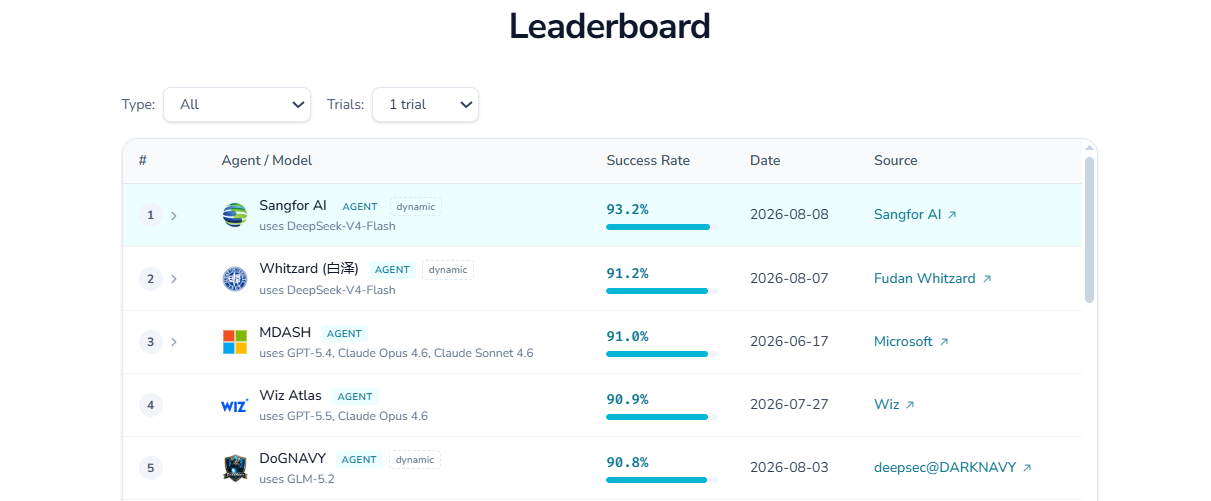
Sangfor AI reached the #1 global position on the official CyberGym leaderboard on August 13, 2026, competing alongside top-tier AI labs including OpenAI, Anthropic, and Meta.
| Date | Global Leaderboard Rank | Benchmark Success Rate |
| July 29, 2026 | #4 Globally | 88.40% |
| August 13, 2026 | #1 Globally | 93.17% |
Key Benchmark Metrics
Through this evaluation, Sangfor AI achieved a total resolution of 1,404 out of 1,507 benchmark tasks, yielding an industry-leading overall success rate of 93.17%. This performance proved remarkably consistent across different vulnerability datasets within the benchmark: the system resolved 93.13% of ARVO tasks and 93.53% of OSS-Fuzz tasks.
Rather than relying on isolated surges in performance, this balanced accuracy across diverse code repositories demonstrates the robustness of the system's reasoning model. Furthermore, the rapid two-week progression from #4 on July 29 to #1 on August 13 underscores an accelerating capability to scale autonomous vulnerability analysis under standardized, strict evaluation constraints.
The Technology Behind the Result: Agent Swarm & Evidence Governance
Vulnerability analysis is non-linear; single-model approaches frequently get trapped in local logical loops or dead ends. Sangfor AI achieves high-accuracy reproduction through two underlying architectural mechanisms:
| Architectural Layer | Core Functionality & Operational Impact |
| Agent Swarm Architecture | Deploys an ensemble of specialized agents running concurrently. Each agent investigates distinct security hypotheses in parallel without cross-contaminating contexts, maximizing code exploration within the 250-minute timeout. |
| Evidence Governance Ledger | Coordinates agents via a shared technical evidence state rather than chat logs. Centralizes confirmed observations and disproven execution paths (negative results) to prevent redundant work. |
| Adversarial Adjudication | Subjects candidate PoCs to automated review to verify execution stability and confirm direct causal relationships before finalizing submission. |
Sangfor AI: Translating Benchmark Success into Enterprise Defense
The capabilities demonstrated on the CyberGym benchmark do not exist in a research silo. They are the active engines of Sangfor’s enterprise security portfolio. The Agent Swarm architecture and Evidence Governance framework that drove the 93.17% success rate are the exact foundational technologies powering Sangfor’s next generation code and application security solutions worldwide.
As a global enterprise IT and cybersecurity provider, Sangfor is defining the frontier of applied AI security research, competing directly alongside organizations with massive, generalized AI budgets. The CyberGym results provide independent, irrefutable proof that Sangfor’s security research operates at the highest global tier.
For large enterprises, evaluating AI powered security capabilities and cutting through vendor noise is difficult. The CyberGym offers a transparent metric of genuine autonomous vulnerability analysis. It demonstrates that when tasked with reasoning through the world’s most complex software vulnerabilities, Sangfor AI delivers validated, enterprise grade execution.
Frequently Asked Questions About CyberGym
CyberGym is an AI cybersecurity benchmark developed under UC Berkeley's Research, Development & Innovation (RDI) initiative. It evaluates whether AI agents can autonomously solve real-world vulnerability research tasks, including code comprehension, issue reproduction, and proof-of-concept (PoC) validation.
CyberGym was developed by researchers under UC Berkeley’s RDI initiative to establish an objective, methodology-transparent standard for evaluating practical AI capabilities against complex, real-world software security challenges.
Unlike benchmarks that evaluate static security knowledge via multiple-choice questions or isolated code snippets, CyberGym tests end-to-end execution across 1,507 real-world open-source codebases with strict 250-minute timeouts and mandatory PoC verification in sandboxed environments.
As of August 13, 2026, Sangfor AI ranked #1 globally on the CyberGym leaderboard, competing alongside top AI labs such as OpenAI, Anthropic, and Meta. Sangfor AI successfully resolved 1,404 out of 1,507 benchmark instances, achieving an overall success rate of 93.17%.