
Summarize this article with AI:
 Ask ChatGPT
 Ask Grok
 Ask Perplexity
 Ask Claude
 Ask Google AI
The Story: Unchecked Trust
Incident Overview
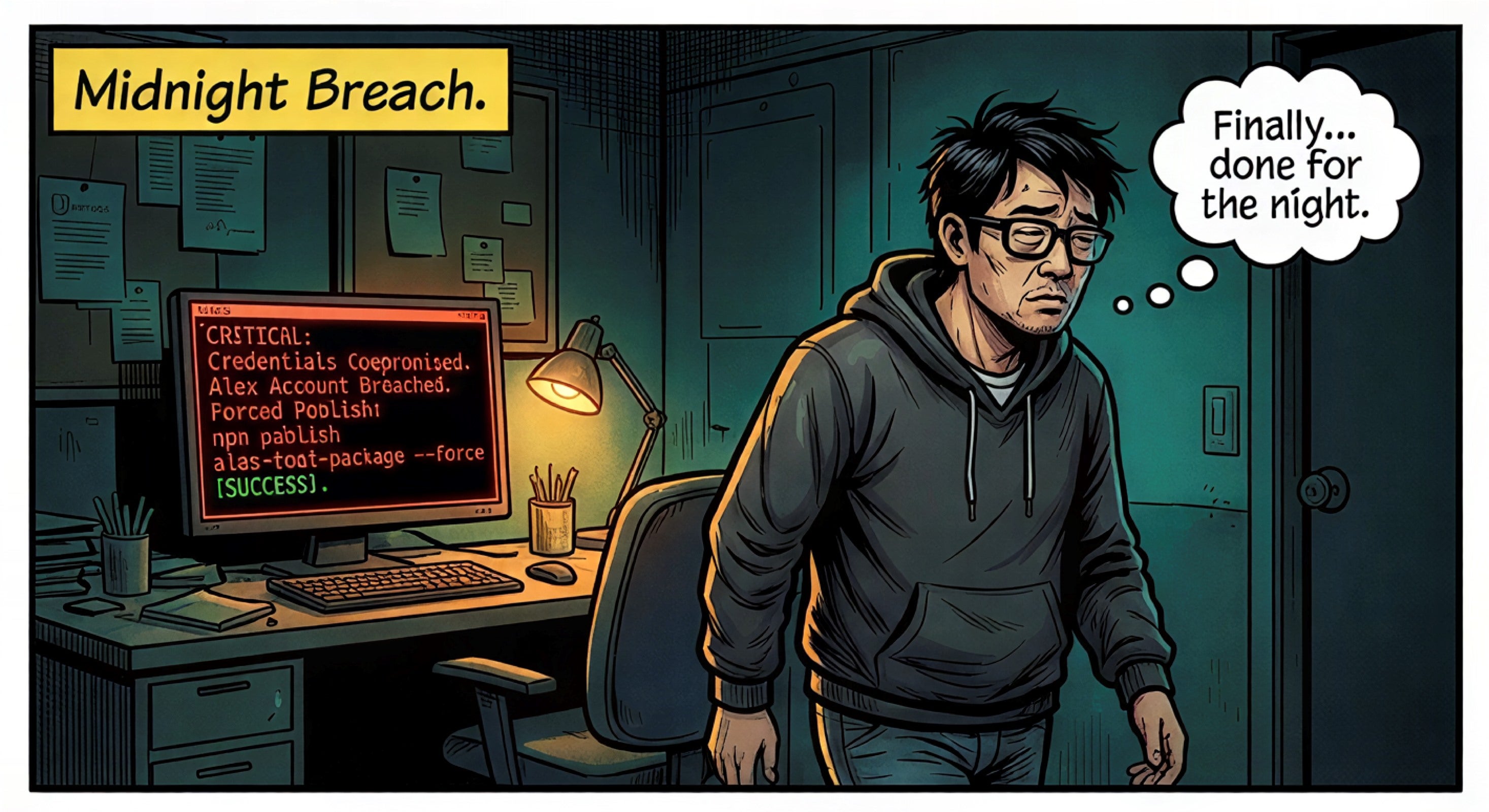
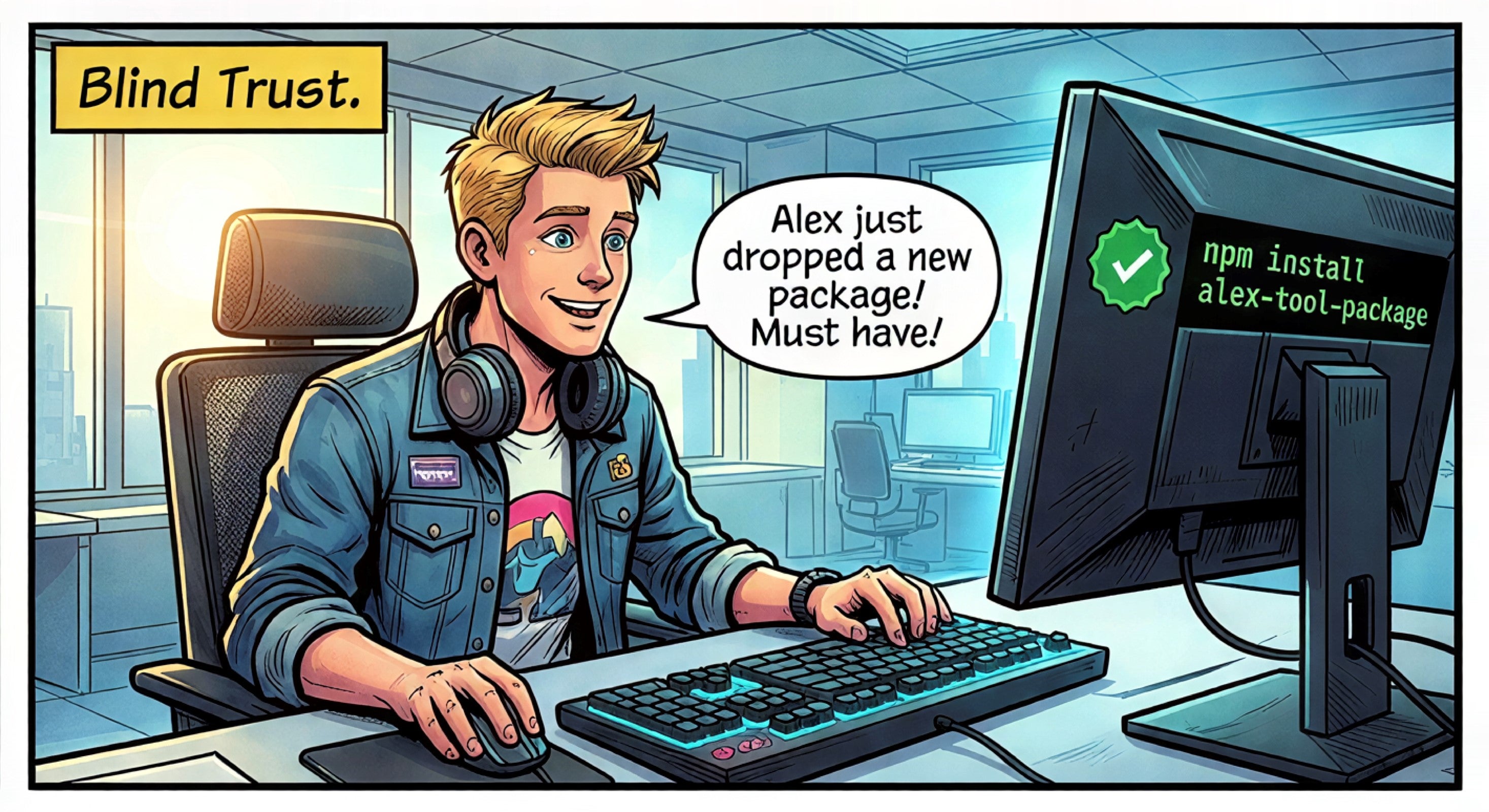
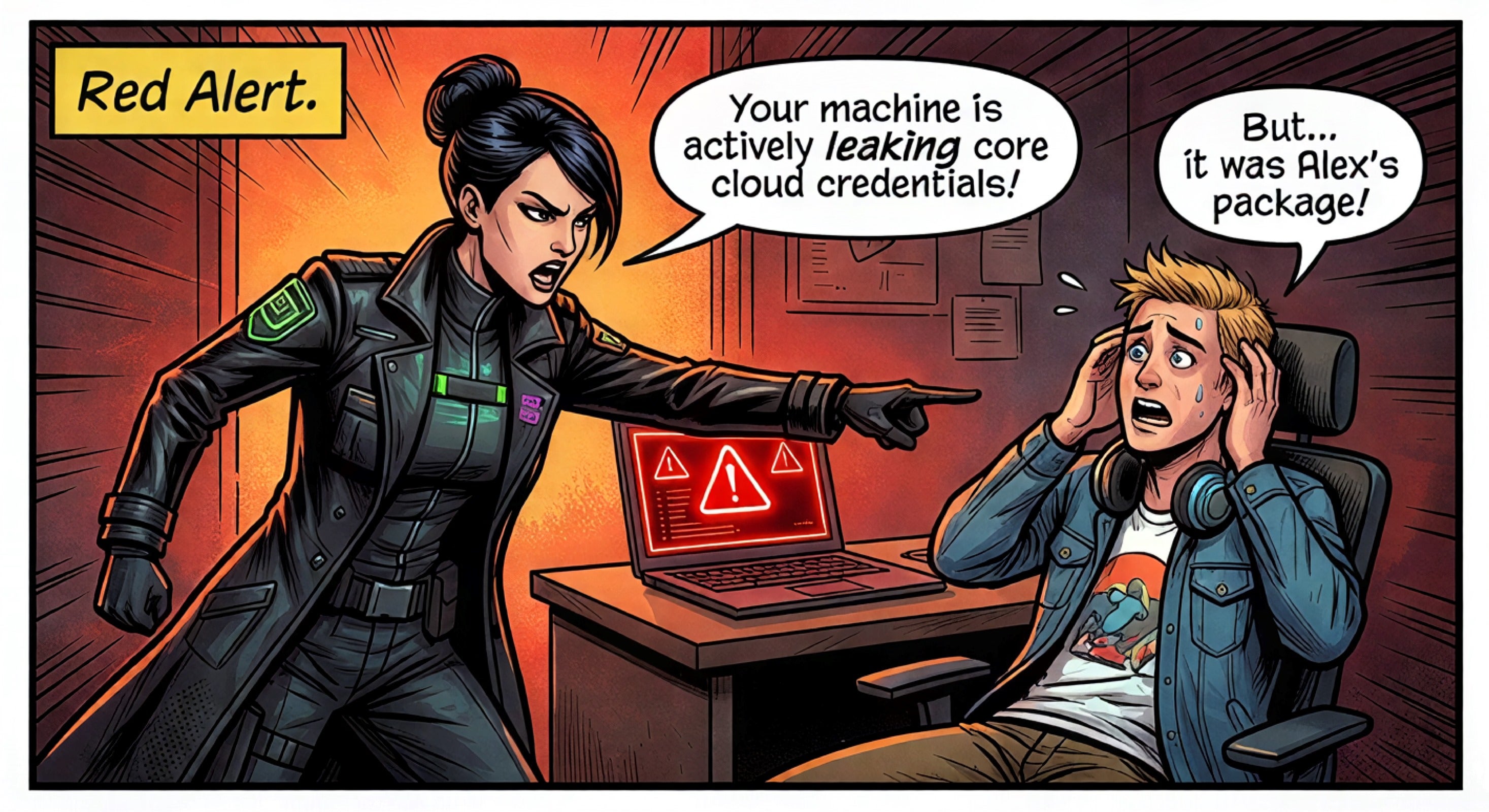
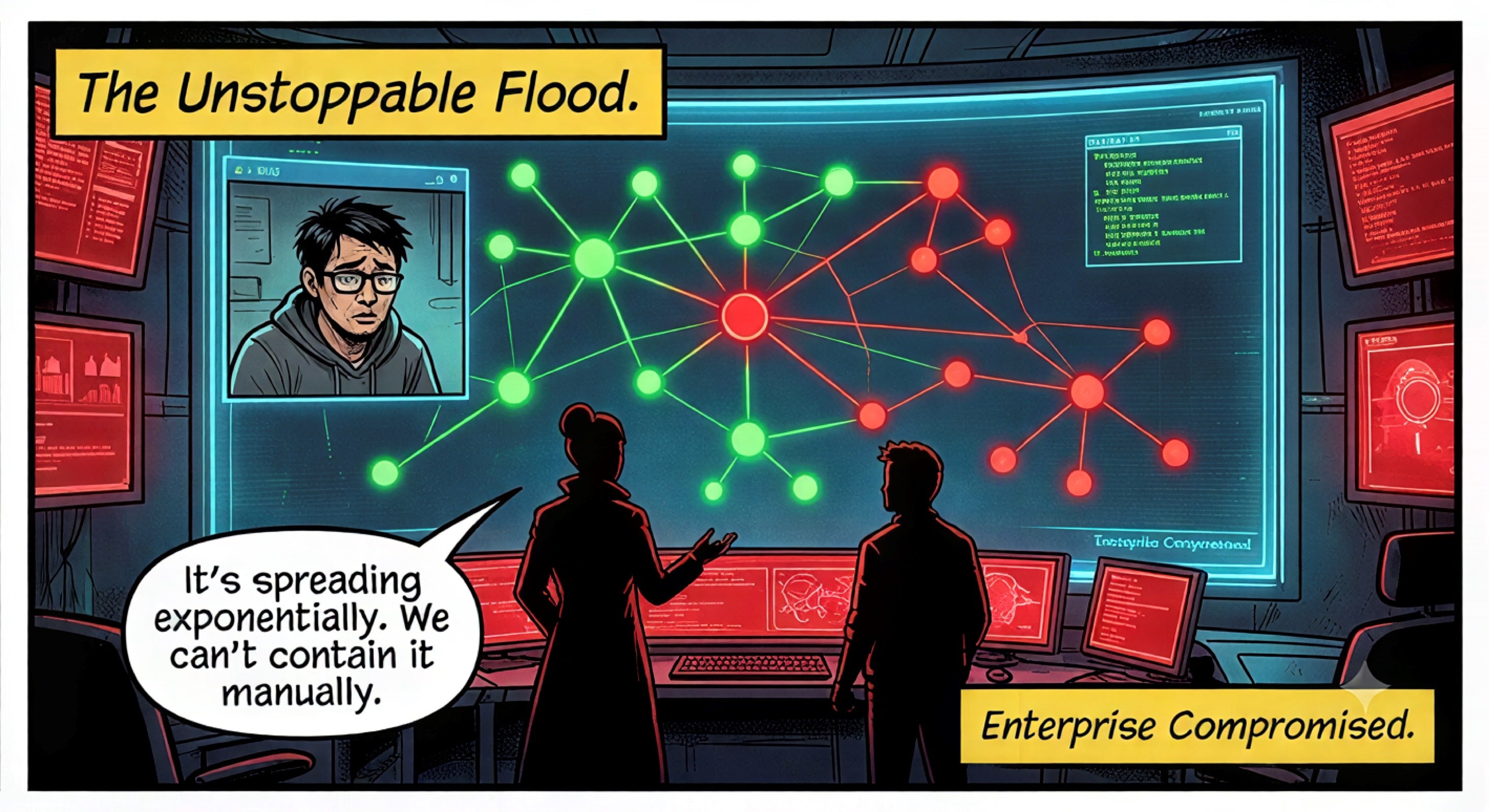
The Aug 4, 2026 ChainDrop incident proved that valid provenance does not guarantee code safety. By abusing publishing identities and preinstall scripts, the malware propagated autonomously across unrelated projects—stealing CI/CD secrets and infecting new repositories at machine speed, long before security teams could react.
Confirmed Facts and Risk Inference
What Public Research Confirmed
The Attack (Reported by Microsoft): On Aug 4, 2026, a self-propagating "Mini Shai-Hulud" worm hit 400+ npm packages. Using obfuscated preinstall hooks, the malware executed immediately upon npm install without needing to be imported, hijacking AWS, GitHub, K8s, and Vault credentials while leaving persistence in dev tools.
The Scale Mechanism: The campaign exploded via an automated loop: stolen npm tokens were instantly used to patch, infect, and republish the developer's other packages. Attackers also modified registry tarballs directly, bypassing GitHub commit history entirely.
The Trust Failure (Snyk & StepSecurity): Hundreds of packages and thousands of versions were compromised. Snyk confirmed that legitimate GitHub Actions (OIDC) workflows generated valid provenance signatures for malicious code, proving that automated trust mechanisms can be weaponized.
What remains unknown
Download statistics and package counts are temporary snapshots that measure exposure, not confirmed compromise. Downstream impacts, such as cloud abuse or credential theft, must be treated as risk scenarios until backed by incident logs. Do not assume a breach merely because an infected package appeared in a lockfile, nor assume safety simply because no alert was triggered.
Why Valid Provenance Was Not Enough
Provenance and trusted publishing were introduced to solve a real problem: proving that an artifact was built by the workflow it claims, rather than assembled on an attacker’s laptop. ChainDrop did not break that guarantee—it routed around it. When malicious code is already present in the repository state a legitimate workflow builds from, or when a published tarball is modified using a stolen token that the registry considers fully authorized, provenance continues to tell the truth about a build whose inputs were already a lie. It is worth being precise about what each trust signal in a dependency pipeline actually attests:
| Trust signal | What it proves | What it does not prove |
| Familiar package name | The dependency uses an expected identity in the registry | That the current release was authorized or reviewed |
| Patch-version increment | The release follows a normal-looking version pattern | That a matching source change or release approval exists |
| Registry integrity metadata | The downloaded artifact matches what the registry served | That the served artifact is benign |
| Valid provenance | The artifact was built or published through the stated workflow identity | That the source, workflow context, or publishing identity was uncompromised |
| Passing application tests | Expected application behavior still works | That an install lifecycle script did not run separately |
The practical conclusion is not to abandon provenance. Each row in this table is still worth having—the failure mode is treating any single row as if it covered the whole column. The organizations best positioned during ChainDrop were those that combined provenance with source-review evidence (does this release correspond to a commit someone approved?), protected release workflows, dependency policy that slows adoption of brand-new versions, identity monitoring around publishing accounts, and runtime detection that watches what install scripts actually do rather than what their metadata claims.
Attack Chain and MITRE ATT&CK Mapping
| Stage | Observed behavior or risk | ATT&CK mapping | Defender focus |
| Package publication is compromised | Malicious code is inserted into legitimate package releases | T1195.002 Compromise Software Supply Chain | Compare package artifacts with source tags and approved release records |
| Install hook executes | A JavaScript loader runs during `preinstall` | T1059.007 JavaScript/JScript | Monitor lifecycle scripts and unusual Node.js-to-Bun process chains |
| Credentials are collected | Developer and CI identities, configuration files, and secrets are searched | T1552 Unsecured Credentials | Reduce secret exposure and alert on abnormal secret access |
| Additional component is loaded | The loader starts a larger second-stage payload | T1105 Ingress Tool Transfer | Detect unexpected runtime downloads and new executable content |
| Publishing identities enable spread | Recovered npm or workflow access may be used to publish more packages | T1078 Valid Accounts, where stolen identities are used | Restrict token scope, require strong publishing controls, and detect anomalous releases |
Immediate Exposure Check
- Search dependency trees, lockfiles, internal artifact stores, base images, and CI caches for affected releases identified by current trusted advisories. Remember that internal mirrors and caches can continue serving a malicious version after the public registry has removed it.
- Determine whether lifecycle scripts were enabled when an affected package was installed. An affected version present with scripts disabled is a different severity than one that executed.
- Treat any developer workstation or runner that executed an affected release as potentially compromised, and enumerate every credential and identity that host could reach at execution time—not just the ones the job explicitly used.
- Preserve package-manager logs, CI logs, endpoint process telemetry, registry publication history, and cloud audit trails before cleanup. Once caches are purged and runners rebuilt, these records are the only way to distinguish “potentially exposed” from “actually accessed.”
- Review unexpected package releases, repository changes, workflow edits, new developer-tool configuration, and unusual access to cloud or secret stores.
- Do not rotate credentials from a potentially affected host. Rotation performed on a machine the malware can still observe may simply hand the attacker the new secrets.
Behavioral signals worth hunting for
Beyond matching known-bad versions, the reported mechanics of this campaign suggest several behavior-based hunting angles that remain useful even as package lists change:
- Install-time process chains in which a package manager spawns unexpected script interpreters or runtimes during dependency installation, particularly on CI runners.
- Publishing events for your own packages that lack a corresponding source commit, tag, pull request, or release approval—the same source-to-artifact gap researchers used to identify malicious versions.
- Patch-version releases of owned packages occurring outside expected pipelines, timing windows, or maintainer working patterns.
- New or modified developer-tool and workflow configuration files appearing in repositories without a reviewed change.
- Outbound connections from build environments to domains that no dependency manifest or build step explains.
Recommend Action
- Contain First, Rotate Clean: Isolate infected systems first, then rotate credentials exclusively from an uncompromised environment.
- Rotate All Reachable Secrets: Revoke every secret accessible to the pipeline (Cloud, K8s, Git, Vault)—not just what was touched.
- Rebuild & Purge Caches: Rebuild runners from scratch and purge shared/poisoned package caches entirely.
- Disable Lifecycle Scripts: Block preinstall scripts by default; make execution opt-in via strict allowlists.
- Delay Version Adoption: Enforce a minimum-age delay for new package releases to let registry scanners catch malware first.
- Harden Publishing Tokens: Treat npm write tokens as production credentials; strictly limit OIDC scopes and alert on anomalous publishes.
- Unify Telemetry: Cross-correlate logs across Endpoint, CI/CD, Registry, and Cloud—no single console tells the whole story.
How Sangfor Helps
| Problem | Our Solution |
| Silent Execution & Secret Harvesting Malicious preinstall scripts execute automatically during npm install, harvesting cloud keys, K8s tokens, and developer credentials directly from system memory before conventional tools alert. |
Athena XDR Cross-correlates telemetry across endpoints, developer workstations, CI/CD pipelines, and cloud clusters in real time. It instantly detects anomalous process behavior, memory scraping, and unauthorized credential extraction—stopping host compromise before secrets leave the boundary. |
| Automated, Machine-Speed Worm Propagation The worm uses stolen credentials to autonomously infect and republish open-source packages at exponential speed, easily outrunning human incident response teams. |
Athena MDR Delivers 24/7 human-led threat hunting backed by AI automation. Dedicated security experts execute specialized, high-speed response playbooks within minutes—revoking compromised tokens, isolating infected runners, and halting worm propagation before it spreads to downstream repos. |
| Bypassing Perimeters via "Trusted" Signatures & Valid Pipelines Malicious code passes through legitimate GitHub Actions / OIDC workflows and carries valid provenance, abusing "trusted" external connections to exfiltrate secrets and phone home to C2 infrastructure. |
Athena SASE Enforces strict, zero-trust network segmentation and granular outbound controls. By assuming all third-party code is unverified until proven otherwise, Athena SASE blocks unauthorized outbound C2 connections, prevents registry-hopping traffic, and isolates compromised CI/CD runners from reaching production assets. |
Call to Action
If your organization is building on open-source ML platforms, piloting internal AI agents, or simply relying on cloud and cluster service accounts you have not reviewed lately, this incident is a useful forcing function. Talk to our team about a compromise assessment of your AI/ML pipeline exposure, or about how appliance-level collection paired with AI-driven analysis can help you detect and respond to a machine-speed adversary before it reaches your production data.
Source Index
- Microsoft Security Research, “ChainDrop supply chain compromise: Anatomy of a self-propagating worm,” August 4, 2026. Supports the 400-plus package scope, credential collection, automated propagation, OIDC publishing path, IoCs, and recovery guidance.
- Snyk, “Inside the keyv npm Supply Chain Compromise,” August 4, 2026. Supports the independently confirmed release list, lifecycle execution, valid-provenance finding, timeline, and explicit unknown victim count.
- StepSecurity, “ChainDrop npm Worm,” August 4, 2026. Supports campaign-scale observations and additional analysis of propagation and credential targeting.
- BleepingComputer, “Massive ChainDrop npm supply-chain attack infects hundreds of packages,” August 4, 2026. Provides independent reporting on the expanding scope and response context.