
Summarize this blog article with AI:
 Ask ChatGPT
 Ask Grok
 Ask Perplexity
 Ask Claude
 Ask Google AI
In Part 1 of the Advancing SecOps Maturity series, we mapped how security operations matures from tool-based security to siloed SecOps, SIEM-centric SecOps, and AI-assisted SecOps.
In Part 2, we examined why AI-assisted SecOps can still struggle. Much of today's AI assistance improves individual tasks, while analysts often remain the continuity layer: carrying context from step to step, validating AI-supported outputs, judging business impact, and deciding whether action is safe.
That is the execution gap, and closing it requires more than adding another AI feature, automation rule, or recommendation engine. It requires a different operating model: one where AI can help carry security work across multiple steps while humans define objectives, set boundaries, and supervise critical decisions.
This is the direction behind Agentic SecOps.
Agentic SecOps points to the next evolution in the SecOps maturity model: moving from isolated AI-supported tasks toward more continuous, context-aware, and trusted workflow execution under human supervision.
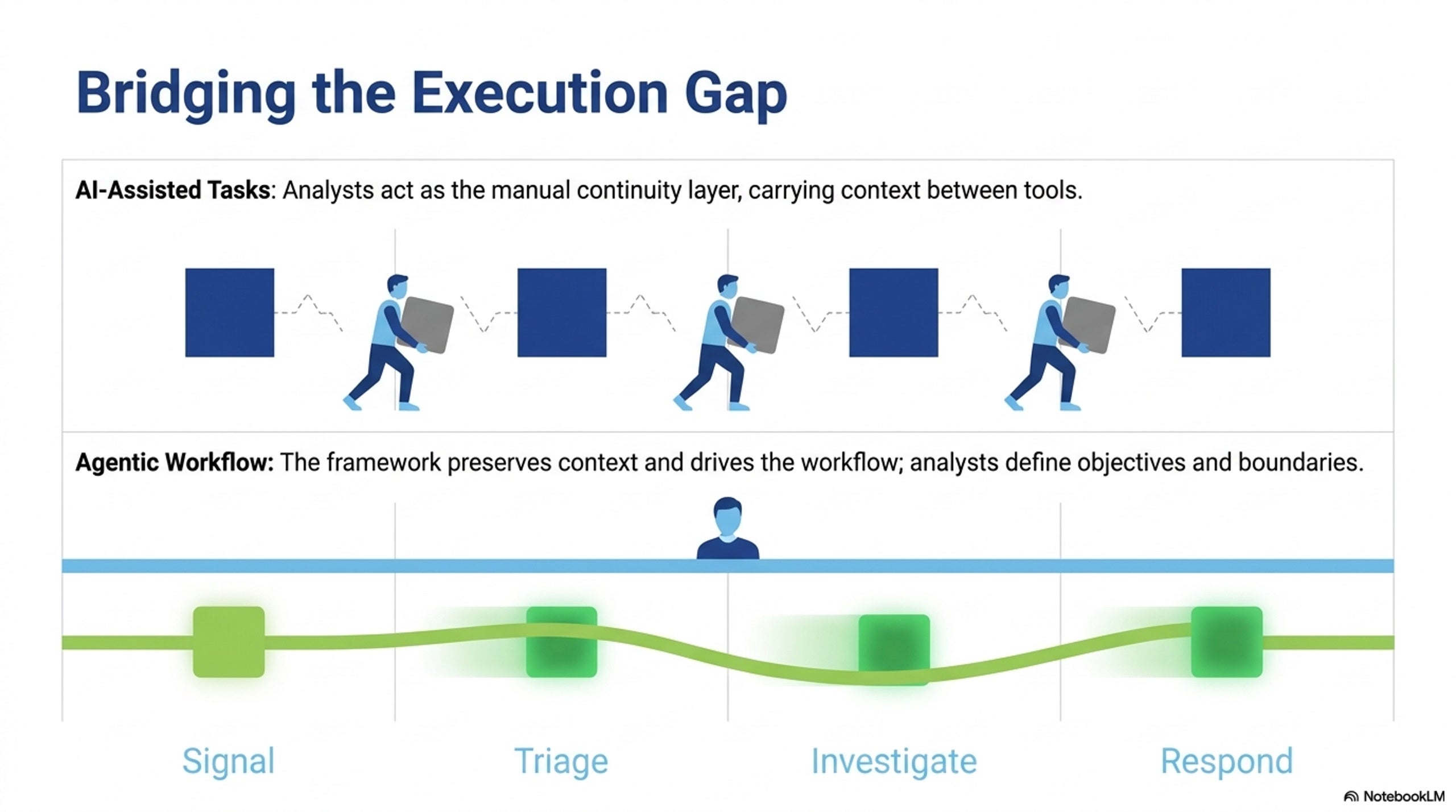
This article explains what Agentic SecOps is, what capabilities make agentic workflow execution possible, and how organizations can begin building toward a more agentic operating model without assuming full autonomy all at once.
What Is Agentic SecOps?
Agentic SecOps is an advanced security operations model in which a coordinated system of AI agents works toward defined security objectives by carrying workflows forward under human supervision.
The key difference is that Agentic SecOps is not limited to producing isolated AI-generated outputs for analysts to review and connect. An agentic framework can preserve context, invoke tools, assess progress, take approved actions, and move work across the SecOps workflow: from suspicious signal, to alert, to triage, to incident investigation, to response, documentation, and improvement.
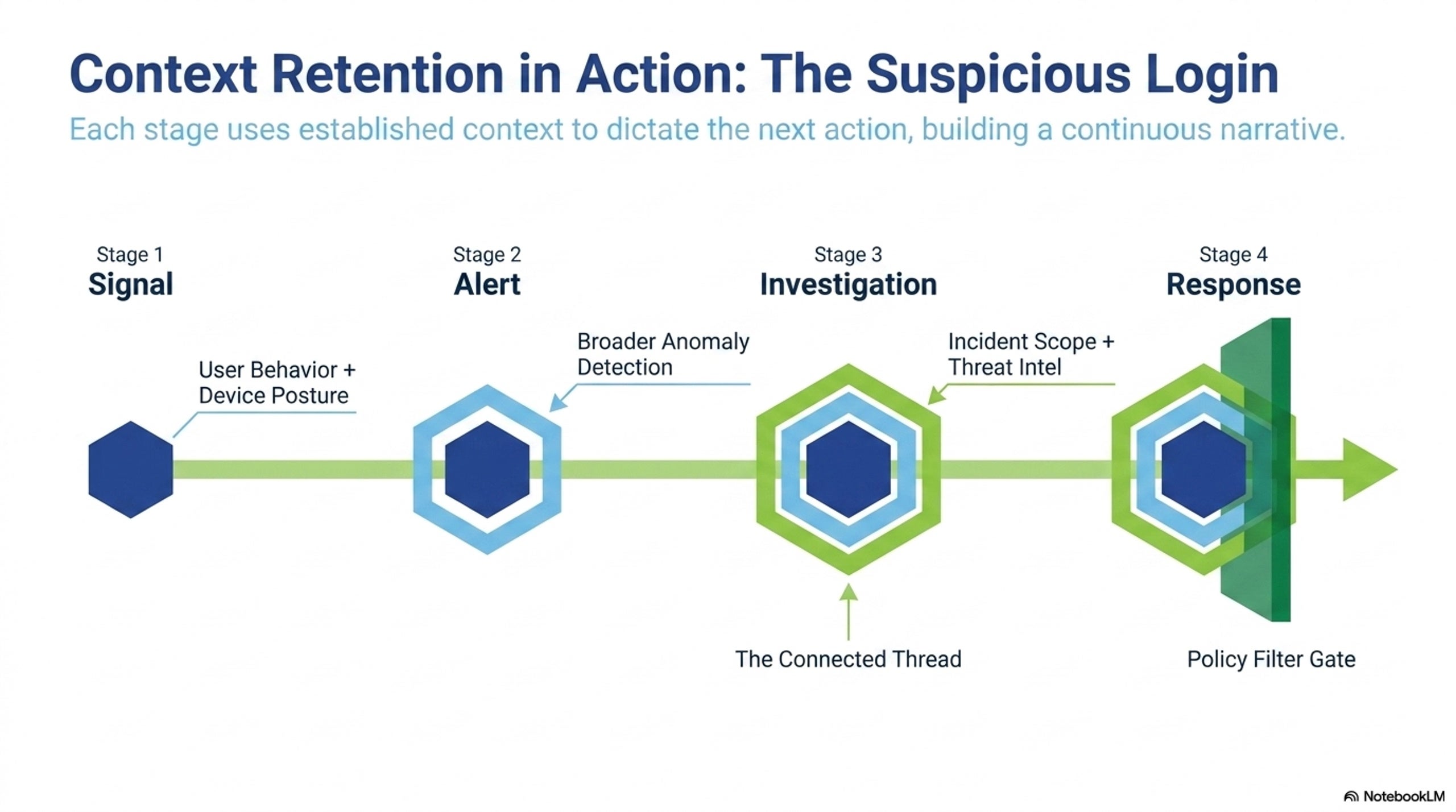
For example, when a suspicious login is detected, an agentic workflow can gather context such as user behavior, device posture, location, and recent activity to decide whether the behavior should become an alert. It can then use the alert context to determine whether the activity is isolated or connected to a broader incident, use the incident context to guide investigation, and combine the investigation findings with asset criticality, business impact, and policy boundaries to recommend or execute a response. At each stage, the framework uses what has already been learned to decide what should happen next and to carry the work forward within defined boundaries.
Analysts remain human-in-the-loop: they define objectives and policy boundaries, review exceptions, and approve high-impact actions. Agentic SecOps doesn't remove analysts from security operations, but reduces the manual coordination required to move work from signal to decision or action.
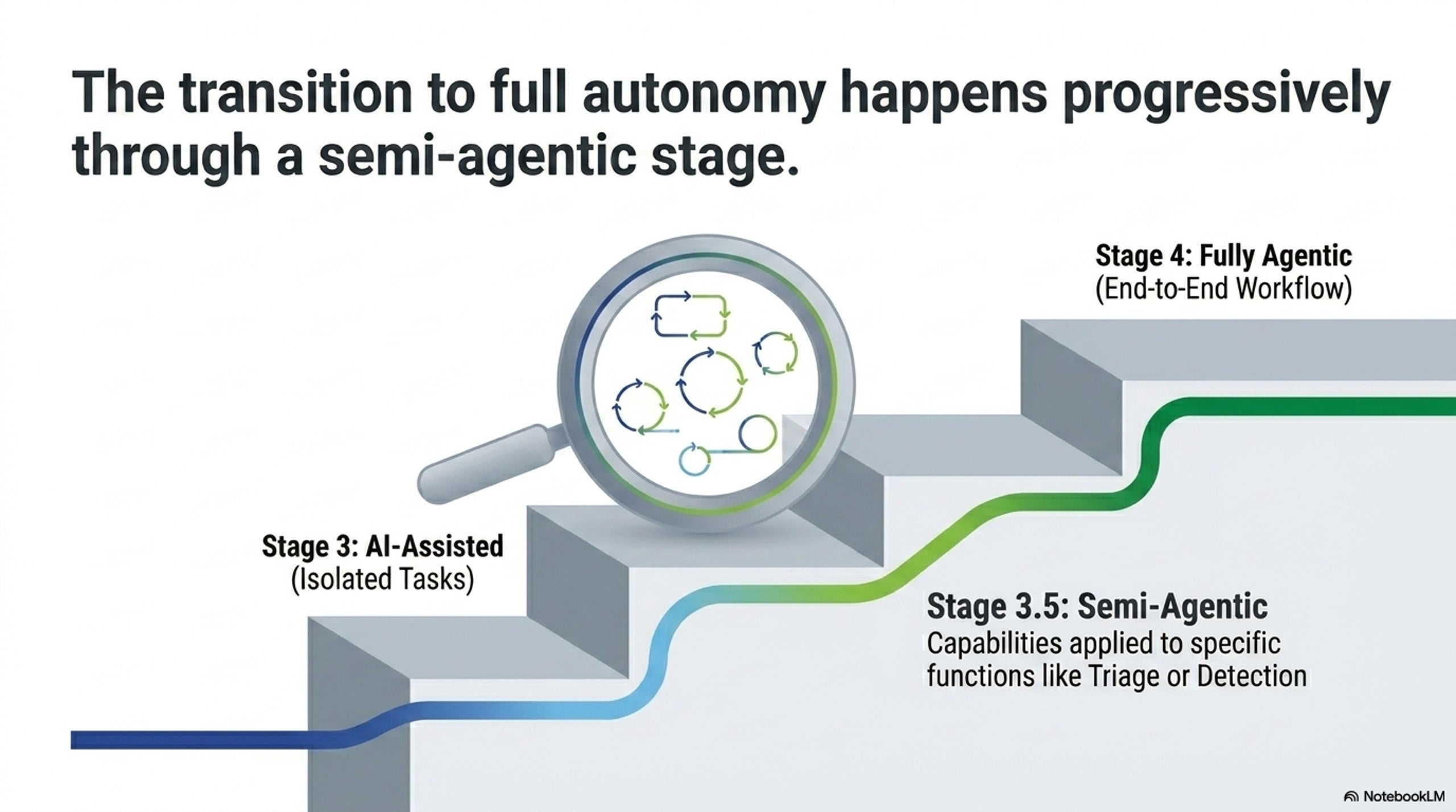
This describes the fully realized vision of Agentic SecOps. It is important to note, however, that the market is still progressing toward this model. Even as more platforms and vendors describe capabilities as "agentic," end-to-end agentic security operations remains an emerging model.
Today, agentic capabilities are more likely to appear within specific parts of the SecOps workflow, such as detection, triage, investigation, or response. This can be understood as "semi-agentic" or Stage 3.5 in the SecOps maturity model. It sits between AI-assisted SecOps and fully agentic SecOps, where agentic capabilities emerge within parts of the workflow before they are connected across the broader operating model.

That is why Agentic SecOps should be understood as both a maturity direction and an operating model: where security operations is moving, and what organizations need to build toward.
The Core Capabilities of Agentic SecOps
For Agentic SecOps to carry security work across multiple stages of the workflow, it relies on five core capabilities. These capabilities define what makes a system truly agentic, beyond isolated AI-assisted tasks.
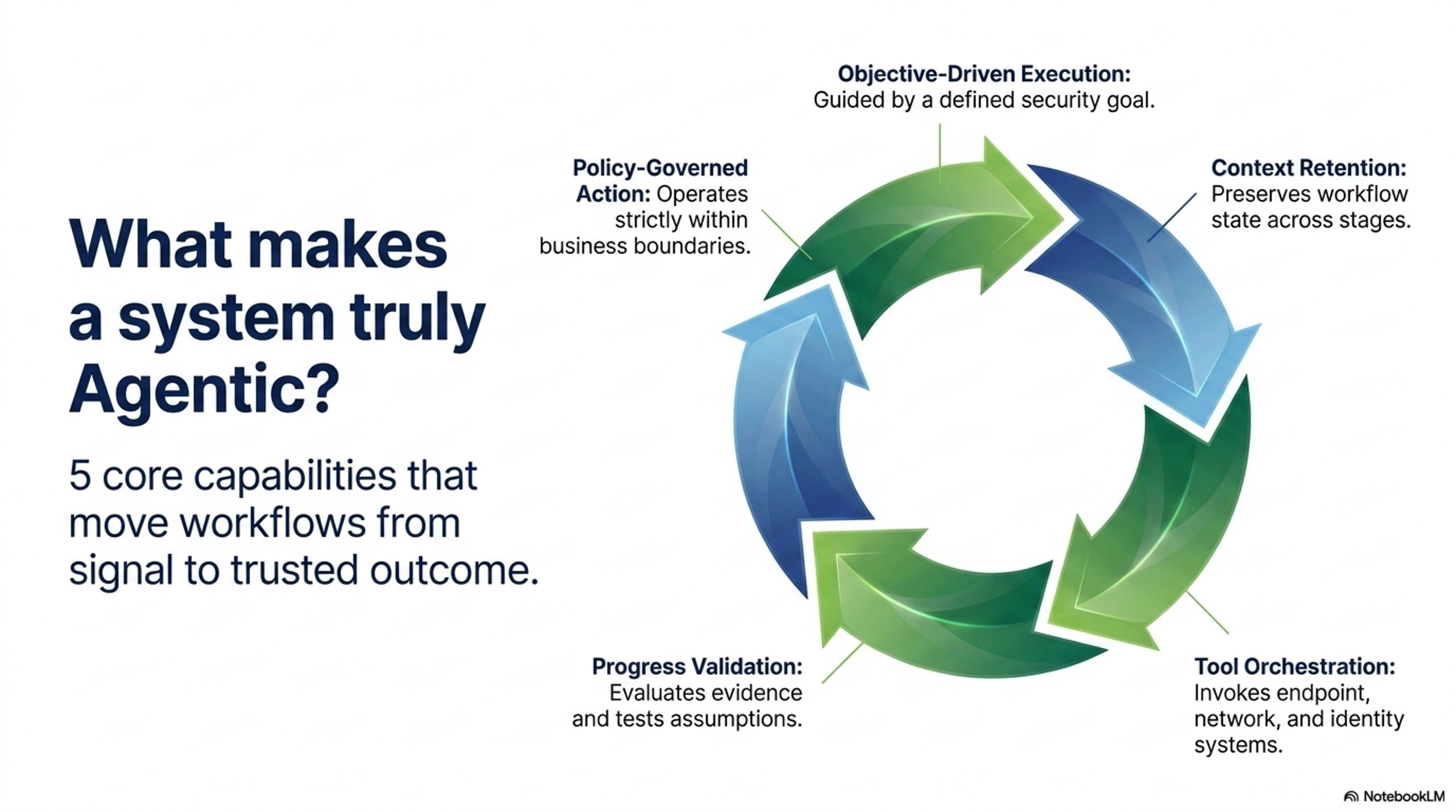
The first capability is objective-driven execution. Agentic SecOps begins with a security objective that gives the workflow direction and helps determine what evidence should be gathered, what assumptions should be tested, and what decision or action the system is working toward.
The second capability is context retention. Security work depends on what has already been observed, what has been ruled out, and what evidence is still needed. Agentic SecOps needs to preserve context and workflow state across stages, so each action builds on what came before instead of restarting the process.
The third capability is tool orchestration. Security operations depends on many systems: endpoint, network, identity, cloud, email, threat intelligence, case management, and response tools. Agentic SecOps needs to invoke the right tools to gather evidence, update cases, and, where policy allows, prepare or initiate response actions.
The fourth capability is progress validation. An agentic workflow should not only collect information or trigger actions. It should evaluate whether the available evidence is sufficient, whether signals are connected, and whether the workflow is ready to move forward, escalate, or stop. It should also reassess earlier findings or actions when new evidence appears.
The fifth capability is policy-governed action. Security response must account for asset criticality, business impact, user disruption, and approval requirements. Agentic SecOps needs to operate within those boundaries before recommending, initiating, or taking actions.
Together, these capabilities explain why Agentic SecOps is more than another AI assistant. Its value comes from enabling security work to progress toward a trusted outcome, with enough context, validation, and control to support decisions or actions.
Human Supervision and Governance
At this point, the question is not only what Agentic SecOps can do, but how it remains controlled. If AI agents can gather evidence, invoke tools, recommend actions, or move cases forward, how does the organization make sure those workflows remain safe, accountable, and aligned with policy?
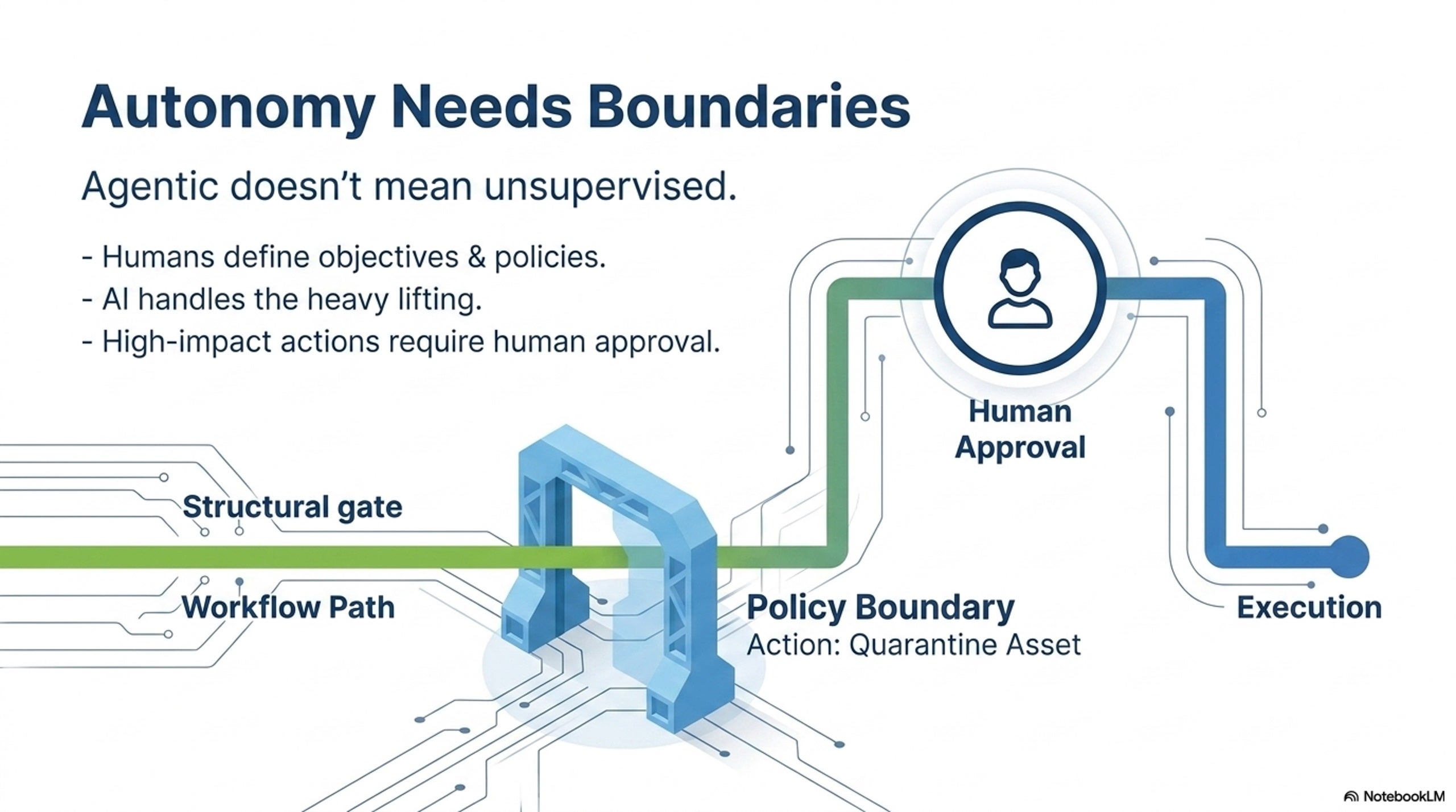
That is why human supervision and governance are essential: Agentic SecOps needs clear boundaries for what the system can do, when it must escalate, and which actions require approval.
Those controls start with defining scope, policy boundaries, and decision thresholds. Not every workflow should become agentic at once, and not every action should be treated the same way. The system needs to understand which workflows it can support, which actions are allowed or restricted, which assets or users require special handling, and what confidence level is required before a response can be recommended, escalated, or taken.
Human approval remains essential for sensitive or high-impact actions. The workflow should escalate when evidence is incomplete, risk is high, the action could disrupt the business, or the recommendation falls outside policy.
Auditability is equally important because teams need to review and verify whether an agentic workflow acted correctly. The workflow should leave a clear record of the evidence it relied on, the tools it used, the policies it checked, and the rationale it provided.
Governance also includes how the system learns and improves over time. Agentic workflows should capture both system telemetry and human feedback, including outcomes, exceptions, and analyst interventions, so they can be refined and become more trustworthy.
How Agentic SecOps Addresses the Trilemma
Part 2 introduced the SecOps Trilemma: the difficulty of improving operational efficiency, effectiveness, and trust at the same time. That challenge matters because security teams face faster, more sophisticated threats while working under constant pressure to investigate accurately, respond quickly, and maintain confidence in every decision. Agentic SecOps addresses that trilemma by changing how security work is executed.
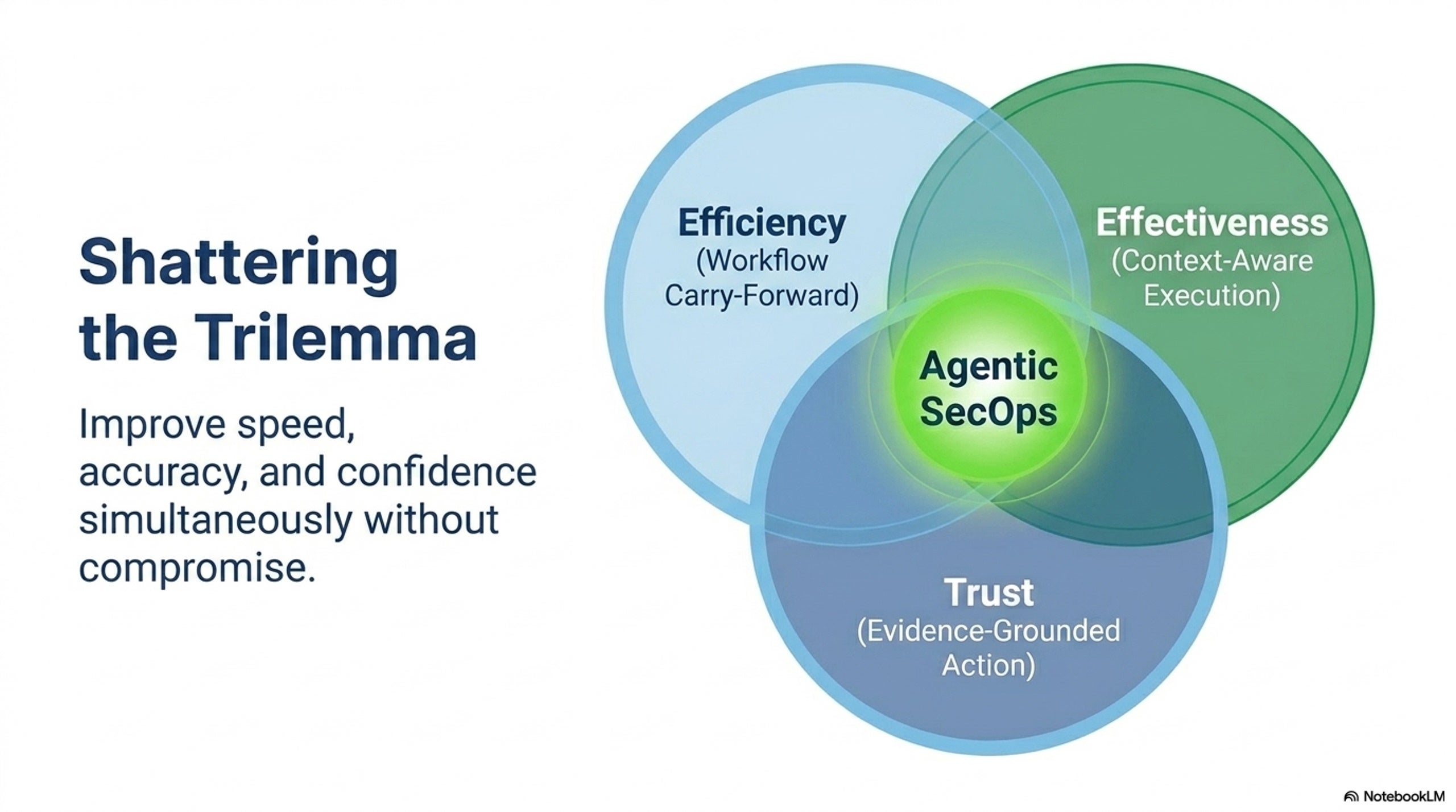
It can improve efficiency through workflow carry-forward. Instead of analysts repeatedly moving between tools, collecting evidence, and triggering each next step manually, AI agents can progress routine workflow steps within approved boundaries. This reduces manual coordination and allows analysts to focus on exceptions, judgment, and high-impact decisions.
It can improve effectiveness through context-aware execution. Agentic SecOps does not only move faster from one step to the next. It can help determine what needs to happen between those steps: what evidence is still needed, which signals are related, how the activity should be interpreted, how serious the risk is, and what response is appropriate.
It can improve trust through evidence-grounded, governed execution. The same process that helps the system operate more effectively can also make its recommendations easier to review. The SOC can see the evidence, context, policy checks, and rationale behind the recommendation before action is taken.
This is how Agentic SecOps can address the SecOps Trilemma. It changes the execution model, so teams are not forced to choose between speed, depth, and trust.
Building the Bridge to Agentic SecOps
Agentic SecOps represents an advanced stage of SecOps maturity, but organizations do not arrive there in a single step. The industry itself is still progressing toward this model, and many platforms are not yet delivering fully integrated, end-to-end agentic security operations.
In the near term, organizations are more likely to move through a Stage 3.5, or semi-agentic, model where agentic capabilities appear inside specific functions while the technology matures toward broader workflow-level execution. To make that model practical, organizations need the right foundations in place: reliable telemetry, connected security controls, defined operating processes, clear governance policies, and operational capacity.
That is where the next feature in the series comes in: the Sangfor Athena A³ SecOps Newsletter, available via Gartner.
It turns the Agentic SecOps vision into a practical framework for action: how organizations can strengthen the technology, process, governance, and operational foundations needed for more agentic security operations.